
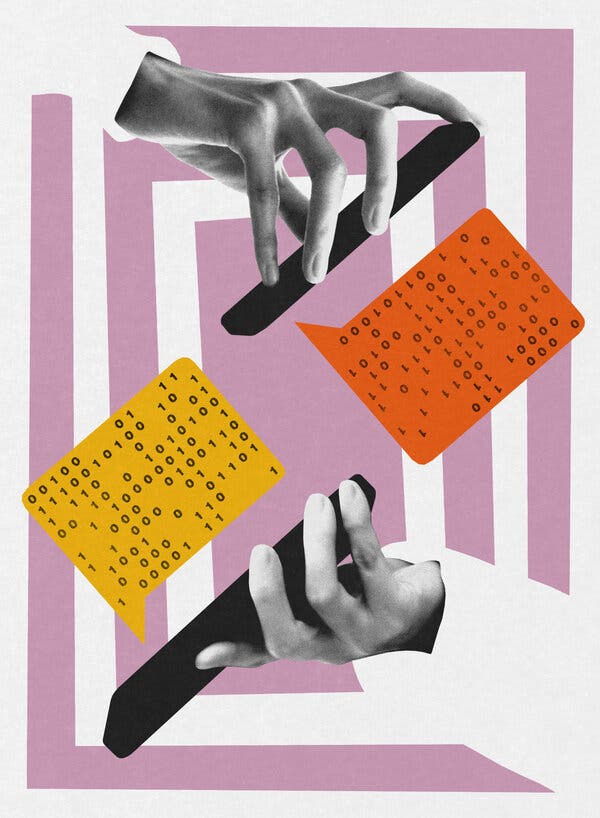
Good morning. An increasing number of people are turning to artificial intelligence (AI) to manage tasks. Are we entering an era where machines primarily communicate with each other?
If you have not looked for a job lately, you may find the recent changes surprising. Job seekers often use AI chatbots to create résumés and cover letters. Simultaneously, employers utilize AI to filter through these applications. Both parties claim these tools are essential to keep pace with each other. Despite this, the process feels impersonal and frustrating. Is genuine connection being lost in this exchange?
This trend is evident in various scenarios. A high school student might use an AI chatbot to draft an essay, which a teacher grades using AI. Similarly, someone might use a chatbot to craft a clever opening line to a romantic interest, who then responds via a chatbot-generated flirty message. In some cases, individuals rely on their AI assistants to interact with a company’s AI-based customer service system.
“We’ve officially reached the point where customer support is just two LLMs locked in a recursive loop of ‘I understand your concern,’ while the actual humans on both ends just watch the credits roll,” a Reddit user observed.
The last few years have seen humans adjusting to chatbots as conversational partners. However, as more people use AI for daily tasks, these interactions clash and create what one might call “bot loops.” These are the cycles initiated when humans on both sides of an exchange delegate their roles to AI.
Bot Interactions and Personal Life
Some individuals remain optimistic about bot-driven exchanges simplifying personal and professional routines. It is plausible that an AI voice agent could eventually call the Department of Motor Vehicles (DMV) for you, interacting with another AI on the other side. This could spare you a trip to your local DMV.
Whitney Wolfe Herd, CEO of the dating app Bumble, suggests that AI personas could eventually go on dates with each other and then provide feedback. Though when attempted by a colleague, it did not yield favorable results.
This evolving landscape prompts questions about the future of communication and connection between humans in a world increasingly managed by AI.