
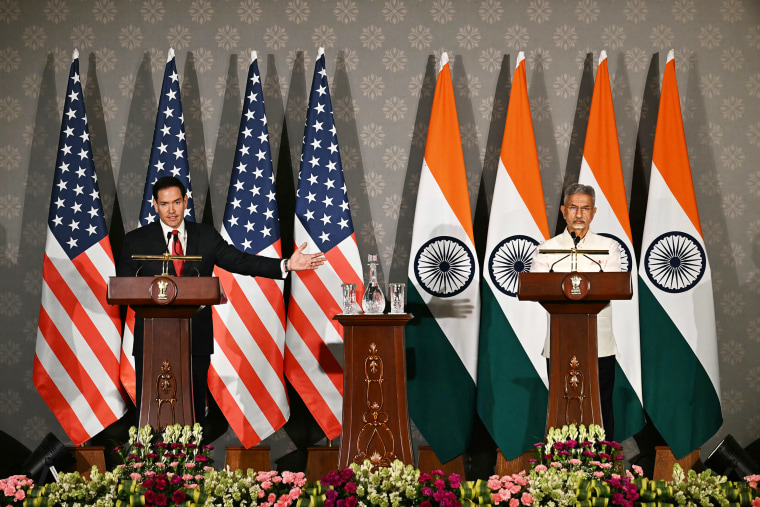
The summer heat in New Delhi challenges even those familiar with high temperatures. Secretary of State Marco Rubio experienced this firsthand upon his arrival in India. Over a four-day visit, Rubio engaged in meetings with Prime Minister Narendra Modi and foreign ministers from Australia and Japan. The scorching heat greeted him at the Taj Mahal, sparking concern from social media users over how he would endure.
During the inauguration of the U.S. Embassy’s new consular building, Rubio remarked on the heat, noting that it was less humid compared to Miami but still intense. His visit came at a crucial time for the Quad, the Quadrilateral Security Dialogue, amidst strained U.S.-India relations due to recent U.S. tariffs on Indian exports. Although the two nations have reached an interim trade agreement, other disputes remain, notably concerning energy policies. Additionally, U.S. relations with Pakistan over Iran have raised New Delhi’s concerns.
In his discussions with Quad partners, Rubio announced initiatives aimed at enhancing maritime surveillance, port infrastructure, and the management of critical minerals in the Indo-Pacific. He emphasized the importance of preventing threats to global maritime trade routes, which see 60% of global traffic.
During his visit, Rubio and his wife, Jeanette, toured historical sites such as the Amber Fort in Jaipur and the Taj Mahal. Despite the searing temperatures, Rubio highlighted the significance of U.S.-India relations, expressing excitement over future collaborative opportunities. His discussions included the ongoing conflict with Iran. He emphasized the need to reopen the Strait of Hormuz to secure oil imports, an issue affecting India due to rising fuel prices.
Rubio announced a U.S.-India pact on critical minerals and rare earth supply chains, aiming for cooperation on mining and recycling processes. This agreement seeks to reduce dependency on potential monopolies, indirectly referencing China. The Quad countries reinforced their opposition to destabilizing actions in the region, particularly involving maritime navigation in the South China Sea.
After concluding his visit to India, Rubio traveled to Yerevan, Armenia, to attend a Memorandum of Understanding Signing Ceremony with Foreign Minister Ararat Mirzoyan. Armenia, traditionally reliant on Russian energy, has been signaling an intention to shift from Moscow’s influence.