
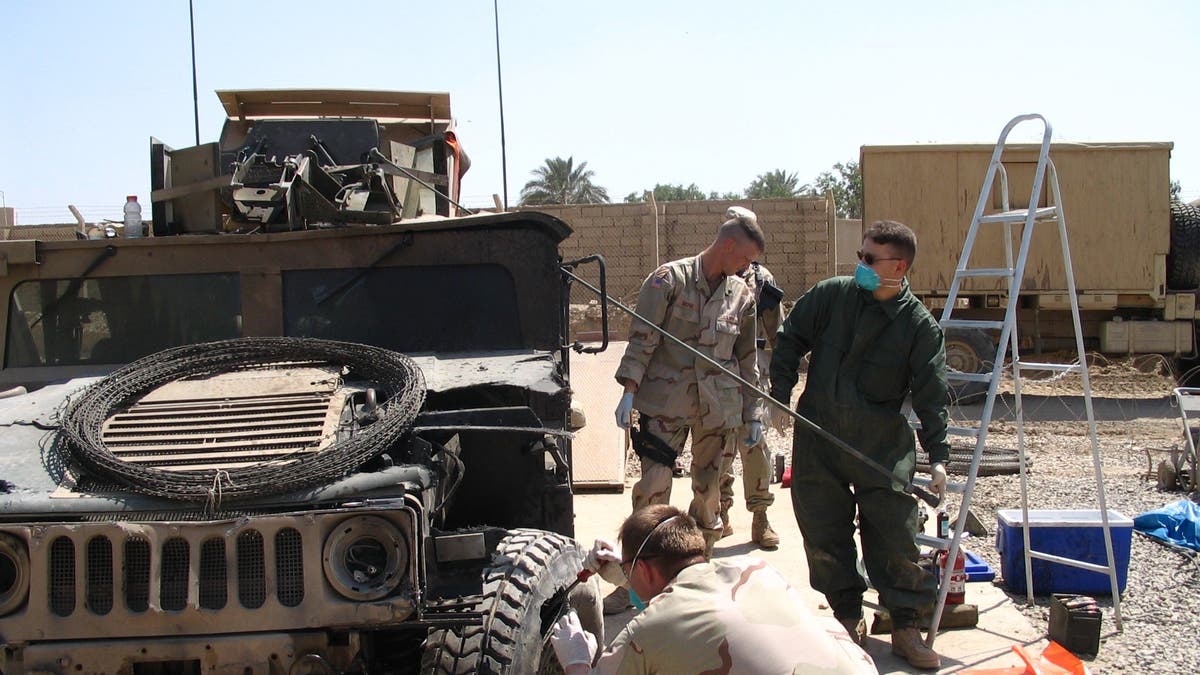
Nearly two decades ago, a deadly incident involving an explosively formed penetrator hit a U.S. Army vehicle on a road in Baghdad. The attack resulted in the death of Staff Sgt. William Brooks and left Sgt. (Ret.) Robert Bartlett with severe injuries. Bartlett recalled the damage saying it cut through his face and severely wounded his comrades.
This attack was part of a broader Iranian effort to target American troops in Iraq, according to federal court findings. The courts found that Iran manufactured or supplied the weapons used and that the attackers received training from the Islamic Revolutionary Guard Corps.
It cut me in half from my temple down through my jaw.— Robert Bartlett
Bartlett, who survived the attack, spent four years undergoing surgeries and reconstruction at Walter Reed. His armored Humvee took the hit while he was driving on Route Pluto in Baghdad on May 3, 2005. The courts later attributed these attacks to Iranian-supplied weapons linked to the Islamic Revolutionary Guard Corps.
Additional federal cases involving victims such as Capt. Shawn English and Maj. Stuart Wolfer resulted in findings that Iran’s support was pivotal. These cases offered acknowledgment of Iran’s role. However, the affected families continue to cope with their loss.
Beverly Wolfer Nerenberg, sister of Maj. Stuart Wolfer, shared memories of her brother, describing his role in her wedding as her “man of honor.” Wolfer, a father of three, was killed by a rocket strike in Baghdad in 2008. His family was informed of Iranian involvement soon after the attack.
Tricia English, widow of Capt. Shawn English, recounted her late husband’s awareness of explosively formed penetrators, which eventually claimed his life. Despite initial claims labeling the weapon as a roadside bomb, legal proceedings offered a clearer picture of Iranian involvement.
Sgt. (Ret.) Robert Bartlett engaged in litigation not only for himself but for those who did not return. The legal actions were under the terrorism exception to the Foreign Sovereign Immunities Act, allowing victims to sue Iran. The judgments found that Iran supplied Shiite militias with resources to target Americans.
Iran, as per the U.S. Treasury Department, used the Quds Force to support proxy groups in the region. Tricia English emphasized that American troops were targeted by Iran, despite no formal state of war between the two countries.
For families like the Bartlets, Englishes, and Wolfers, the conflict with Iran extends over many years. The litigation highlights Iran’s systematic proxy warfare, affecting perceptions of the attacks’ origins. Families call for accountability and recognition of the continued impact of these proxy wars.
The legal cases illustrate the challenges in holding Iran accountable. Despite numerous judgments, Iran has not voluntarily paid the compensation, leaving families and victims facing financial and emotional obstacles.