
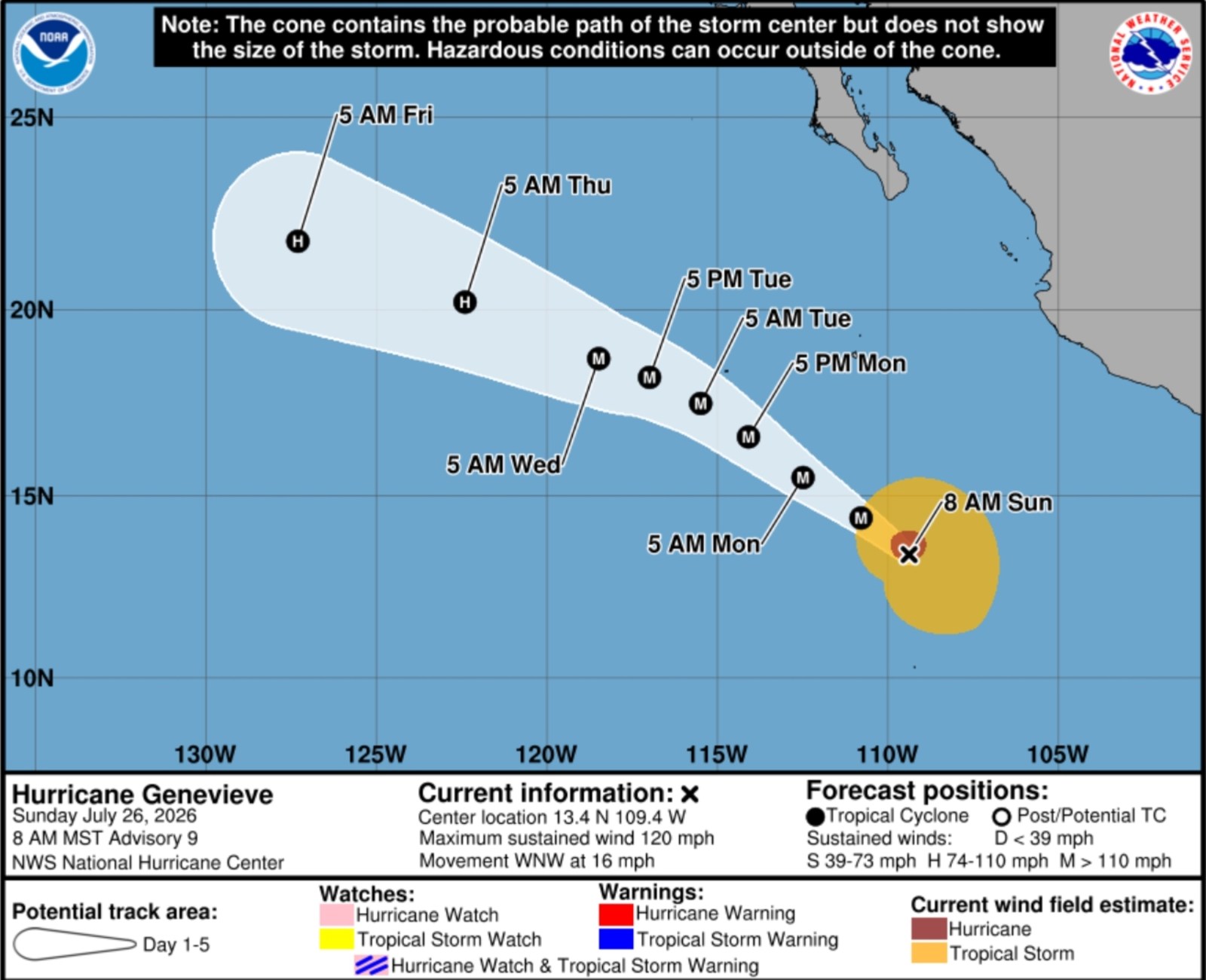
Hurricane Genevieve has become the first major hurricane of the 2026 Eastern Pacific season. It marks the first significant hurricane in both the Eastern Pacific and Atlantic basins this year. Weather experts caution that Genevieve might intensify into a Category 4 storm by Monday.
Current Status of Hurricane Genevieve
The National Hurricane Center (NHC) reports that Genevieve, a Category 3 hurricane, is generating sustained winds of 120 miles per hour. It is currently over the open waters of the eastern Pacific Ocean, located well southwest of Mexico. While no landfall is anticipated, meteorologists predict potential strengthening in the coming days, followed by a gradual weakening by the week’s end.
Hurricane Fausto Tracks Hawaii
In addition, the NHC is monitoring Hurricane Fausto, which is moving towards Hawaii. The NHC has been contacted for further information.
Understanding Major Hurricanes
A major hurricane is classified as a Category 3, 4, or 5 storm on the Saffir-Simpson Hurricane Wind Scale (SSHWS), with sustained winds of at least 111 mph. These storms can cause extensive wind damage and significant coastal effects when nearing populated areas. Genevieve reached this level after rapid intensification.
In a Category 3 hurricane, should the storm approach land, “devastating damage will occur,” according to the NHC’s SSHWS webpage. “Well-built framed homes may experience significant damage or loss of roof decking and gable ends,” the website explains. “Numerous trees will be snapped or uprooted, impairing roads. Utilities like electricity and water may be disrupted for several days to weeks afterward.”
Location of Hurricane Genevieve
On Sunday morning, the NHC reported Genevieve’s position as approximately 515 miles southwest of Manzanillo, Mexico, moving west-northwest at roughly 16 mph. The hurricane has a minimum central pressure of 963 millibars, indicating its fortified structure.
Live Updates on Hurricane Genevieve
Weather visuals on windy.com depict Genevieve stirring near Mexico’s coastline with powerful winds. Satellite images capture the storm’s distinct eye. Though the storm is expected to remain offshore, it could impact coasts slightly. The NHC advisory notes that “swells generated by Genevieve are affecting parts of Mexico’s southwestern coast and might reach parts of the Baja California Peninsula by tonight or Monday.” The advisory warns these swells may result in hazardous surf and rip current conditions.
Forecasts show Genevieve staying over the sea, eventually facing cooler waters and less favorable conditions, likely causing it to weaken. Yet, it may maintain its major hurricane status at least through Wednesday morning.
Genevieve’s significant development is the first of its kind for the 2026 season across the major North American basins, while the Atlantic remains inactive and no other tropical cyclones are currently under NHC observation.