
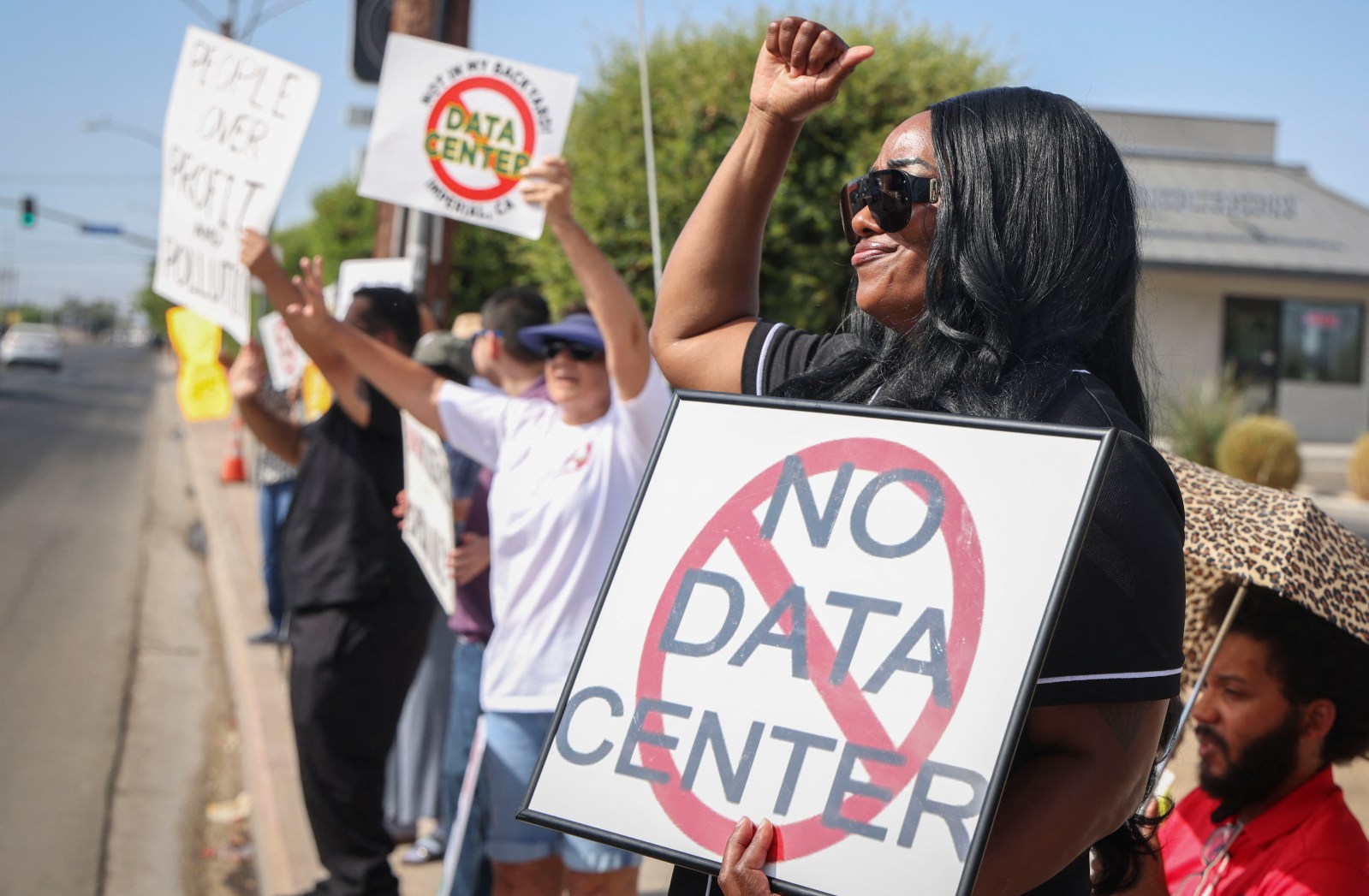
Sixty-three percent of U.S. voters are against AI data centers being constructed in or near their communities, according to a recent Emerson College poll. This marks an increase of 21 points since December 2025. The rise indicates a significant shift in public opinion on a technology initially anticipated to provide benefits but has brought concerns such as increased electricity costs and potential water supply issues.
AI Data Centers: Public Concerns
The Emerson College poll, gathered from 1,100 likely 2026 voters on July 19 and 20, shows that 63 percent of Americans express concern about artificial intelligence. Only 14 percent feel excited, while 22 percent are neutral. When considering the facilities necessary for running AI and machine learning models—used weekly by 62 percent of Americans per Gallup—skepticism is more evident among those with higher education.
Those with postgraduate degrees show 79 percent opposition, reflecting a 27-point increase. College degree holders at 72 percent oppose them, marking a 25-point increase. Among high school graduates, 37 percent are opposed, which is a smaller rise of 9 points.
Overall, 27 percent of U.S. voters support the construction of AI data centers nearby, while 10 percent remain neutral. A separate Redfin survey in May among 4,000 adults found 53 percent opposing local AI data centers, compared to 34 percent in support.
Generational Differences in Opposition
The Redfin survey reveals greater opposition among baby boomers and Gen Xers, with 65 percent and 60 percent against local data center buildings, respectively. In contrast, only 42 percent of Gen Zers and 43 percent of millennials express the same sentiment.
U.S. residents show more resistance to data centers compared to other structures, like apartment complexes, which face 39 percent opposition. “A buyer recently asked me to ensure no data center was planned near a home,” shared Matt Ferris, a Redfin agent in Virginia.
Concerns include noise, traffic, and the potential impact on the neighborhood atmosphere. The perception is often that such data centers negatively alter communities.
Community Resistance and State Responses
The Data Center Opposition Report highlights at least 430 grassroots groups across 40 states opposing hyperscale AI data centers. Of these, 192 appeared in a span of 92 days during recent months.
States, previously offering tax incentives for attracting data centers, now reconsider their stance due to environmental and resource concerns. New York recently imposed a statewide freeze on new hyperscale data centers for a year to develop environmental standards. Governor Kathy Hochul aims to address rising utility bills and resource use.
Maine lawmakers passed a temporary ban, later vetoed by the governor. Virginia’s attempt to pause new data centers until 2028 also failed. Similarly, Oregon restricts new data centers from using its Enterprise Zone tax program.
Economic and Educational Benefits
Despite opposition, certain benefits exist in regions hosting AI data centers. A Redfin analysis of Virginia’s largest data center hubs, Loudoun and Prince William Counties, illustrates this. Over 15 years, these counties experienced significant growth in education spending compared to neighbors, largely funded by AI data center-generated tax revenue.
Loudoun County hosts 176 data centers, generating substantial personal property tax revenue from them. Prince William County stands third with 77 facilities. In Loudoun, this revenue increased over 15 years by 639 percent per resident, whereas in Prince William, it rose by 349 percent.
Educational spending also jumped: 82 percent more funds allocated per resident in Prince William and 77 percent more in Loudoun County.
A Federal Reserve Bank of St. Louis report confirms that AI data center construction has bolstered local economies. Economic activity in communities with centers has experienced positive growth.