
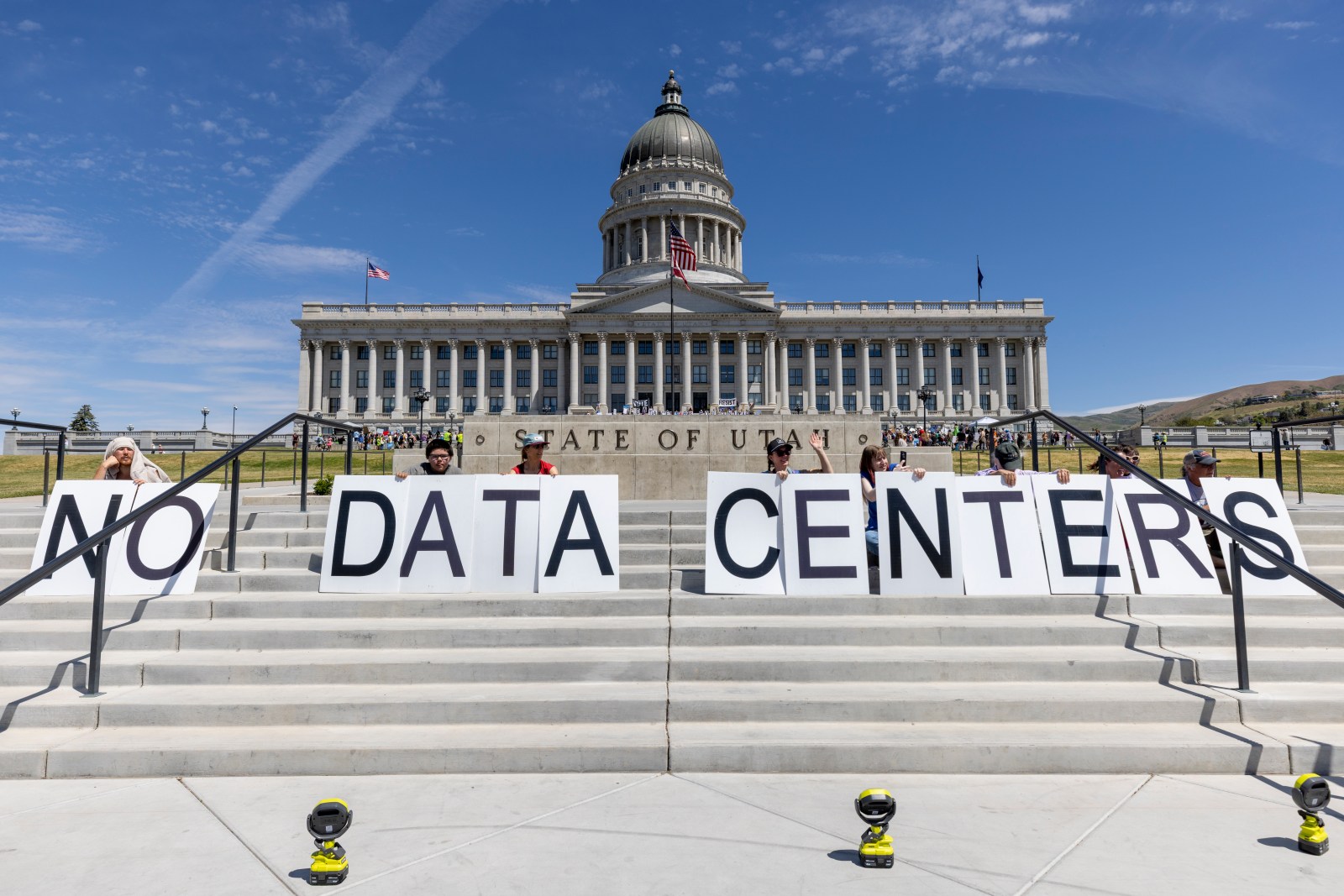
Local opposition to data centers is turning into a significant national political discussion. Public opinion is shifting, and policy actions are following. A recent Gallup Poll revealed that 70% of Americans oppose artificial intelligence data centers in their community. Currently, over 4,300 data centers exist across the U.S., including more than 600 in Virginia, over 460 in Texas, and over 130 in New York, according to Data Center Map.
The rapid establishment of AI-driven facilities is raising concerns in communities and spurring action. Environmental activist Erin Brockovich launched a website to track these issues, bringing more attention to data center-related challenges.
Policy Response
Policymakers are responding. New Jersey Governor Mikie Sherrill introduced plans requiring data centers to support grid infrastructure necessary for their expansion and report on energy and water usage. In Pennsylvania, Governor Josh Shapiro announced standards data center developers must meet to gain state support, focusing on benefits to local communities and responsible development.
New York’s Business Response
Business communities are also raising concerns. Around 500 New York businesses have urged Governor Kathy Hochul and state lawmakers to propose a temporary statewide moratorium on new data centers. They fear rapid expansion will harm small firms by increasing pollution, straining resources, and elevating electricity prices.
These businesses argue the rapid growth is creating more fossil fuel pollution, straining water resources, and depleting natural resources heavily relied on by businesses. The proposal suggests new facilities could significantly increase statewide electricity consumption, requiring additional gas infrastructure and risking pollution without providing many permanent jobs.
Newsweek contacted Governor Hochul’s office to comment on the letter.
Concerns in Texas
Similar concerns arise in Texas. Agriculture Commissioner Sid Miller called for a temporary pause on new hyperscale data center developments in the state. He emphasized the explosive growth consuming land, water, and power at great speed in rural areas. Miller stated that some centers use as much electricity as entire towns and compete with rural areas for resources.
Local Governments Take Action
In New Jersey, some towns have moved to ban data centers completely. East Greenwich Township approved a ban on data centers while considering an application from American Tower for a new facility. Millville city commissioners also unanimously banned data centers.
According to WHYY, Monroe Township banned all data centers related to artificial intelligence, cloud computing, and cryptocurrency, after facing opposition to a large proposed project. Other municipalities, like Andover Township and Logan Township, have adopted similar measures.
Local Impacts in Arizona and Georgia
Residents in Arizona and Georgia express day-to-day concerns about new data centers. Axios reported that Arizona neighborhoods oppose new proposals due to noise, water strain, and quality of life impacts. Commissioners argue that on-site power components could benefit the larger grid, and developers engage in public outreach to address concerns.
In Georgia, Georgia Power is using eminent domain for Project Wansley, a high-voltage transmission corridor across Coweta and Fayette Counties to support multiple AI-related data centers. The New York Post reported issues along the route, including disputed property appraisals and compensation, with some homeowners feeling pressured.
Economic Impacts
Resistance to data centers is affecting the industry. Miquel Vila from 10a Labs reported to Industrial Info Resources that local opposition has increased. Last year, 17 projects were delayed and 31 canceled, affecting $156 billion in investments. Eleven states are considering temporary halts on new data centers.