
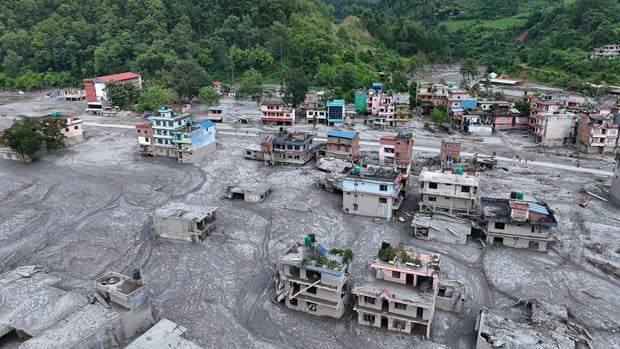
The death toll from last Wednesday’s catastrophic flash floods in Nepal and along the Chinese border has surpassed 600. Approximately 3,000 individuals remain missing as rescue efforts have extended into four days. Poor weather conditions are currently obstructing aerial rescue missions involving workers and military personnel. These teams have been tirelessly working to locate survivors since the disaster occurred.
Rescue Operations Face Challenges
A Nepali Army spokesperson, Brig. Gen. Raja Ram Basnet, reported that helicopter operations are delayed until weather conditions improve. He stated that more than 100 people are believed to be trapped in a mud-filled tunnel at a hydropower construction site in Rasuwa district, Nepal. Video footage shows rescuers pulling a man from the tunnel, covered in dark brown mud, one of many potentially trapped inside. Due to mud depth of 4 to 5 feet and minimal landing areas, the operation was hindered despite the use of helicopters with baskets.
Nepali and Chinese authorities have warned of more flooding risks from a newly formed lake upstream. Potentially affected individuals are advised to relocate to safer areas. Concerns over the lake overflowing have prompted rescue teams to temporarily relocate.
Efforts and Impact
Authorities have rescued more than 3,700 people in Nepal so far. On the Chinese side, state media reports 558 individuals still missing. Among the missing are hundreds of foreigners present in the area for work, trekking, or pilgrimage purposes.
The Red Cross noted on Friday that around 90,000 people have been affected by the flooding, likely triggered by the collapse of a rocky ledge and a large glacier portion it supported. This extreme rockfall registered as a magnitude 5.2 seismic event.
Causes of the Disaster
Scientists indicated satellite images show bedrock underneath a high Himalayan glacier collapsing, taking part of the glacier with it. The resulting rock and melted water caused sudden river swelling, sweeping structures away in both Tibet and Nepal.
Researchers are still analyzing satellite and ground data to determine the precise flood cause. Jakob Steiner, a geoscientist from the University of Graz, noted a significant glacier portion has detached.
The Hindu Kush Himalayan region is warming rapidly, affecting glaciers, snow, permafrost, and mountain slopes. Approximately 78% of glaciers between 14,760 and 19,685 feet elevation are highly exposed to warming.
Missing Americans
The U.S. State Department revealed that five American citizens have reached safety, while about 90 remain unaccounted for. The U.S. Embassy in Nepal announced relief efforts, including supplies requested by Nepal’s government.
Catholic Relief Services, through Caritas Nepal, will provide over 2.5 metric tons of food, 500 blankets, mosquito nets, and foam sheets for temporary shelter flooring.
22 Americans were part of 80 missing individuals from an Isha Foundation pilgrimage, led by Indian spiritual leader Sadhguru Vasudev.
Affected families and collaborators await developments. Some U.S. citizens were crossing from China into Nepal when the flood struck, impacting transportation and pilgrimage efforts.
President Trump expressed deep concern, acknowledging the severe impact on infrastructure. He assured U.S. support to Nepalese leaders to offer necessary aid.