
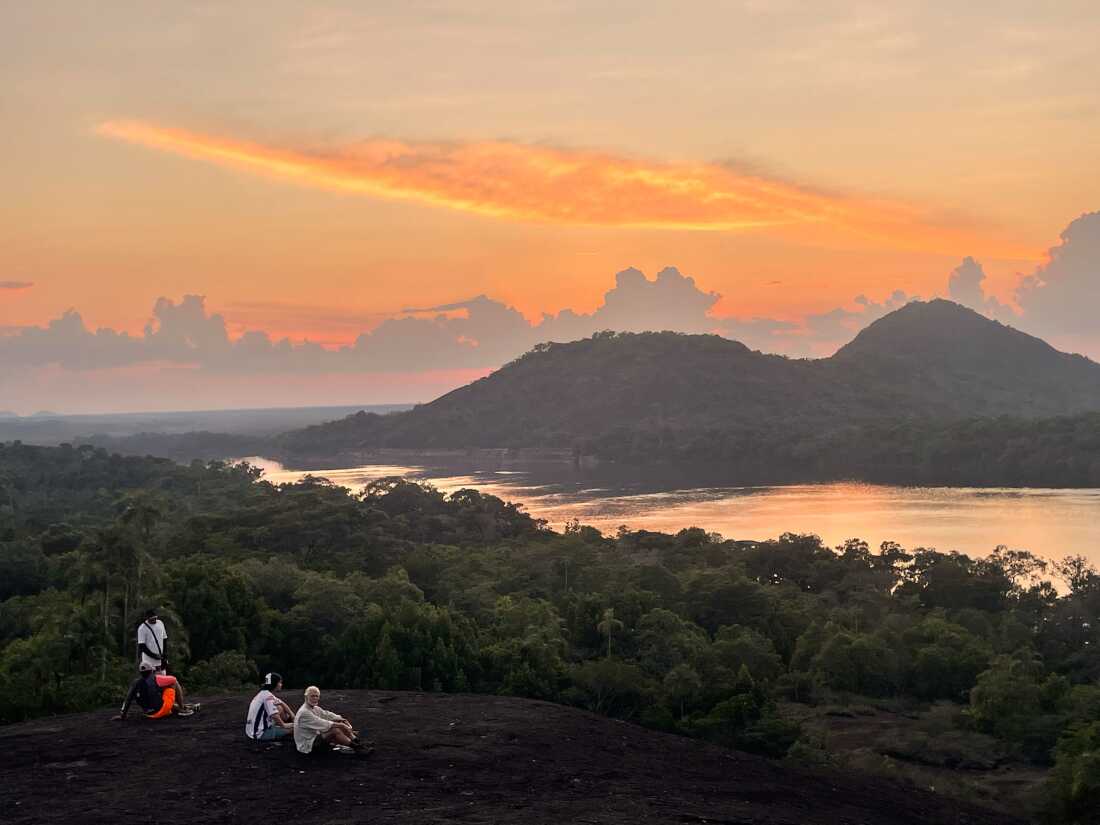
As the sun sets over Colombia’s remote Mavecure Mountains, three towering rock formations emerge above the vast Amazon jungle. In the early morning, the Amazon rainforest comes alive with the sounds of howler monkeys, parrots, and frogs, creating a natural wake-up call.
A group of friends from the U.S. embark on a journey in eastern Colombia, near the Venezuelan border. Although the landscape initially appears uniformly flat and green, it soon reveals three massive rock formations, the Cerros de Mavecure, rising 2,000 feet above the jungle. These formations, made of sandstone, shale, and quartz, are barren and rounded at the top. They evoke memories of Rio de Janeiro’s Sugarloaf Mountain.
The name ‘Mavecure’ is linked to the poison-dart blowguns used by Indigenous groups for hunting. According to Ignacio Rodriguez, the local guide, this place holds spiritual significance for the Puinave and Curipaco Indians, who often leave offerings here.
Marcela Sánchez, an industrial engineer from Cali, describes the view from one of the peaks as ‘divine.’ Reaching the summit of the smallest peak takes a couple of hours in 90-degree heat, requiring guide ropes and ladders. However, the effort is rewarded with breathtaking views, reminiscent of Peru’s Machu Picchu.
Colombia’s diverse landscapes, including the Amazon, Caribbean beaches, and Andean Mountains, position it as a prime tourist destination. The country is a paradise for bird-watchers, with over 1,900 avian species, surpassing any other nation.
For years, Colombia’s tourism suffered from guerrilla warfare and drug violence, but the 2016 peace treaty shifted things. By 2025, Colombia welcomed a record 3.1 million international visitors, according to Remanso’s mayor, Delio Agapito. Tourism has transformed the economy, prompting locals to shift from polluting gold mining to tourism-related ventures.
Fabio Pérez, a former gold miner, now operates a hostel and an apiary project, selling honey to tourists. “Tourism has improved our quality of life,” he shares, highlighting how it allows families to stay together.
Despite the tourism boom, Mavecure receives few visitors compared to popular spots like Cartagena or Medellín. Its remote access, with no roads and limited flights, influences this. Rustic bunkhouses offer basic accommodations, as noted by Fernando Carrillo of Aroma Verde, an environmental foundation.
Rodríguez guides the group up the mountain with caution against grabbing thorny branches or encountering snakes. Luckily, it’s a dry, reptile-free season. Near the top, they meet other climbers trying edible rainforest ants. Colombian anesthesiologist Sebastian Rivera tastes one and notes its lemon-like flavor.
The summit rewards climbers with panoramic views of the jungle and the Inírida River. Catalina Laverde, a Colombian lab technician, feels her climb with friends is a dream realized. Rivera appreciates the serenity, although he acknowledges developing tourism in the region. “It’s not a five-star resort,” he says, “but you do get these natural wonders.”