
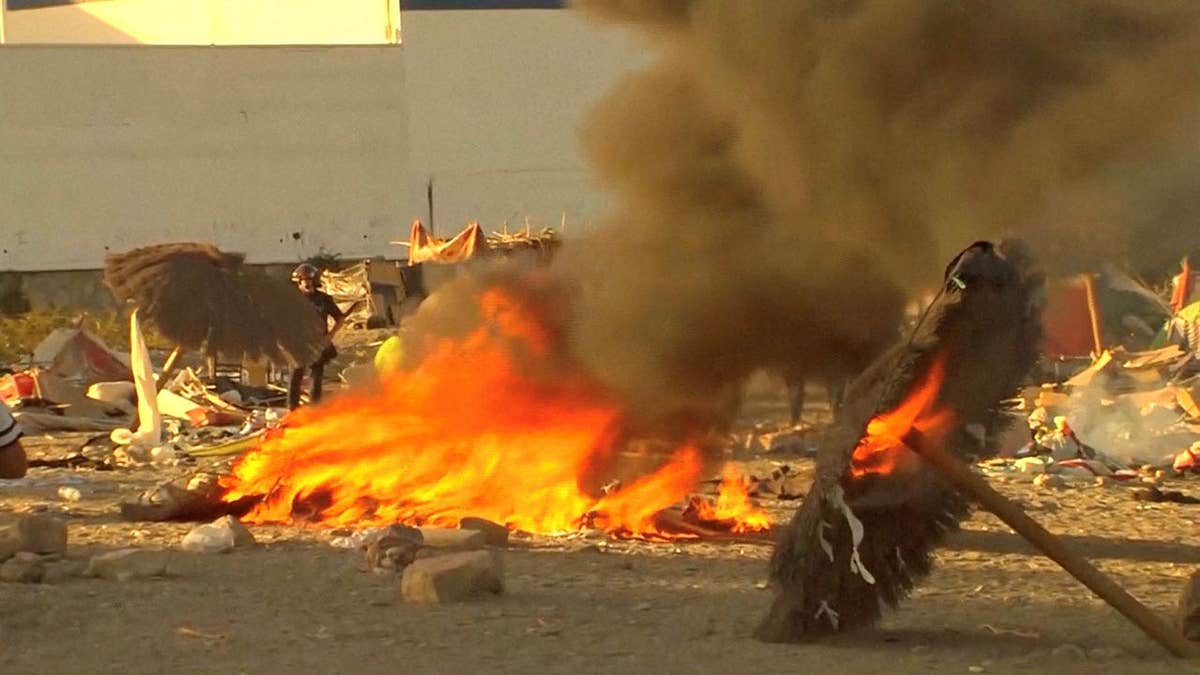
Residents in Ceuta, a Spanish enclave in North Africa, have dismantled and burned makeshift shelters used by migrants, escalating tensions sparked by a massive influx from Morocco. Prime Minister Pedro Sánchez has accused networks linked to Russia and Israel of spreading disinformation that exacerbated the situation.
Protesters carrying Spanish flags targeted beachside migrant camps, destroying shelters and starting fires, as reported by Spain’s broadcaster RTVE and EFE news agency. Demonstrators chanted slogans demanding the expulsion of migrants while moving toward the camps, EFE noted on August 27. The protests continued the next day, as residents marched toward the Trampolín and Benítez beach areas, repeating their demands.
This unrest follows a major surge on July 30 and 31, with over 72,000 migrants crossing from Morocco into Ceuta, one of the EU’s two land borders with Africa. Approximately 100 people died during the crossing, Ceuta authorities reported. As of Monday, around 5,000 migrants remained in the area.
The State Department has raised a travel warning for parts of Spain due to the migrant surge, which has prompted military deployment. Law enforcement has been monitoring the situation as residents destroy migrant camps by the beach.
On Monday, Sánchez attributed the mass crossing to a disinformation campaign backed by foreign entities. Spanish authorities indicated that misleading social media content falsely suggested that migrants reaching Ceuta by sea could stay in Spain.
According to research by the European Union’s diplomatic service, Russian and Israeli networks allegedly participated in spreading this disinformation alongside far-right groups. Sánchez suggested that the crisis was used by Russia and Israel to attack Madrid over disagreements on Ukraine and Gaza policies, though he provided no detailed evidence.
Both the Israeli and Russian governments have rejected Sánchez’s claims. Israeli Foreign Minister Gideon Sa’ar accused Sánchez of diverting blame from domestic issues. Dmitry Peskov, Kremlin spokesman, also denied any Russian involvement.
Sánchez has dismissed allegations that Morocco facilitated the border surge, despite accusations from Spanish opposition and human-rights groups. Morocco denies allowing the crossings intentionally.
Disinformation surrounding the crossing had been building, with activity traced on platforms like TikTok, Facebook, and Instagram. Incorrect interpretations of Spanish immigration law were circulated, misleading potential migrants about the possibility of remaining in Spain. This intensified after Spain’s Supreme Court restricted the immediate return of intercepted migrants near Ceuta and Melilla.
Zineb Riboua, a research fellow, highlighted that Islamist movements were politically exploiting the crisis by portraying Europe as prosperous and attacking Morocco’s ties with Israel and the U.S. She observed that activists encouraged Moroccan youths to seek opportunities in Europe rather than their own country.
Italy has extended its suspension of Schengen free-movement arrangements with Spain due to the surge in Ceuta. This action, initially taken on July 31, continues as leaders address the broader implications of the migration crisis.
Nile Gardiner of the Heritage Foundation warned that Ceuta could become pivotal in unraveling the EU’s stability, noting the potential collapse of the Schengen Agreement.
Effie Lachter of Fox News Digital contributed to this report, bringing extensive experience in covering global crises and political accountability.