
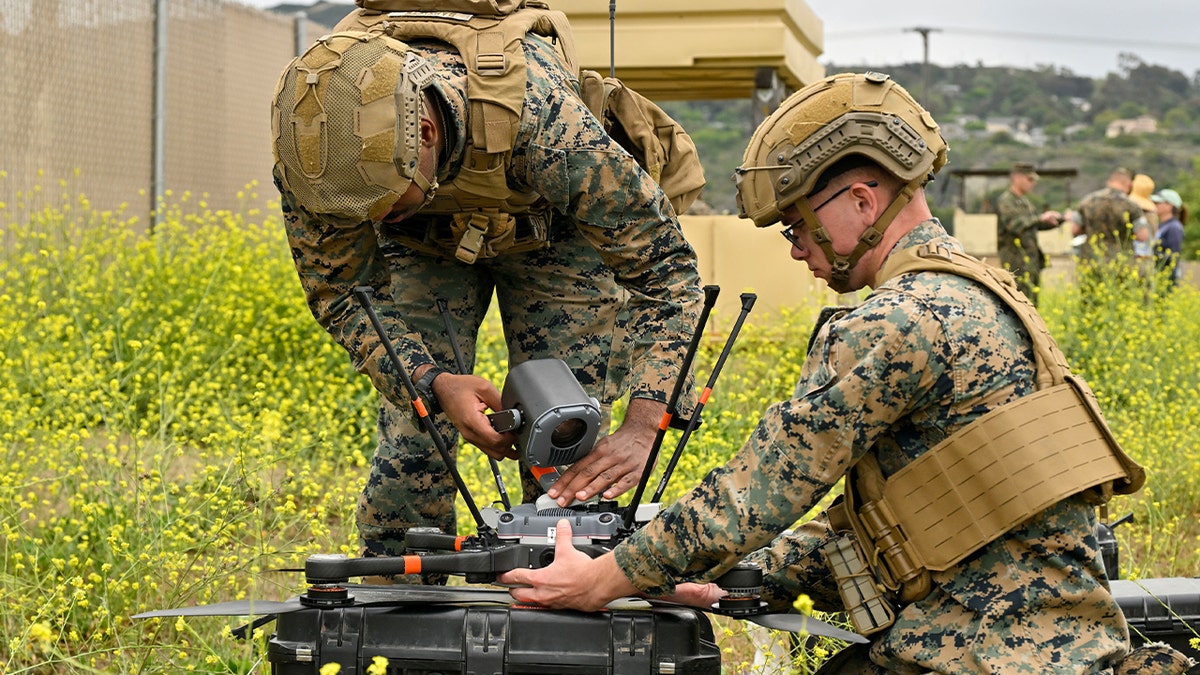
Modern battlefields heavily rely on drones, much like 20th-century conflicts depended on artillery shells. Ukraine produced 5 million drones last year, while Russia launched 805 in one night against Ukrainian cities. In this warfare, victory depends on manufacturing capabilities rather than sophisticated technology.
Every drone motor contains at least one permanent magnet. China manufactures nearly all of these magnets. President Donald Trump’s executive order on June 6, 2025, sought to prioritize American-made platforms, directing every federal agency to support this goal. The Pentagon’s Drone Dominance Program plans to purchase 200,000 drones by 2027 and 340,000 by 2028.
The U.S. imports almost all of its 50,000-ton annual permanent magnet consumption from China. While magnets are not smart components, lacking data and surveillance capabilities, they generate the magnetic field essential for drone performance. Stopping magnet supply halts program scaling.
T.S. Allen highlighted that drone production scale depends on the availability of batteries and other critical components. Most critical mineral processing occurs in China and Malaysia.
China’s rare-earth dominance was achieved through state subsidies and low-cost pricing, driving Western competitors out. This dominance enables price manipulation and export restrictions. Rare earth prices can dramatically fluctuate.
In April 2025, China imposed export licensing requirements on rare earth elements and magnets, affecting defense and industrial motor supply chains. Within weeks, less than a quarter of export license applications were approved. Europe’s largest drone motor producer, Motor-G, relies on Chinese magnets. Ukraine faced similar challenges when attempting to localize motor production.
Allen estimated producing ten times the current output to meet battlefield demands. A scarcity of magnets can affect smaller fleets, but larger fleets face significant hurdles. During wartime, access to critical materials is crucial.
Iron nitride is used in various commercial sectors. Both iron and nitrogen, components of iron nitride magnets, do not require export licenses and are embargo-proof. These magnets offer competitive performance, especially at higher temperatures and reduced weight, benefiting drone motor design.
American science underpins this technology, and U.S. manufacturers are scaling up production. By integrating iron nitride in drone motors, a proven commercial technology enters a high-stakes sector.
Attrition warfare is a contest of production. The side that maintains production capacity prevails. Supply chains are vulnerable to disruptions. Identifying critical inputs without adversarial control is essential.