
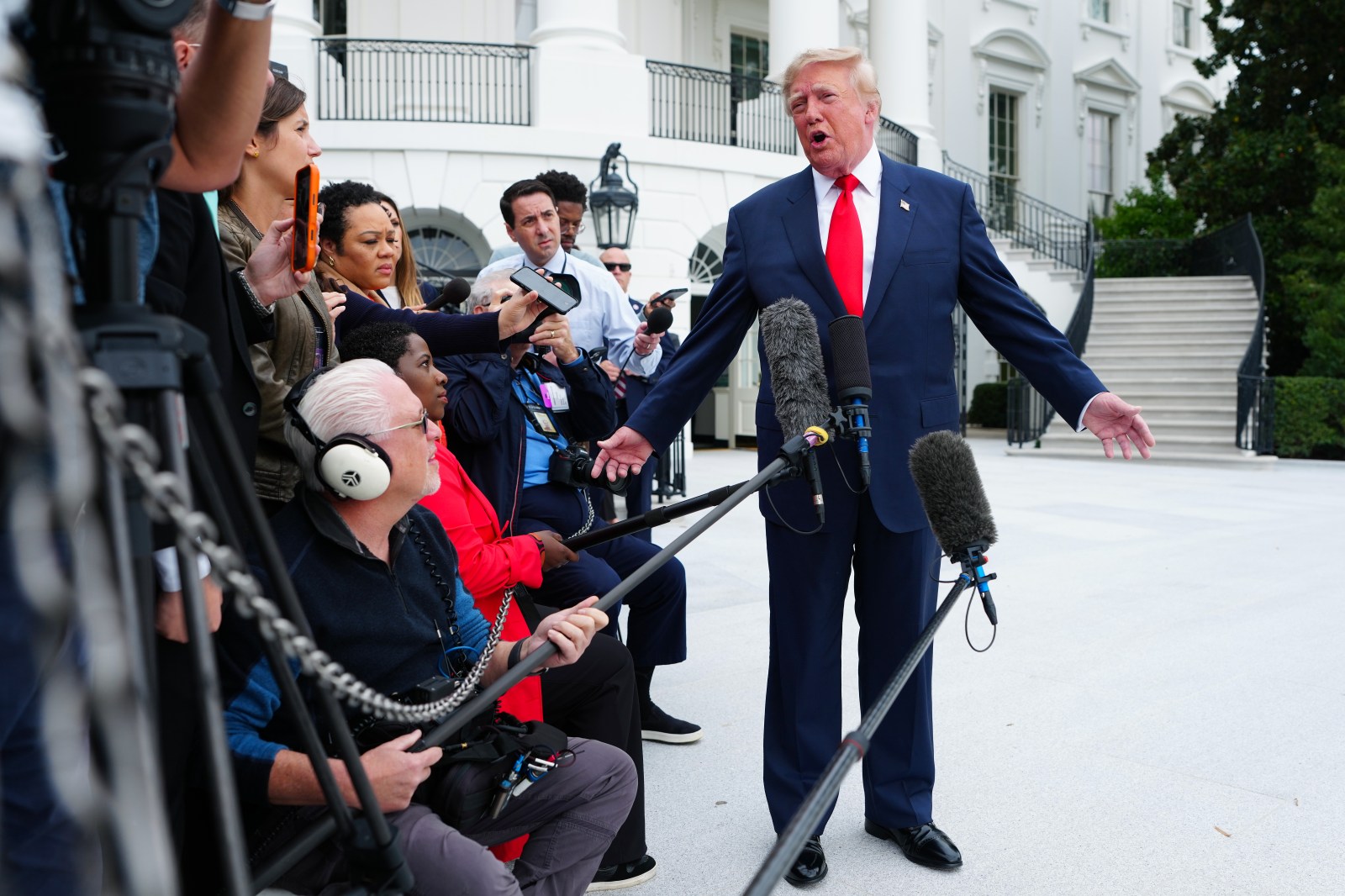
President Donald Trump promoted a pastor’s endorsement of broadcasting Nidal Hasan’s execution, while indicating that the final decision rests with him. Trump highlighted the views of Robert Jeffress, a senior pastor at First Baptist Dallas and Trump supporter, who argued that public execution underscores the sanctity of life.
The discussion has created divisions among religious leaders. Pope Leo XIV reiterated the Catholic Church’s stance against capital punishment. The head of the U.S. Conference of Catholic Bishops also condemned the proposed broadcast. Meanwhile, opposition grew among Democratic lawmakers and Republicans who, while supporting Hasan’s execution, disagree with making it a public event.
Trump expressed his thoughts on the matter, stating, “There are two thoughts: don’t show it and show it.” He suggested that witnessing the execution might deter similar crimes, though he acknowledges that it’s ultimately his decision to make.
Defense Secretary Pete Hegseth noted that the military planned to make Hasan’s execution public to emphasize the serious consequences of such actions. Trump defended the death sentence by describing Hasan as a “vicious killer” responsible for 13 deaths and more than 20 injuries.
Religious Perspectives
Robert Jeffress argued that capital punishment has biblical roots, referencing Genesis 9:6. He stated that exposing more people to the execution could reinforce the intended lesson of life’s sanctity. Jeffress maintained that capital punishment is a command from God, serving as a lesson for society. He expressed interest in watching the execution himself.
Pope Leo XIV did not mention Hasan specifically but reiterated the Church’s opposition to the death penalty, terming it an attack on human dignity. Leo argued that justice and public safety can be achieved without resorting to execution. Archbishop Paul Coakley urged reconsideration of the proposed livestream, suggesting it undermines societal morals.
Political Opinions
Vice President JD Vance expressed skepticism about whether the government will proceed with the broadcast. He emphasized the need to remember Hasan’s crimes, amidst the controversy of the execution’s public broadcast.
Republican lawmakers, including Senator Thom Tillis and Senator John Curtis, voiced their opposition to a public broadcast. They highlighted the distinction between supporting Hasan’s sentence and opposing the notion of turning it into a spectacle.
Criticism also came from families of Fort Hood victims. Kristopher Craig, whose brother was killed in the attack, urged against turning the execution into a spectacle, focusing instead on accountability rather than spectacle.
Expert Views and Historical Context
Austin Sarat, a professor from Amherst College, remarked that livestreaming the execution would convert its inherent brutality into a display of cruelty. He argued that it would terrorize rather than educate.
The Death Penalty Information Center reported no precedent for livestreamed executions in the U.S., with most public executions stopping in the 1930s.
Hasan’s execution, set for December 3, follows his 2013 conviction on 42 counts related to the 2009 Fort Hood shooting.