
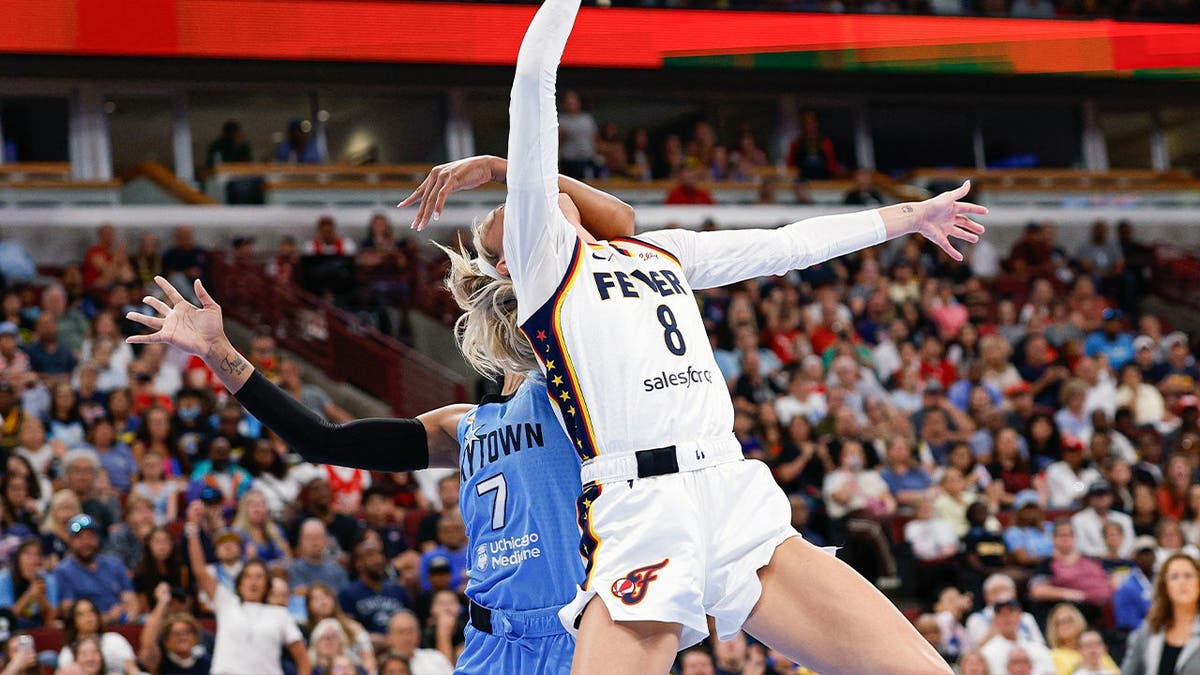
During a Saturday afternoon game, Chicago Sky’s DiJonai Carrington was ejected after a severe foul on Indiana Fever forward Sophie Cunningham. The incident, where Carrington fouled Cunningham around the neck, sparked significant attention beyond the game itself.
Following her ejection, Carrington attributed the referee’s decision to “white privilege” in a social media post from the locker room. This claim added to the complexity of the situation, as social media users became aware of the event through viral clips, while ESPN’s live coverage largely ignored the post-game developments.
Sophie Cunningham, the fouled player, is already in the public eye due to her controversial opinions on female athletes competing against biological males. Her stance has stirred significant discussion outside the realm of sports.
DiJonai Carrington’s history includes allegations of dirty play, such as an instance where she was accused of jabbing Caitlin Clark’s eye during a game. Similar to her current statement, Carrington had linked Clark’s actions to “white privilege” previously.
The ongoing theme suggests accusations related to race and privilege play a recurring role in Carrington’s controversies.
Despite the uproar, ESPN aired only one replay of the foul immediately after it happened during the course of the broadcast. During halftime, the focus remained on discussing the Fever and Sky game without addressing Carrington’s racially charged claim.
As the game continued, ESPN included another replay of the incident, comparing it to a less aggressive foul. However, discussion about the social media post was notably absent.
Analysts claim these developments were sidelined by ESPN because they challenge prevalent narratives within the network. Some observers note that ESPN commentators have previously contended with claims regarding racial dynamics in the WNBA, involving figures like Caitlin Clark and Sophie Cunningham.
Claims of racial bias and white privilege appear to lead to tensions between some Black players and the media figures covering them. These dynamics could explain the lack of immediate focus on Carrington’s post.
Carrington’s aggressive play raises questions about who in the WNBA acts as a bigot or aggressor. It doesn’t comfortably fit within the narrative ESPN often presents to its audience.
The question remains whether anyone at ESPN will defend Carrington’s actions or criticize Cunningham for causing tensions related to race. Figures like Monica McNutt and Stephen A. Smith are speculated to potentially engage with this discourse.
Objective observers often identify Carrington as having a pattern of aggressive play. She faces growing calls for suspension as her actions pose a danger on the court. The ongoing debate highlights complex intersections of race, privilege, and accountability within professional sports.