
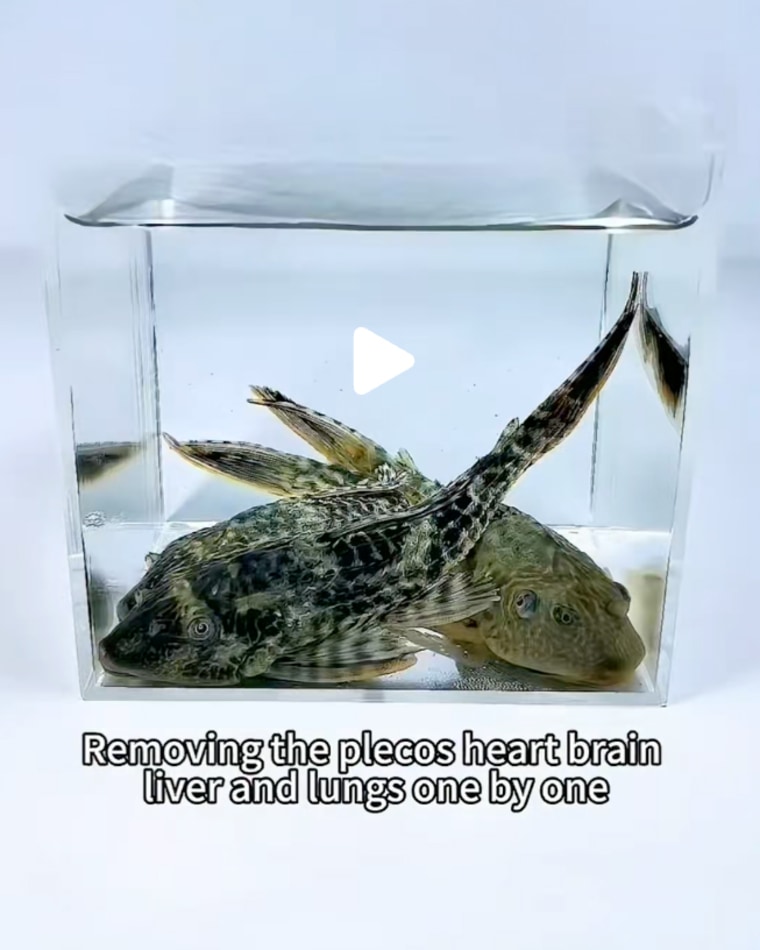
Recently, a disturbing trend has emerged on social media platforms. “LabGerm” videos, often starting with a pair of gloved hands before a white backdrop, present distressing scenes involving fish and other small animals. An AI-generated voice usually narrates these videos, accompanied by lively music.
The videos, sometimes partially or entirely AI-generated, display animals subjected to painful “experiments.” They offer no conclusions or findings. Instead, the shocking content seems to be their main purpose, drawing outrage and significant attention online. This phenomenon, often termed “rage bait,” has increased their visibility.
Originating on Douyin, a Chinese social media app, these videos have expanded to platforms like TikTok, Instagram, and Facebook. NBC News reviewed numerous videos, revealing the spread of content depicting small animals like pleco fish, leeches, and insects being harmed. An investigation found at least 49 accounts sharing such content on Douyin.
Social media platforms are struggling to control this type of content. Although TikTok removed several accounts for violating community guidelines, many imitators remain active. Users can still find videos expressing outrage over “LabGerm” on YouTube and Meta platforms.
“Members of the public might see this content and be outraged. But we’ve even seen people creating content about the content, which is then, I think, leading people back to the content,” said Nicola O’Brien, lead coordinator for the Social Media Animal Cruelty Coalition.
The spread of these videos highlights the difficulty of monitoring objectionable content online, where both positive and negative engagement fuel its distribution. The content tends to draw interest due to its shocking nature.
Nicola O’Brien explained how modern social media enables the widespread sharing of disturbing content. Historically, such content remained in niche online communities until social media incentivized its broader reach. Companies now attempt to enforce rules against animal abuse videos, but the vast user base complicates moderation efforts.
A TikTok spokesperson confirmed that the platform removed flagged accounts and emphasized its efforts to educate users on reporting animal abuse. Meta did not comment on this issue.
Although the origin of these videos remains unclear, their presence on international platforms like TikTok and Meta highlights the global reach of objectionable content. Douyin, restricting access outside China, nevertheless hosts accounts that NBC News found involved in the spread of these videos.
The banned TikTok account “LabGerm” claimed to stop posting pleco content out of fear of removal. The videos often label pleco fish as invasive, which some use to rationalize the abuse, further complicating their reception.
“Unfortunately, fish are often not recognised by the public — or by moderation systems — as sentient animals capable of suffering,” said O’Brien.
Peter Li, a University of Houston professor specializing in China’s animal policy, has monitored these videos, noting their persistence partially results from AI enhancement. Users request specific “experiments” on pleco fish in comments, treating the animals as participants rather than victims.
China lacks comprehensive animal cruelty laws, making prosecution for torturous content challenging. Despite some companies taking steps against these videos, the problematic content persists.