
In the Chesapeake Bay and its tributaries, the invasive blue catfish poses a significant threat to native seafood like the blue crab. To manage this issue, local schoolchildren are contributing by eating catfish for lunch.
At Preston Elementary School on Maryland’s Eastern Shore, students enjoy catfish sandwiches as part of a local food initiative. Second-grader Ben Rochon eagerly announced, “I got a catfish sandwich!” His reaction was positive, stating, “It’s yummy.” Known affectionately as the “catty patty,” these catfish cakes are popular among students, some preferring them with ketchup or mayo, while others, like fifth-grader Teagan Donovan, enjoy them plain.
This initiative, overseen by Beth Brewster of Caroline County Public Schools, serves more than just lunch. It turns the invasive blue catfish into a food source. Introduced to the Chesapeake Bay for recreational fishing, these catfish are apex predators with voracious appetites, potentially endangering native species like crabs and rockfish.
Beth Brewster and her team created a catfish cake that resembles a traditional crabcake. This recipe received approval from the USDA, allowing it to be served across the U.S.
The pandemic slowed this program, but Virginia’s collaboration with Bay2Tray, a California-based seafood initiative, reignited the momentum. Schools in Maryland and Virginia now serve blue catfish as part of their lunch menus.
Invasive blue catfish, initially native to the Midwest, were introduced to Virginia rivers in the 1970s. They adapted to brackish water, spreading throughout Maryland’s tidal tributaries. A record rainfall in 2018 further accelerated this distribution.
Currently, blue catfish make up about 70% of the fish biomass in parts of the Chesapeake Bay, threatening the seafood industry reliant on traditional species like flounder. States like Maryland seek to use human consumption to control their population, a strategy also seen in Kentucky and Illinois with the Asian carp, and Maine with green crabs.
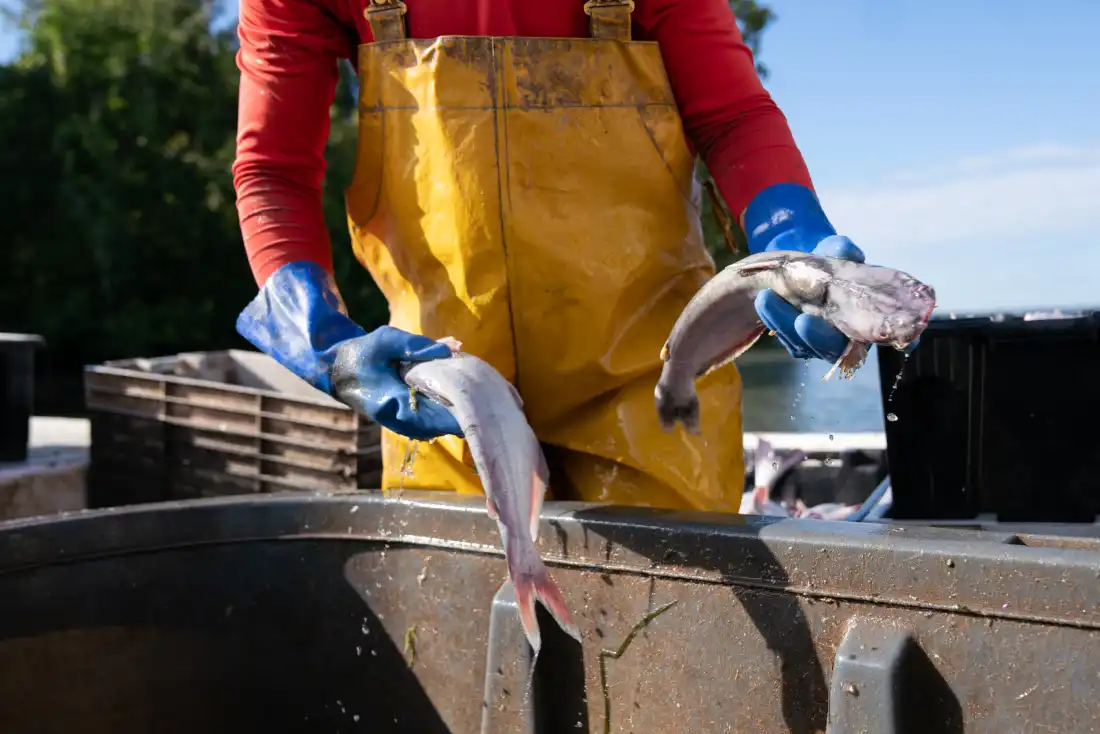
Maryland waterman Rocky Rice, who shifted from crabbing to catfish fishing over a decade ago, now targets these invasive fish primarily. “It’s usually about a hundred pounds to a tub,” Rice says, reflecting on his daily catch. While catfish do not fetch high market prices, Rice finds them a dependable source of income.
“You can catch as many of them as you want,” says Branson Williams, of Maryland’s Department of Natural Resources, emphasizing the need to reduce blue catfish numbers.
Logistical challenges remain due to USDA inspection requirements. Only four processors in Maryland manage the blue catfish, but it still reaches markets, food banks, and schools, thanks to initiatives like Bay2Tray.
Jenn Lovewell of Real Good Fish promotes harvesting millions of blue catfish to maintain ecological balance, summed up as “Eat the problem and save the bay.”