
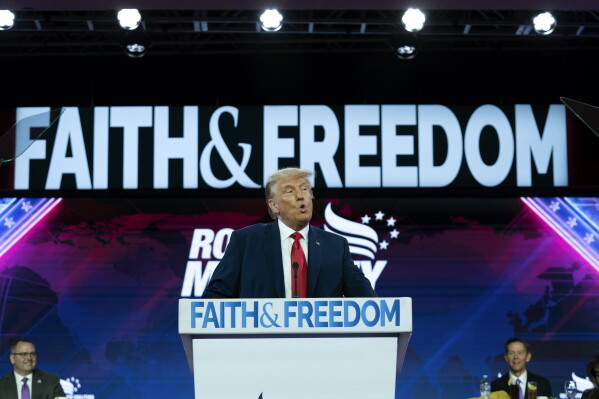
The U.S. Constitution does not cite Christianity or any specific religion. While the Declaration of Independence refers to rights derived from a ‘Creator’ and ‘Nature’s God,’ it does not specify further. Nevertheless, many Americans, particularly Republicans and white evangelicals, believe the founders aimed to establish the U.S. as a Christian nation.
Supporters of Donald Trump, amid his presidential campaign efforts, express these views strongly. To different individuals, the concept of a Christian America varies, with some maintaining a broad belief in God and country values. However, a focused group within this populace suggests that the Constitution had divine inspiration, that the government should establish the U.S. as a Christian nation, and that the separation of church and state should no longer be enforced.
This ideology is often linked to Christian nationalism, which combines American and Christian values, aiming to elevate Christianity in public life. This belief offers an origin story for Americans, presenting them as fulfilling God’s plans. Eric McDaniel, a government professor at the University of Texas, argues it creates a notion of ‘national innocence,’ discouraging confrontation with darker aspects of U.S. history. These beliefs connect with past doctrines like Manifest Destiny and recent slogans such as ‘America First’ and ‘Make America Great Again.’
Trump echoes some of these ideas, suggesting bans on immigrants opposed to ‘our religion.’ Many conservatives endorse these Christian national origins, although they may reject the ‘Christian nationalist’ label. Republican House Speaker Mike Johnson claims the U.S. was founded as a Christian nation, citing Thomas Jefferson’s ‘divine inspiration’ in drafting the Declaration of Independence. WallBuilders, influential to Johnson, criticizes historians who allegedly minimize America’s Christian roots. They are currently suing the Washington Metropolitan Area Transit Authority for refusing to display their ads about the founders’ purported beliefs.
Trump’s vocal supporters cast current politics as spiritual battles for the nation’s fate. Figures like Steve Bannon and Charlie Kirk describe the U.S. using biblical references, underscoring a belief in Christian foundations. Republican Party platforms in states like Texas and Kentucky highlight ‘Judeo-Christian’ values as founding principles.
The Rev. Robert Jeffress, from the First Baptist Church of Dallas, refrains from the Christian nationalist label but acknowledges Christian origins for America. He believes the founders, though not uniformly Christian, established laws and principles rooted in Judeo-Christian faith, citing figures like John Jay in support.
Conversely, Anthea Butler, head of religious studies at the University of Pennsylvania, argues history negates a Christian nation concept. She highlights that the idea serves as an exclusionary narrative, prioritizing White Anglo-Saxon Protestants and rationalizing views of others as ‘heathens.’
John Fea, author of ‘Was America Founded as a Christian Nation?’ views the rhetoric as political rather than historical. He asserts advocates often use a biased or incomplete interpretation of history for political objectives. Although some Christian rhetoric existed among founders, Fea points to their diverse beliefs, with key figures like Thomas Jefferson and Benjamin Franklin acknowledging Jesus as a teacher, not divine.
While some activists seek to remove religion from public life, Fea warns against oversimplification in historical narratives. He highlights the importance of understanding the 18th century’s complexity.