
This week, China’s military shared footage of a recent close encounter between a Chinese aircraft carrier group and a Japanese warship. The event occurred during the Chinese group’s deployment in the Western Pacific Ocean.
Such encounters in international waters are becoming more common. China is expanding its naval exercises beyond its coastal boundaries, frequently engaging in the Western Pacific. The U.S. refers to the area as the first island chain.
According to the Chinese military, Japanese ships and aircraft repeatedly engaged in close tracking and surveillance of the Liaoning carrier group. This deployment lasted over 40 days in the South China Sea and the Philippine Sea. China accused Japan of harassment and provocations during this period. However, China claims its military acted professionally in response to these actions.
Japan has not officially commented on the incident. The Japanese Defense Ministry has yet to respond to written questions.
Tensions between China and Japan are rising once more, partly due to Japan’s military modernization, supported by the U.S. This has led to warnings from China about a potential resurgence of Japan’s past militarism.
The Liaoning, a Soviet-built carrier, has been in service since 2012 and is China’s first operational aircraft carrier. China released the video as the Liaoning’s combat training ended, returning to its home port in Qingdao.
State media footage showed elements of the Liaoning group shadowed by the Japanese destroyer JS Asahi, with Japanese patrol planes overhead. Japan’s Defense Ministry reported monitoring the Chinese group’s movements as they entered the Philippine Sea in mid-May. The Liaoning and its escorts joined the area shortly after.
In early June, the Liaoning group conducted multiple jet and helicopter operations east of the Philippines. The Joint Staff Office of Japan’s Defense Ministry confirmed the JS Asahi monitored the Liaoning’s return to the East China Sea on June 20.
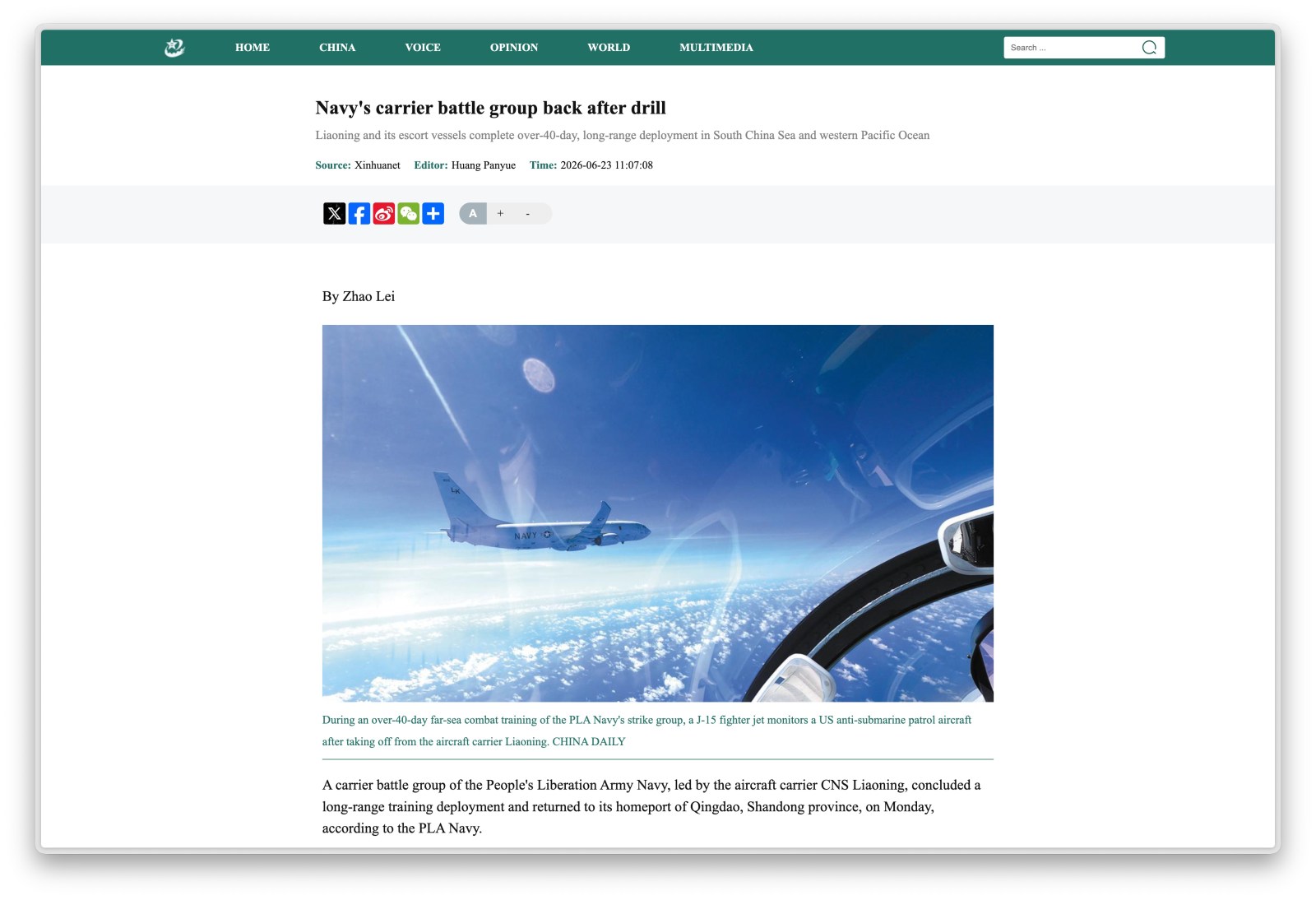
A separate report included a photograph of an encounter between a Chinese jet and a U.S. Navy patrol plane. A J-15 fighter monitored the U.S. aircraft. This encounter went unmentioned in official press releases. The U.S. Pacific Command had no immediate comment.
The Liaoning’s deployment marked its first in wider Pacific waters since December. Last year, both the Liaoning and China’s second carrier, the Shandong, were deployed in the Philippine Sea.
China stated that the latest deployment incorporated realistic combat exercises and various drills, such as search and rescue training. Officials claim these exercises adhere to international laws and are not directed at any specific nation.