
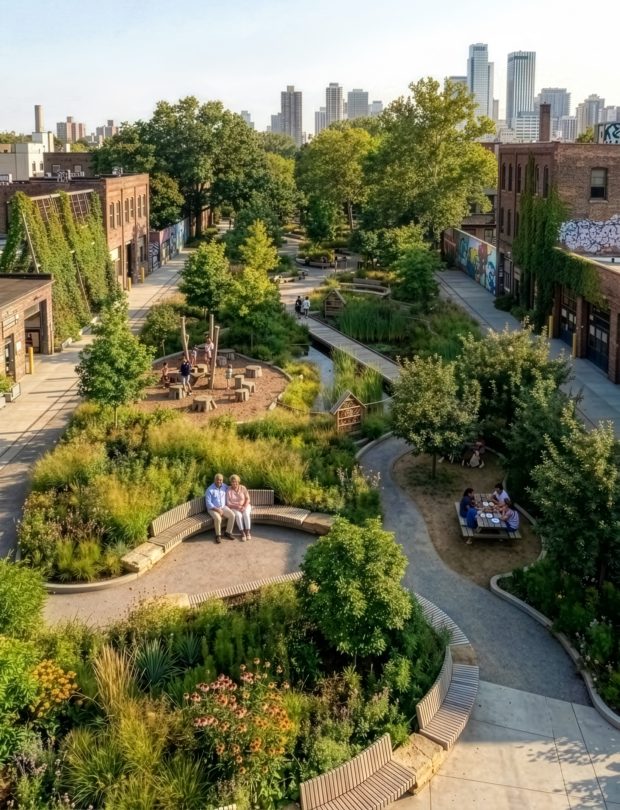
When architect Daniel Burnham developed the 1909 Plan of Chicago, his ‘make no little plans’ philosophy steered the city’s growth, its parks, and its open lakefront for over a century. World Business Chicago is aspiring to discover the next significant idea that could shape the city’s future with its ‘Horizon Lines’ contest.
About 200 creative thinkers submitted their forward-looking visions of Chicago for the year 2050, with ideas including building islands in Lake Michigan and themed public toilets. On Wednesday, six finalists emerged, competing for a $5,000 reward and the possibility of turning their concepts into reality.
Phil Clement, CEO of World Business Chicago, commented, ‘We asked Chicagoans to envision the future of our city in ways both visionary and rooted in real opportunity, and these finalists deliver precisely that.’ A panel of ten experts selected these six finalists. Their works, along with other top submissions, will be showcased at the Chicago Cultural Center throughout the summer, inviting public input.
Finalist Concepts and Their Vision for Chicago
Green City Rising: Chicago’s Living Network of Neighborhood Arboreta
The Morton Arboretum envisions returning Chicago to its original motto, ‘Urbs in Horto,’ which translates to ‘city in a garden,’ by creating a network of mini-forests throughout the city. This plan focuses on increasing the tree canopy amidst industrial structures, offering a revival of the city’s green roots. ‘We miss that forest canopy,’ noted Elle Rampel, who led this initiative at World Business Chicago.
The Third Frontage Initiative
This initiative envisions transforming Chicago’s extensive 1,900-mile alley network into community streetscapes. The proposal, submitted by Gensler and Adrian Smith + Gordon Gill, suggests that alleys be remodeled to include housing and green spaces. This would enhance civic life while retaining functional aspects of alleys. Tian Ouyang and Yibin Yang, the authors, state that Chicago’s next great public space could be hidden in plain sight.
Repairing the Scars of the Interstate Highway Era
The Metropolitan Planning Council’s proposal covers parts of the Dan Ryan and Eisenhower expressways with green spaces, turning highways into tunnels with pedestrian parkways atop. The idea is inspired by Boston’s Big Dig project, addressing how highways separated neighborhoods yet could serve as passageways underneath. ‘On top, there’s potential for parks and developmental opportunities,’ said Rampel.
Wonderways: Reimagining Chicago’s Boulevards as a Network of Climate Commons
Chicago’s century-old Boulevard system could be a new network of ecological and social landscapes, according to design firm MKSK. This proposal aims to couple the existing expansive green spaces with more eco-diverse elements, like prairies and micro-forests, creating active recreational areas. ‘The project aims to build upon the historic boulevards with integrated nature and wildlife,’ said Rampel.
AgriFlats
Developed by Wheeler Kearns Architects, AgriFlats transforms food deserts into urban farms, providing growers with interconnected greenhouse-living setups. The potential for 230 permanent jobs and a direct farm-to-table supply has promising economic and community-building consequences. Inspired by projects such as Gotham Greens, this proposal locates its facilities in Chicago’s Far South Side.
Re-Loop, The Living Mile
The Re-Loop Vision Coalition plans an ‘experience district’ featuring sculptures made from recycled CTA rail steel. Including food stalls and a place for salvage businesses, the concept might make unused land near Rate Field a tourism point of interest. Backers suggest it might rival iconic attractions and retain momentum even if the White Sox relocate.
World Business Chicago will award $5,000 to the chosen concept with $1,000 prizes for the other five finalists. The exhibit at the Cultural Center runs through September 20, allowing the public to weigh in until July 24. The winner announcement will occur on September 15.
Beyond these finalists, other ambitious ideas like an elevated Buckingham Fountain or man-made islands are also on display.