
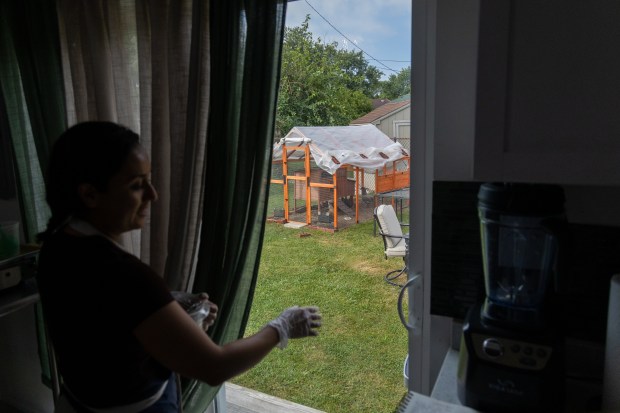
Scottsdale Avenue, located near Burbank on the southwest edge of Chicago, resembles a typical neighborhood. It features brick houses and two-flats with tiny, well-kept yards. Children spend time in the grass during the waning days of summer. On weekends, however, crowds gather along the sidewalk to purchase fresh pastries from one of the city’s numerous home-based bakers.
Samaria Pérez is one such baker. On a recent Thursday, she was beginning the base of her croissant dough. These pastries are among the many baked goods that have recently sold out within hours of Pérez posting an online link for digital orders. By Saturday, she will have roughly 500 pastries boxed and labeled with a “Samaria’s Kitchen” sticker, ready for pickup. Her licensed micro-bakery kitchen could easily be confused for a commercial bakery, except for the proximity of her living room.
Pérez, 30, possesses two commercial ovens and a sizeable 40-quart mixer, which requires a large whisk or paddle attachment. She also maintains a separate, carefully organized room containing additional fridge space, freezer drawers, rolling racks, flour and sugar bins, sheet pans, parchment paper, and various baking tools and gadgets. Outside her home, a coop houses four chickens.
“I try to use my own chickens’ eggs in as many recipes as possible, particularly for curds,” Pérez said. “The eggs can change the flavor and even my customers tell me, ‘I don’t know what you put in this pastry, but it’s different.’ I know it’s the eggs.”
Samaria Pérez displayed the backyard chicken coop where she collects fresh eggs, behind her home in Chicago’s Ashburn neighborhood, on September 5, 2026. (Arthur Maiorella/Chicago Tribune)
Pérez is meticulous about quality ingredients. She exclusively uses Kerrygold Irish Butter and purchases raw honey from local beekeepers. Even when buying milk from Target, she ensures it is USDA-certified organic, free of growth hormones and prohibited pesticides.
Her passion for quality reflects what she learned from her grandmother in Mexico. “I have spent so much time in kitchens, and I always remember how my grandma operated her kitchen and food businesses,” Pérez shared, smiling. “She cared about quality, cleanliness, and details. The ingredients mattered.”
When Pérez started her home-based business months ago, these principles were her driving force. They have culminated in an eagerly awaited weekly bake sale, demonstrating that Chicago’s food lines aren’t only at Michelin-starred establishments but also at small businesses.
As Pérez prepared croissants on Thursday, her sister and business partner, Arely Pérez, 29, formed golf-ball-sized cookie dough portions. They were carefully wrapped and frozen for baking fresh on Saturday, just before the 10 a.m. to 1 p.m. collection window.
With more local entrepreneurs bypassing costly brick-and-mortar operations, Pérez believes her pastries’ quality difference will help her thrive. “I first thought, there has to be a way that people keep coming back,” Pérez confessed, noting her reluctance with social media. “But I know the way to draw more people is by showcasing the ingredients we use.”
Pérez has baked for friends and family for years. Before Samaria’s Kitchen officially opened, she hosted bake sale pop-ups outside her house. Her pastries were praised by neighbors. Juanita Cano, a pastry aficionado, described her neighbor’s pastries as challenging to get, citing word-of-mouth and a loyal following.
“The first thing I tried was an olive oil sliced cake with orange hints and mascarpone frosting,” Cano recounted. “Delicious. When she did another sale weeks later, she was nearly sold out by 9:30 a.m. I wondered how this could happen!”
A line formed outside Pérez’s microbakery on September 5, 2026, in Chicago’s Ashburn. (Arthur Maiorella/Chicago Tribune)
Line culture isn’t new in cities like Chicago, yet customers consistently appear for good food, whether outside major bakery names or Pérez’s residence. Cano noted customers lining up in pouring rain for pastries one Saturday morning.
“I told my mom to go for me because my kids were asleep.” Cano laughed. “When she delivered the pastries and was skeptical, but after trying them, she said they were indeed worth it.”
Replacing her sales model, Pérez moved to online ordering, only producing items already sold. Her modest Instagram following built organically from loyal customers helps spread the word about her micro-bakery.
One customer shared a video post highlighting the rain-soaked bake sale, accruing 274,000 views. Sales surged, although some debate arose. The video caption referred to the pastries as Mexican bread, yet the comment section disagreed.
“There was controversy as many noted, ‘That’s not Mexican bread.’ They were right,” Pérez reacted. “Though I am a Mexican baker, my pastries incorporate Mexican flavors but don’t adhere to traditional panaderías, which typically don’t sell croissants.”
Aside from sourdough bread, one of her top sellers, Pérez offers traditional Mexican sweet bread during pan de muerto season, although her typical offerings remain diverse.
Recent selections included pistachio, pecan, chocolate, almond, burnt honey, and honey-orange croissant knots. Savory items featured rajas con queso croissant knots topped with cotija cheese and tortilla chips. There were cinnamon rolls, espresso Nutella buns, churro cajeta cruffins, strawberry cheesecake Danish, banana bread tea cakes, and chocolate chip cookies, ranging from $3 to $8 each.
“Our croissants benefit from a manual dough roller, allowing more control,” Pérez said. Texture attention to Kerrygold butter, lightly beaten with flour for ideal folding pliability, mimics high-grade European butter. The chilled butter brick meets the dough for perfect flakiness.
Roughly 20 butter blocks are prepared simultaneously, folding and laminating dough with organic flour follows. Pérez and her sister deliberate flavors and amounts needed.
Pérez is experienced, drawing on 13 years in professional kitchens and bakeries. She moved from Nuevo Laredo, near the U.S.-Mexico border, to Chicago at age 17 to join her stepfather.
Initially struggling with culture shock, she missed home. “I had to repeat senior high school, learning just enough English to attend,” she said. “Grades suffered due to language barriers.”
After high school, Pérez shifted from law studies to culinary arts at the late Robert Morris College. She began cooking at 5 in her grandmother’s kitchen. An associate’s degree and ServSafe certification preceded jobs as a savory chef, transitioning later into pastry.
At home, she explored unique flavors and techniques for ideal crumbs or flakiness. For Pérez, a home bakery offers economic viability and creative freedom.
Business experts observe a rise in solo ventures, aided by tech innovations like digital storefronts and payment processors.
“Compared to standard brick-and-mortar, these advancements offer lower initial costs and risks,” said Sean Higgins, professor of finance at Northwestern University’s Kellogg School. “Customer acquisition through online presence becomes simpler and cheaper.”
The Front Porch, an expansive online directory for home makers and bakers, lists 27 microbakeries in Chicago with expected growth.
Consumer choice paradox could see oversaturation among micro-businesses with niche targeting, potentially benefiting consumers, Higgins noted.
For Pérez, her audience seeks high-quality, locally made pastries. Her popularity grows, but she worries about meeting increased demand.
Pérez invested around $20,000 for commercial kitchen gearing at home. Shiny ovens and mixer often appear on her Instagram posts. Videos, predominantly in Spanish with English translations, spotlight laminated dough or upcoming pastry flavors.
“Honesty in food resonates with people,” Pérez said. “Some hesitate with home-based enterprises, but small businesses offer a personal touch versus mass-production.”
Pérez incorporated ingredients like piloncillo and Mexican chocolate into recipes. Her Hotplate storefront link for online purchases usually sells quickly due to limited quantity.
During Saturday mornings, amidst her energetic 4-year-old son, her husband assists with order boxing.
“I enjoy every aspect of my life now,” she said. “Previously, other jobs imposed schedules and unfavorable bosses, but now I determine what I produce.”