
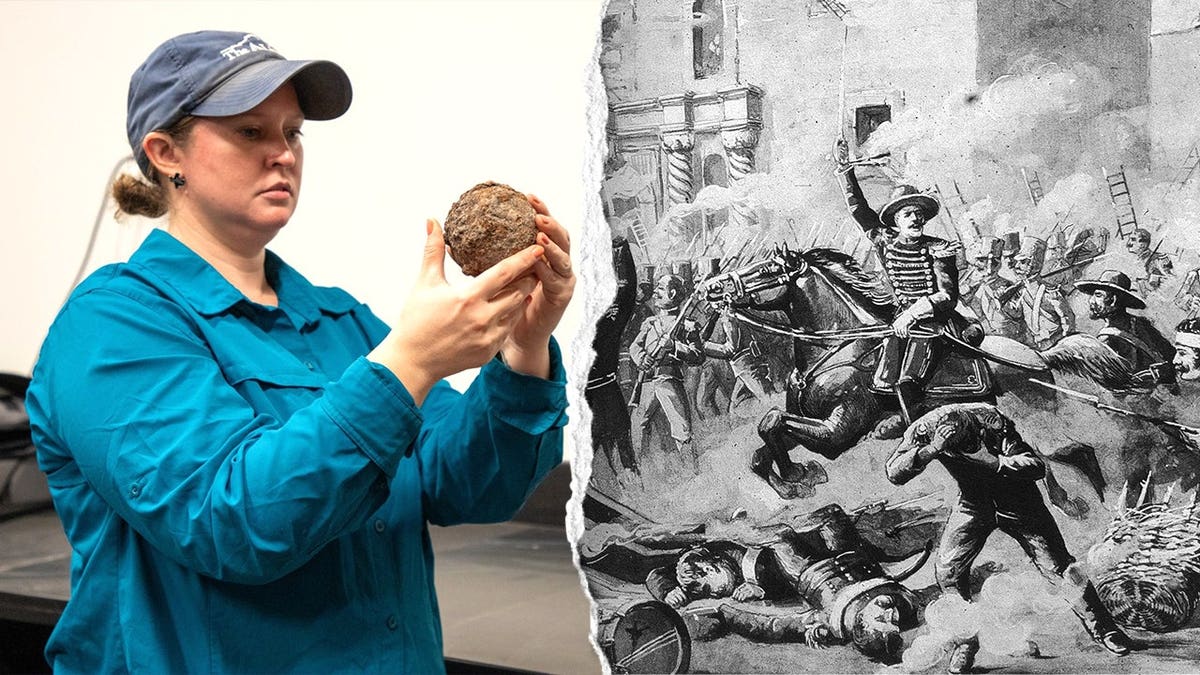
Archaeologists have made a significant discovery with the unearthing of a cannonball potentially fired during the 1836 Battle of the Alamo. The discovery occurred on June 2, with the Alamo Trust, the organization in charge of the Alamo Mission, announcing it on June 16.
Secrets of Revolutionary War battlefields continue to surface over 250 years after America’s founding.
The cannonball appeared outside the northeast corner of the Alamo Church, in a unit where another was found in March. Images display the heavy rust on the cannonball, indicating it has remained undisturbed for nearly 190 years, much like the adjacent find.
Tiffany Lindley, director of archaeology at the Alamo, detailed in a press release, “Whenever they were dropped, possibly in 1836, they haven’t been touched since. That’s what makes them extra special.”
The Battle of the Alamo holds great importance in Texas history. It took place from February 23 to March 6, 1836, where Texian forces, including notable figures like Davy Crockett and William B. Travis, faced a larger Mexican army. Despite losing, this battle became a rallying point for the Texas Revolution.
Lindley expressed surprise at discovering the second cannonball, given the extensive past usage of the site, which includes military and commercial activity. “We find what gets left behind, often broken or discarded items, but such finds are rare,” said Lindley.
The newly discovered cannonball isn’t as well-preserved as the previous one since it’s made of solid iron compared to the solid bronze of the first. Despite this, it remains in good condition, and both artifacts are set to undergo conservation.
Lindley noted that the excavation continues to yield numerous historical artifacts daily. “We uncover dozens of historic artifacts each day, alongside less thrilling items like nails and brick,” she explained, emphasizing that the cannonball, though remarkable, is only a small part of the ongoing project.
Eventually, the analysis of collected data from these excavations will provide much insight into the lives and activities at the historic site.