
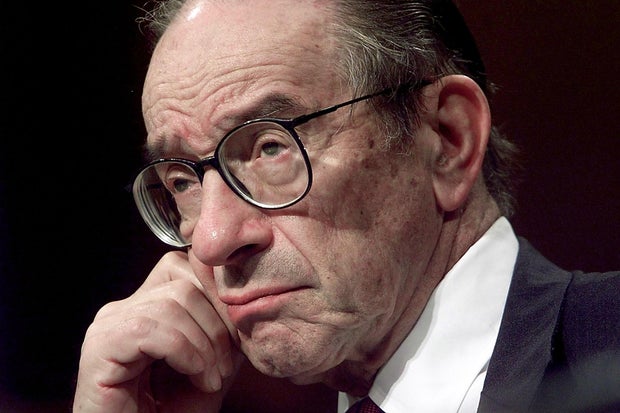
Alan Greenspan, esteemed economist and former chairman of the Federal Reserve, passed away at the age of 100. His wife, Andrea Mitchell, shared that Greenspan died at his home due to complications related to Parkinson’s Disease. Mitchell, an NBC News chief Washington and foreign affairs correspondent, provided this information in a statement.
Greenspan was one of the longest-serving chairmen in the history of the Federal Reserve. He held this influential position during a period known as the Great Moderation. From the mid-1980s until 2007, this era was characterized by low inflation, growth in the stock market, and overall economic stability. Despite this calm period, several financial crises marked his tenure. These included the stock market crash of 1987 and the bursting of the dot-com bubble in the early 2000s.
In 1996, Greenspan introduced the term “irrational exuberance” to capture the unbridled investor optimism leading to market bubbles, specifically in the tech sector. He left a significant and controversial legacy, connected by some to the 2008 global financial crisis, a major economic event that followed his chairmanship. Critics have argued that his “loose money” policies contributed to the subprime mortgage crisis, which precipitated the Great Recession, the most severe U.S. economic downturn since the Great Depression.
The Economist highlighted a primary criticism of Greenspan, describing him as a firm believer in market efficiency. Critics claim that he failed to identify and manage economic bubbles in the late 1990s and mid-2000s, leading to insufficient regulation of the financial sector. Greenspan, however, defended his record in a 2007 interview with Fortune Magazine. He said he was accused of “revisionist history” and insisted that he had raised concerns about potential risks in the housing market.
As a young economist, Greenspan did not consider human behavior critical in economic forecasting. However, he later acknowledged that human emotions, such as euphoria and distress, played an essential role in economics, shaping systemic activities.
One of Greenspan’s trademarks as Fed chair was his enigmatic economic commentary, which left lawmakers, economists, and investors eager to interpret his remarks. He also urged the Federal Reserve to shift towards greater transparency, arguing against surprising markets without purpose. In a 2009 Federal Reserve oral history, he remarked on the importance of predictability in market interactions.
Greenspan was born on March 6, 1926, in New York City. His parents, Herbert, a stockbroker, and Rose, a homemaker, divorced when he was five. This was partly due to the financial distress following the 1929 stock market crash. From a young age, Greenspan displayed exceptional mathematical ability. He progressed from studying music at Juilliard to earning degrees in economics from New York University, including a doctorate.
During his university years, Greenspan became influenced by Ayn Rand and participated in her “objectivist salon.” His career began at the National Industrial Conference Board, analyzing demand for metals. He later founded an economic consulting firm, Townsend-Greenspan & Co. Among his public service roles, he chaired the President’s Council of Economic Advisers under Gerald Ford and joined Ronald Reagan’s Economic Policy Advisory Board.
Appointed by Reagan in 1987, Greenspan served as Federal Reserve chairman through the terms of four presidents: George H.W. Bush, Bill Clinton, and George W. Bush. He retired from the Board in 2006. Greenspan married journalist Andrea Mitchell in 1997.
In an interview with Fortune Magazine, Greenspan revealed that while no president directly asked him to lower interest rates during his tenure, some hinted at it. He humorously noted that no politicians requested an increase in rates either.