
Sonia Monet Saxon often wakes up at 4 a.m. to the smell of burning asphalt. Her home in McKinley Park is so close to an asphalt plant that the odor makes it difficult to step outside on some days. Even before smoke from wildfires in Canada and Minnesota brought record levels of PM2.5 to the Chicago area, pollution was a constant issue in many neighborhoods.
A day before the intense smoke arrived, Saxon used zip ties to attach an air quality sensor to a railing in McKinley Park. This was her latest installation among about 15 others she has done in recent years. Her aim is to track pollution from the asphalt plant. “I love this neighborhood so much, but if you were here yesterday or the day before around this time, it would smell like burning asphalt,” she said. “It was almost unbearable to be outside.”
Chicago measures air quality through various methods, from affordable sensors like the one Saxon used to a sensor network established by the city and the University of Illinois Chicago (UIC). More advanced regulatory monitors exist, though they are more costly and complex to use.
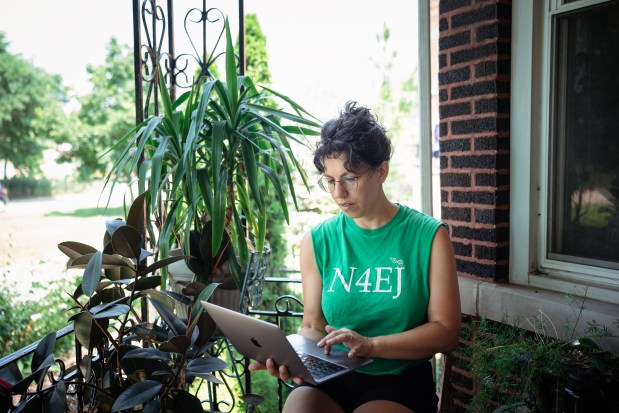
Sonia Monet Saxon, community science organizer at Neighbors for Environmental Justice, installs an air quality monitor at a home in McKinley Park neighborhood on July 15, 2026. (E. Jason Wambsgans/Chicago Tribune)
UIC professor Serap Erdal leads the Open Air Chicago project, which represents the second-largest air monitoring network worldwide after London. However, the sensors only measure fixed points throughout the city. According to studies, future satellite capabilities could close gaps in air monitoring where no coverage currently exists. Yet, some advocates argue this doesn’t address pollution’s root causes.
Neighborhood Air Sensors
Saxon, 39, is a community science organizer at Neighbors for Environmental Justice. Her focus is the MAT Asphalt plant in McKinley Park, criticized for its proximity to schools, public parks, and homes since opening in 2018. Saxon has installed PurpleAir sensors, which cost $289 each, funded in part by a UIC grant. These sensors publicly share data online, measuring fine particles known as PM2.5.
PM2.5 particles come from factories, power plants, vehicles, fireplaces, and wildfires. They pose health risks and can be deadly.
The sensor installed by Saxon on July 15 initially showed a PM2.5 level of 58, rising to 71 in two minutes. Although within acceptable limits according to PurpleAir, prolonged exposure poses risks, especially to sensitive individuals. When wildfire smoke increased PM2.5 levels to 595 on July 16, AirNow reported similar readings, marking the air as hazardous to everyone.
In September, Chicago and UIC completed installing sensors for Open Air Chicago. These solar-powered units are on light poles across the city, with more placed in neighborhoods suffering heavier pollution, identified by the Chicago Environmental Justice Index. Thirteen groups, including Neighbors for Environmental Justice, chose sensor locations, often near daycares, schools, and hospitals.
Angela Tovar, chief sustainability officer, noted the sensors don’t enforce regulations but provide residents with real-time air quality information.
Tovar highlighted that while sensors inform officials about pollution trends, they aren’t used for enforcement but could guide future strategies. Residents can check local air quality through the Open Air Chicago map, with sensor data and educational content launching soon.
Within Legal Limits
Even with Open Air Chicago, Neighbors for Environmental Justice members still put up their air sensors. These sensors predate the city’s and address gaps due to their wider installation. Displaying air quality data locally helps make pollution feel tangible.
The link between asphalt plants and air pollution in Chicago is documented. However, zoning and planning laws often facilitate developments in low-income, minority communities.
Pipes that connect silos at the MAT Asphalt plant are visible from the 2000 block of West Pershing Road, overlooking McKinley Park. (John J. Kim/Chicago Tribune)
MAT Asphalt’s manager, Joe Haughey, often receives odor complaints. While testing shows emissions are below permitted levels, he believes complaints are arbitrary and hard to verify.
Truck Traffic
Significant air pollution also comes from truck traffic in industrial corridors. Residents in areas like Little Village and Elwood have organized against increasing diesel emissions from warehouse developments. A state bill aiming to set emission targets and buffer zones between warehouses and neighborhoods didn’t advance.
Baltazar Enriquez, head of the Little Village Community Council, highlights efforts to improve local air quality and prevent health issues in children.
Enriquez mentioned existing PurpleAir sensors but noted their limitations due to weather and calibration issues. He calls for a more effective monitor.
Sensors vs. Monitors
Chicago has six federal air monitoring sites featuring sophisticated “regulatory monitors.” These need skilled personnel for operation and interpretation and serve to assess compliance with federal standards, unlike community sensors.
Zac Adelman of the Lake Michigan Air Directors Consortium confirms the high cost of regulatory monitors makes cheaper sensors appealing, despite their limitations and vulnerability to environmental conditions.
An air quality monitoring website shows multiple sensors collecting data in McKinley Park. (E. Jason Wambsgans/Chicago Tribune)
Publicly available sensors could be positioned anywhere, affecting readings, according to Adelman. Satellite data presents an option to cover gaps in monitoring.
Satellite Tracking
Many U.S. counties lack regulatory monitors. Kevin Stewart from the American Lung Association points out this issue and suggests satellites might fill monitoring gaps by gathering data from above and calculating PM2.5 levels.
Although satellites cover large areas, interpreting data poses challenges due to environmental reflections and conditions. Satellite imaging could eventually complement various existing air monitoring methods to enhance air quality oversight.
As Saxon’s sensor recorded increasing pollution levels on July 16, McKinley Park residents were reminded of ongoing air quality concerns. Many hope for change through city involvement.