
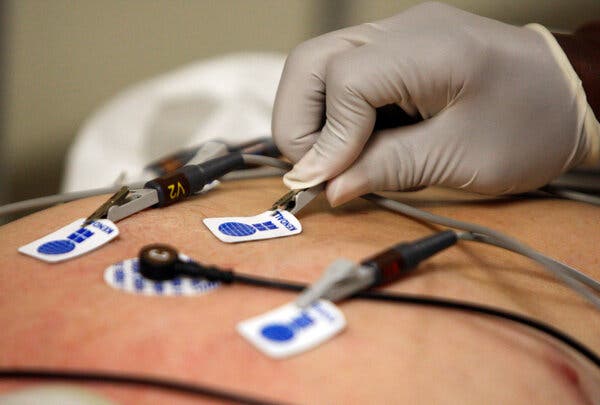
Artificial intelligence is revolutionizing patient care by identifying patterns in medical data that often go unnoticed by human practitioners. One AI program is about to become widely available, free of charge, to assist doctors in diagnosing heart-related issues.
In a clinical trial, an AI program detected signs of severe heart damage in the electrocardiogram (ECG) of a 45-year-old patient. This technology most likely saved the life of Louie Quiros, a caregiver and security guard.
Mr. Quiros arrived at an emergency room in Queens in February 2025. He had been experiencing bloody coughs and severe breathlessness for several days. Despite a rapid heartbeat and difficulty breathing, a chest X-ray did not reveal any issues. His ECG was abnormal but inconclusive, hinting at coronary heart disease, which is uncommon at his age. However, this was not the root of his problem.
Doctors discovered Mr. Quiros had been exposed to wildfire smoke during a recent trip to California. They prescribed asthma medication and an inhaler, temporarily alleviating his symptoms.
Fortunately, Mr. Quiros visited a hospital within the NewYork-Presbyterian medical system. Researchers there are employing an AI program known as EchoNext. This program analyzes ECGs to spot heart damage patterns that humans might miss.
This initiative is part of a clinical trial aimed at assessing the AI program. Developed by Dr. Pierre Elias and his team at NewYork-Presbyterian and Columbia University Irving Medical Center, EchoNext evaluates nearly half a million ECGs annually. Dr. Elias has founded Pathway Labs, a company to further this technology.
EchoNext identified signs of significant heart damage in Mr. Quiros’s ECG. Consequently, the hospital called him back a week later for an echocardiogram, which revealed severe issues. His heart was ejecting only 10 percent of its blood per contraction, and his mitral valve was leaking. This early diagnosis was crucial in addressing his condition effectively.