
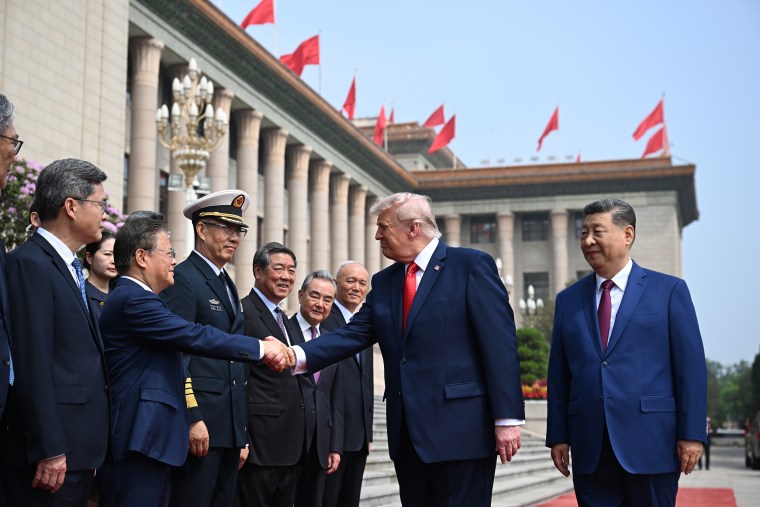
President Donald Trump’s visit to China aimed to build a strong foundation with Chinese leader Xi Jinping. The discussions were framed by various agreements and commitments, though some pressing issues remain unresolved and could affect future relations.
Trade Agreements
The White House released details of several key agreements from the visit. China committed to purchasing at least $17 billion annually in U.S. agricultural goods through 2028. A deal for Boeing planes was also made, although smaller than anticipated, disappointing market expectations. Additionally, China is reopening its market to U.S. beef and restoring poultry imports from bird flu-free U.S. states.
Both countries are establishing mechanisms to address trade and investment. China agreed to reconsider U.S. concerns over its export controls on rare earth elements critical to technology and weapons. However, China’s immediate confirmation of these agreements was not made available.
Political and Economic Implications
Experts describe the summit as emphasizing the personal interaction between Trump and Xi rather than the specific deals. Notably, an agreement was reached to build a ‘constructive relationship of strategic stability’. This description signals a potential framing for future relations during Trump’s term.
China’s economic strategy was displayed with its U.S. purchasing commitments, notably ordering 200 Boeing planes coupled with ensuring access to American-made jet engines and parts.
Future Cooperation
A key takeaway was the establishment of a board of trade and investment, designed to manage trade by potentially reducing tariffs on approximately $30 billion in non-sensitive goods.
Despite this positive framework, concerns remain about Chinese investment prospects in the U.S. A proposed factory in New Hampshire by China’s largest bottled water company, Nongfu Spring, faces national security debates, underscoring the challenges of investment dialogue.
Geopolitical Challenges
Discussions on Taiwan and Iran, two major geopolitical issues, were less clear. There was no U.S. mention of Taiwan in their readout, while the Chinese readout omitted Iran references. China seeks concessions on Taiwan, yet the U.S. policy remains unchanged, as clarified by Trump.
On Iran, Trump and Xi aligned against Iran’s measures affecting the Strait of Hormuz, a vital trade passage. Both oppose Iran’s pursuit of nuclear capabilities, although Beijing remains critical of the conflict in Iran.
Looking Ahead
The dialogue is set to continue with Xi’s confirmed visit to Washington. This meeting, planned for September 24, is seen as stabilizing for bilateral relations. However, ongoing issues like cyberattacks and regional interests, like Venezuela and Cuba, present challenges.
Xi’s positioning with the United States has evolved, portraying a sense of equality in global stature. Trump, however, positioned his approach as needing Xi more, evidenced by his pronounced praise for Xi.