
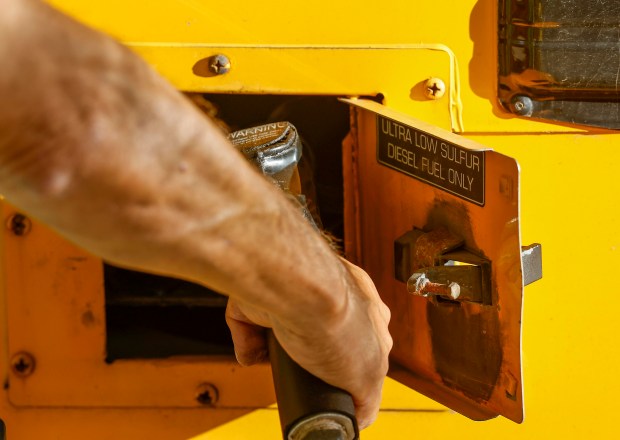
Suburban school districts, especially those with their own bus fleets, face challenges due to high diesel costs this fall. Concerns over global supply, exacerbated by conflicts in Iran and Ukraine and issues like the Sept. 13 power outage at the ExxonMobil refinery in Joliet, have pushed diesel prices in Illinois to record levels. On Sept. 23, diesel reached an average of $6.83 per gallon, according to AAA. As of Thursday, prices have decreased slightly to $6.58 per gallon.
Impact on Naperville Unit District 203
Naperville Unit District 203 operates over 120 diesel school buses, serving around 16,000 students. The district expects an increase of $300,000 in fuel costs for the 2026-27 school year if diesel prices remain high, stated Lisa Xagas, assistant superintendent of strategy and engagement. Xagas highlighted that bus route optimization has already saved the district 900 miles per day, reducing potential higher costs.
“We are closely monitoring diesel prices and assessing the impact,” Xagas commented. “We have not yet considered cutting field trips or transportation for events, and hope not to reach that point.”
Naperville 203 allocated $15.6 million for transportation in its 2026-27 budget, making up 4.2% of its total budget of over $370 million. Despite reserve funds available for short-term coverage, the district faces a budget deficit of $3.9 million due to declining enrollment. If diesel prices remain elevated, tough decisions are expected during the 2027-28 budget planning, starting in April. Currently, there are no plans to add non-diesel buses as the district awaits an order for electric buses.
Challenges for Elgin Area School District U-46
Serving over 33,000 students with 331 diesel-powered buses, Elgin Area School District U-46 is also in the assessment phase regarding diesel price stabilization. The district’s fuel budget for the 2027 fiscal year is set at $2.6 million. While U-46 has not yet determined the budget impact of rising diesel costs, transportation director Marcy Murphy noted evaluations of alternative fuels like electric and natural-gas buses.
Transition to Alternative Fuels in District 211
Palatine-Schaumburg Township High School District 211 shifted from diesel to propane before the 2018-19 school year. Their roughly 200-vehicle fleet now includes 80 propane-fueled buses. Lauren Hummel, Chief Operating Officer, reported propane costs of $1.15 to $1.40 per gallon, about $5 less than diesel. Benefits of propane include improved reliability in cold weather and reduced noise.
District 211 evaluated electric bus options but chose propane due to high electric bus costs and reliability concerns in cold weather. According to a 2019 market study by Atlas Public Policy, new propane buses cost $110,000 to $115,000, compared to $300,000 to $440,000 for electric buses.
Efforts in St. Charles Community Unit District 303
St. Charles Community Unit District 303 began switching from diesel to gasoline-powered buses around the same time as District 211’s shift. The district now operates only 12 diesel buses, roughly 10% of their fleet. Transportation Director Deborah Mason mentioned adjustments like not using diesel buses for long trips in response to rising costs.
“We aim to not impact service or safety standards while managing costs,” Mason emphasized.
Potential postponement of nonessential transportation expenses may occur if high diesel prices persist.
Environmental Considerations and Programs
Susan Mudd from the Environmental Law & Policy Center advocates for electric buses, citing long-term savings and environmental benefits despite higher upfront costs. The EPA’s Clean School Bus Program has provided $2.6 billion to over 1,100 districts for bus replacements with lower-emission options since 2021. ComEd’s Energy Affordability Program also supports transitioning costs.
District 211 has benefited from federal grants to aid the propane transition but Naperville 203 faces funding gaps due to insufficient state reimbursements. State law requires 80% of transportation costs be reimbursed by the Illinois State Board of Education, yet Naperville 203 received $2.3 million less in 2026 and a total of $8.4 million less over five years.
Future Outlook
Patrick De Haan from GasBuddy suggests diesel prices might fall slightly soon as the ExxonMobil plant’s resumption could aid in price stabilization. Significant relief depends largely on international political developments involving the U.S., Ukraine, and Iran. Changes in tensions may lead to tangible price reductions.