
Understanding Splitter’s Vision
Throughout the summer, Tiago Splitter has been preparing his system for the Chicago Bulls, focusing on practicality and simplicity. The approach targets the development of young players like Caleb Wilson. Splitter aims to enhance their transition into the NBA’s fast-paced game.
Offensive Rebounding Strategy
Last season, the Bulls ranked 23rd in offensive rebounding. Splitter’s previous team, Portland Trail Blazers, excelled, ranking second in this area. The Blazers led the league in second-chance scoring, averaging 18.5 points per game. Splitter plans to replicate this emphasis on offensive rebounding in Chicago.
Tre Jones stated, “We’re trying to get everyone on the same page… instead of it just being a couple guys… it’s everybody trying to go in some way or shape.”
Centers Nic Claxton, Zach Collins, and Tobe Awaka were absent during preseason, limiting the execution of this strategy. Awaka is a key player expected to contribute significantly upon his return.
All players, including guards, are encouraged to pursue offensive rebounds, accepting some risk to achieve greater rewards. Analytics support the tactic, suggesting more possessions lead to increased scoring opportunities.
Defensive Mindset
The Bulls are focusing on defensive pressure, aiming to disrupt opponents with high perimeter pressure. Historically, they lacked a rim protector, a role Claxton is expected to fill.
The strategy involves versatile switching, leveraging the length and mobility of their frontcourt. Players like Claxton and Matas Buzelis are trained for multidimensional roles, though younger players face challenges in adapting.
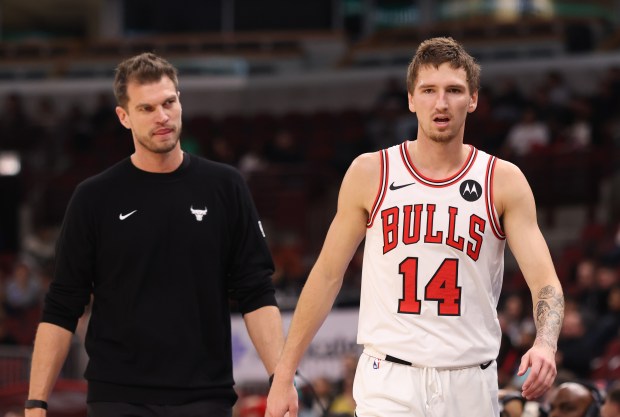
Buzelis prepares to head to the bench, guided by Splitter in a preseason game against the Grizzlies on Oct. 9, 2026, at the United Center.
Wilson is learning the defensive approach, specifically screen navigation. His focus is on positioning and physicality, acknowledging the learning curve as a rookie.
Game Management and Rules
Splitter emphasizes “small rules” that govern plays, simplifying decision-making for young players. The approach balances structured play and organic, fast-paced basketball.
The system permits experimentation, fostering growth and adaptation. Splitter’s vision encourages understanding rather than rigid playbook dependence.
“When you call a play… that’s slower, that’s after a free throw, after a dead ball.” Splitter noted, highlighting the contrast with random, transitional plays.
As the season progresses, Splitter expects to refine the system, adapting to the team’s evolving strengths and challenges.