
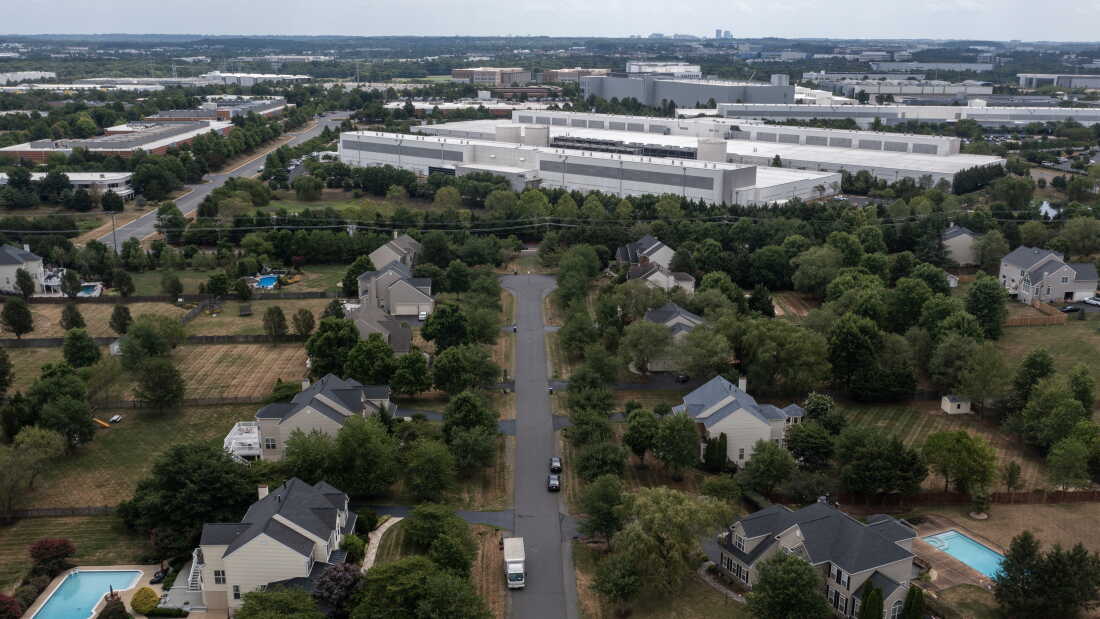
The expansion of data centers in the United States is raising questions about their impact on the housing market. An aerial view from Ashburn, VA, dated July 17, 2024, shows data centers near a neighborhood. Ashburn is part of Northern Virginia, home to nearly 19% of the country’s data centers.
The National Association of Realtors (NAR) has responded by commissioning a study to assess these effects. The study reveals that while some counties see economic growth, others face energy supply challenges due to data centers. Nadia Evangelou, principal economist with NAR, explains the variety in data center categories and their differing impacts.
These facilities are crucial for internet services, from AI to simple web searches. Their growth is evident in places like residential neighborhoods. The NAR overlayed data from 1,500 data centers, property values, home sales rates, demographics, and realtor surveys.
Data centers are concentrated in just 1% of the country. Northern Virginia, Silicon Valley, Phoenix, Central Ohio, and Grant County, Washington, are major locations. Each area has distinct economies and markets, with no single pattern explaining the data centers’ influence on home values, employment, and electricity rates.
Northern Virginia alone houses 319 data centers. In contrast, Louisiana has only one. Despite data center growth, housing markets in these areas remain robust with high income levels.
The study highlights how housing markets begin to feel the effects of data centers even before construction concludes. Abilene, Texas, illustrates this with its Stargate Project. This $500 billion project spans roughly 4 million square feet and is operated by Oracle for OpenAI. Completion is expected by 2026.
Steve Stovall, a local realtor, notes that worker influx boosts revenue and infrastructure but strains the residential market. Home shortages lead to increased prices and many properties becoming short-term rentals.
The median home price in Abilene has jumped to about $342,000 from $250,000 over six years. Predicting further impacts of projects like Stargate is difficult, but energy and environmental concerns are rising among residents. Two more significant data centers are planned around Abilene, promising further real estate implications.
Because data center construction is dynamic, Evangelou stresses the need for ongoing updates to the study. The NAR aims to release a revision within six months to track these changes.