
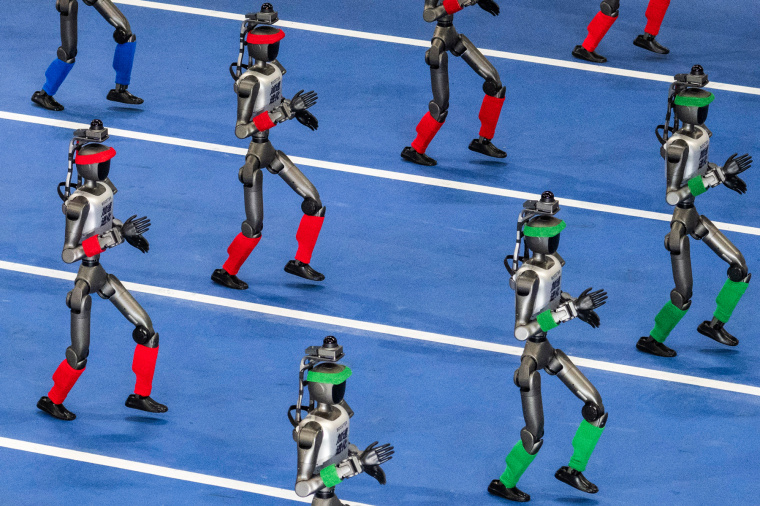
China has unveiled humanoid robots that can outpace the quickest humans. The crucial question now is whether these robots can effectively manage packaging and warehouse tasks while performing precision operations such as connecting cables. These tasks are part of testing their abilities to handle less glamorous but essential jobs.
The World Humanoid Robot Games, a five-day event that started in Beijing, aim to challenge these robots in multiple scenarios. The event combines human sports-inspired events with simulations of factory work, restaurant duties, office responsibilities, and emergency responses. The Chinese state media has been actively promoting the event, showcasing 51 activities, consisting of 30 sports competitions and 21 scenario-based tests. According to Huawei, a partner in the event, over 40% of these events demand full robot autonomy.
During the competition, two robots exceeded Usain Bolt’s world record of 9.58 seconds in the 100-meter sprint. This marks substantial progress from 2025 when the fastest robot took over 20 seconds. A challenging aspect was braking, as robots had to halt by hitting a thick mat placed beyond the finish line.
Furthermore, another humanoid robot, identical to the 100-meter sprint winner, completed a 400-meter run in 39.7 seconds, surpassing South African Wayde van Niekerk’s record of 43.03 seconds. According to Xu Qiaosheng, a spectator and robotics investor, the event’s heightened intensity significantly tests the robots’ battery management and heat dissipation capabilities. Xu emphasized the significance of these developments for China’s industrial sector.
The games feature robots in tug-of-war and weightlifting. Traditional Chinese sports like Tai Chi and pitch-pot, where competitors throw arrow-like sticks into a narrow vase, introduce a futuristic element.
The more informative tests involve robots addressing real-world physical imperfections. Tasks such as handling cables at awkward angles, fetching out-of-reach objects, managing shifting packages, or recovering from missteps offer challenges. These tasks assess the robots’ ability to identify objects, correctly position themselves, apply the right force, and rectify errors without human help.
Yu Chao, Lumos Robotics Chief Executive, believes the games can enhance hardware and showcase the robotics sector. Yu asserts that real value stems from solving actual problems rather than merely demonstrating mobility capabilities.
Apart from traditional sports events, robots will tackle EV charging, restaurant service, emergency response tasks, and hand-dexterity challenges. Industrial assembly and material handling events will also be part of the competition, with a cable connection challenge testing vision, mechanical alignment, and force application.
Galbot, a robotics startup in Beijing, plans to conduct a tennis match featuring autonomous humanoids. These robots will try singles and doubles formats, including ball tracking, serving, and returning shots.
Hua Rong, the chief marketing officer at Zeroth, a robotics company, stated the true test lies beyond the games. As she explained, the key measure is whether these robots can genuinely address users’ problems post-sale.