
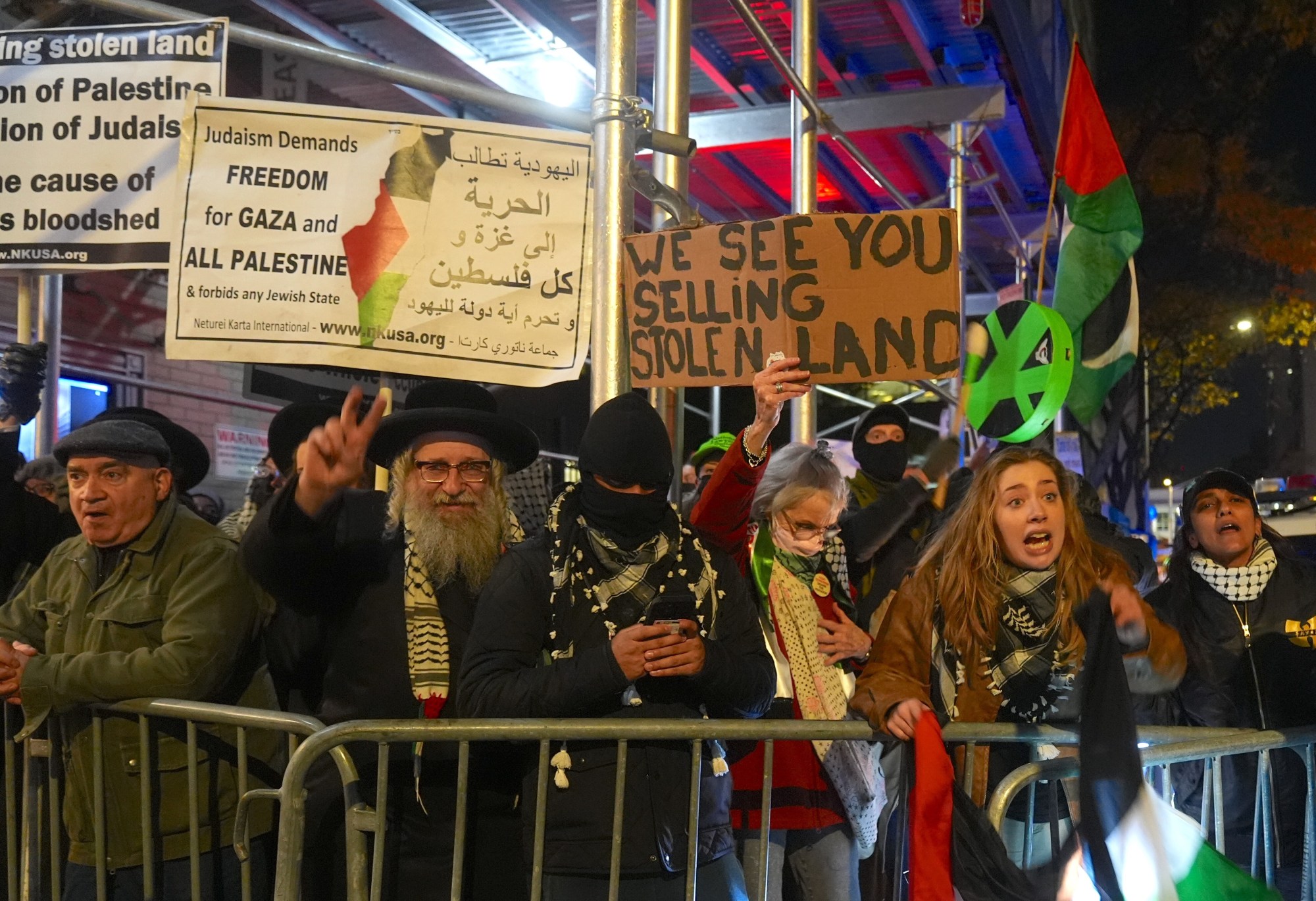
Recent events highlight a troubling pattern of harassment against places of worship in the United States. On November 19, 2025, in New York City, pro-Palestinian protesters gathered outside Park East Synagogue during a settler-recruitment event, organized by Nefesh B’nefesh, which assists American Jews in immigrating to Israel. The demonstrators shouted phrases such as ‘Intifada revolution’ and ‘Death to the IDF,’ as Jewish counter-protesters responded with insults and noise.
Synagogues across America face repeated attacks. The Central Synagogue in New York City was disrupted by a violent assault during Kabbalat Shabbat services, and the Park East Synagogue in Manhattan witnessed approximately 200 protesters chanting antisemitic slurs and threats. In May, demonstrators returned to the same synagogue, brandishing a Hezbollah flag and screaming offensive terms at Jewish attendees.
This issue is not confined to New York. In Los Angeles, similarly masked protesters shouted derogatory remarks at Wilshire Boulevard Temple, leading to arrests for battery and property destruction. These are not isolated events; they signify a dangerous escalation threatening the right to worship freely and safely.
The Anti-Defamation League (ADL) reports that in 2025, protest-related antisemitic incidents totaled in the dozens, with nearly 530 harassment incidents at synagogues across the country. While there’s a decrease in overall antisemitic occurrences since last year, physical assaults reached unprecedented levels. The problem extends beyond the Jewish community. An LDS church was burned in Michigan, and a San Diego mosque saw tragic deaths of individuals protecting students and worshipers.
In response to these challenges, the ADL has contributed to the bipartisan Right to Worship Act, backed by Senators Ted Cruz and Elissa Slotkin, and Representatives Tom Suozzi and Brad Knott. This legislation aims to create a 100-foot safe access zone around religious sites, prohibiting disruptive conduct. It underscores two core American ideals: religious freedom and free speech. Peaceful protests and protected speech under the First Amendment remain safeguarded, while ensuring congregants can attend services without interference.
Current federal protections insufficiently address non-violent actions meant to intimidate or obstruct worshippers. The Right to Worship Act leverages state and local momentum, with successful advocacy leading to safe worship zone laws in places like New York, Maryland, and Arizona. New York City’s Council recently passed buffer zone legislation, and efforts continue in states like California and Pennsylvania.
Support for these measures is strikingly high. Surveys indicate that 70 percent of New York voters support buffer zones. This transcends partisan divides, with substantial backing from Democrats, Republicans, and independents, as well as strong support across Jewish, Muslim, and Christian communities.
The message is clear: the right to worship without fear is fundamentally an American concern, not specific to any single faith. Congress faces a clear decision: whether to shield worshippers from intimidation or reaffirm religious freedom as a democratic cornerstone. Although state efforts contribute significantly, comprehensive federal legislation is vital for consistent nationwide protection.
The Right to Worship Act complements existing laws by filling key gaps and securing the constitutional right to worship freely.
Jonathan Greenblatt, CEO and National Director of the ADL, argues for immediate federal action to ensure safety and uphold religious freedom in America.
Copyright 2026 Nexstar Media Inc. All rights reserved. This material may not be published, broadcast, rewritten, or redistributed.