
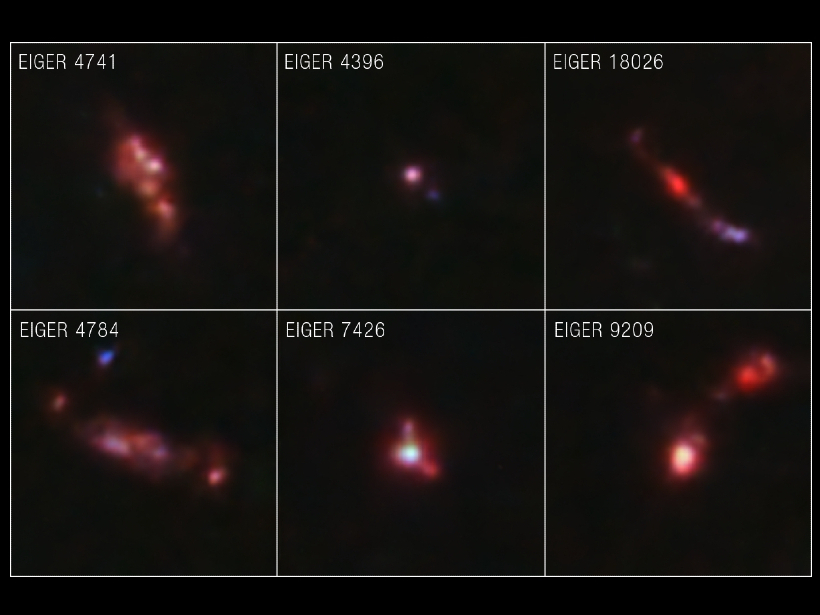
The James Webb Space Telescope, since its launch, has captured detailed images and spectra of galaxies from when the universe was approximately 900 million years old. This has marked the beginning of a new era in astrophysics. Astronomers are now able to study farthest and earliest galaxies ever observed.
Jorge Moreno, an associate professor of astronomy at Pomona College, compares this exploration to paleontology, stating, “If you were a paleontologist, you would dig deeper and deeper to find the oldest bones. In astronomy, what we do is look at our history.” Studying past cosmic events doesn’t require a time machine but rather observing distant objects to look back in time.
Scientists have found that galaxies appeared much earlier in cosmic history than previously anticipated, prompting both excitement and puzzlement among astronomers worldwide. The James Webb Space Telescope has revealed galaxies forming 200-500 million years post-Big Bang, with sizes and brightness previously unforeseen.
The Journey of Light to the Telescope
The telescope reveals some of the earliest galaxies by detecting faint light they emit, which reaches the telescope in the infrared range, invisible to the naked eye. The electromagnetic spectrum encompasses more than just visible light. As the universe expands, cosmological redshift causes light’s wavelength to elongate as it travels through space.
This light’s journey is lengthy. For context, it takes light about eight minutes to travel from the sun to Earth. However, light from Proxima Centauri, the nearest stellar neighbor, takes over four years to reach us.
Galaxies Beyond Expectations
Light allows us to study these galaxies, though it also presents unexpected complications. The brightness of galaxies, often linked to mass, suggests they contain many stars. Yet the modeling indicates insufficient time for galaxies to reach such mass in the period observed. Moreno describes it as seeing “a teenager when you expect a kindergartener.” Assumptions linking brightness to mass might be flawed.
There could be alternative explanations. A supermassive black hole with bright accretion disks or energy jets could make galaxies seem denser. Hot dust within galaxies visible in the infrared might also inflate estimates of their mass.
Structured and Bright Galaxies
Most galaxies are classified as spiral or elliptical based on their structure. Early universe galaxies were expected to be undeveloped blobs. However, astronomers now study galaxies that resemble highly structured ones found locally. This discovery challenges previous notions and enthuses researchers.
The advanced structure and brightness of these galaxies lead some astrophysicists to reconsider the universe’s age. A recent hypothesis suggests the universe might be twice as old, at 26.7 billion years, as previously believed. This came from combining two models; however, the idea remains unsupported by strong evidence.
Moreno advises caution in adopting this theory. If the universe were older than 13.8 billion years, evidence through direct observation of older stars and galaxies would exist. No such evidence has been found.
Reflecting on Cosmic Insights
As NASA continues to receive data from the James Webb Space Telescope, new possibilities and insights arise. Moreno stresses the importance of reflection in science, noting that galaxies often alternate between brightness and dimming. “I think that’s something we need to learn from them,” he says. Reflecting and pacing ourselves is crucial to understanding these cosmic revelations.