
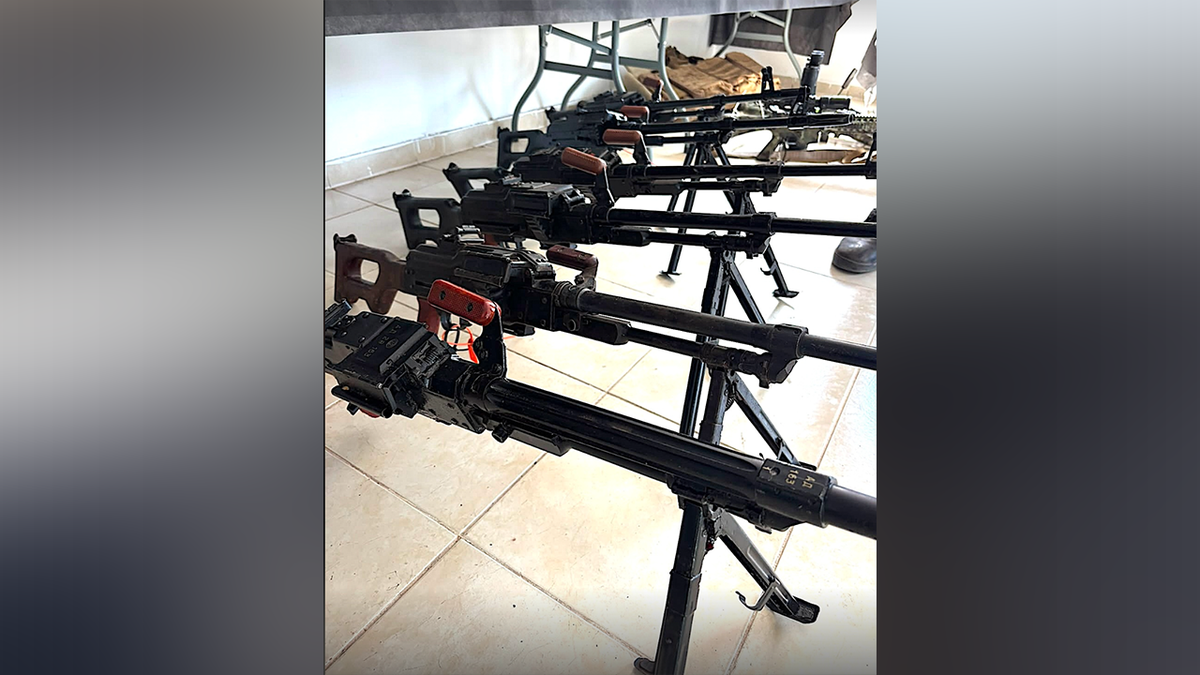
Fox News Digital was granted exclusive access to Israel Defense Forces (IDF) Tzrifin Base, located in central Israel, where an impressive array of confiscated weapons used by Hezbollah and Hamas is stored. This collection includes rockets, grenades, drones, sniper rifles, automated weapons, anti-tank rocket launchers, and mortars, among other military equipment.
These captured weapons originate from various countries, including Iran, Russia, China, Lebanon, and Gaza. They were utilized by Hamas and Hezbollah against Israeli civilians and the IDF following Hamas’s attack on southern Israel on October 7, 2023. Additionally, Hezbollah reportedly targeted Lebanese civilians with these arms.
Despite their designation as terrorist organizations by the U.S., Hamas and Hezbollah form part of Iran’s “axis of resistance.” These groups have reportedly been responsible for the deaths of over 300 American citizens.
“WE WANT LAND INVASION”: IRAN MOUTHPIECE TOUTS NEW MISSILE, BOASTS DECADES OF WAR PREP
During the peak of the conflict, Israel faced a multi-front war against Iran and its proxies. Iranian rockets scattered outside the weapons storage facility at Tzrifin, offering journalists a firsthand look. Tehran launched rockets into civilian areas, including major cities like Tel Aviv and Be’ersheva.
In late February, following a joint U.S.-Israeli attack on Iran, the Islamic Republic fired a ballistic missile into Beersheba, injuring 19 people. A Nazi-era MG-34 machine gun was among the confiscated weapons, found at a Hezbollah terrorist compound in Lebanon. It bears a small swastika emblem, which is a familiar exercise in weapons identification for Israeli military personnel.
Lt. Col. (res.) Idan Sharon-Kettler, commander of the Captured Equipment Evacuation Unit, stated the German MG-34 features “an eagle carrying a swastika stamped on it.” This Nazi machine gun was reportedly used by Iranian regime-backed terrorists in Lebanon as “propaganda or for morale.”
An additional Nazi-era assault rifle, the MP 44 (or StG 44), was seized from Hezbollah. Both Hamas and Hezbollah have employed sophisticated methods to transform vehicles into offensive weapons. These include dual-use technology, which serves civilian and military purposes.
An Egyptian Halawa Motors motorcycle was captured in Israel on October 7, and these motorcycles were used to take Israeli hostages. The IDF estimates that over 1,200 people were killed on October 7, including more than 40 American citizens, and over 250 hostages were taken.
HAMAS SAYS IT WILL DISSOLVE GAZA GOVERNMENT, BUT ISRAEL WARNS GROUP STILL SEEKS HEZBOLLAH-STYLE CONTROL
Additionally, Palestinian Islamic Jihad rockets used as “propaganda dummies” during Gaza parades were captured. The IDF seized all-terrain vehicles (ATVs) from Hezbollah in Lebanon, designed to carry multiple rockets and terrorists.
One ATV held six rockets with launchers, enabling control of strategic roads. Sharon-Kettler claims these vehicles offer significant utility for Hezbollah in southern Lebanon’s terrain.
The IDF also displayed Iranian-produced mortars. “We found hundreds” within Lebanon, Sharon-Kettler noted. Drones captured from Hezbollah include “decay drones” meant to distract IDF resources.
Several Iranian regime-produced canons were confiscated from south Lebanese villages, often stationed in windows of houses. Some captured cannons originate from Russia.
Sharon-Kettler explained the IDF’s presence in Lebanon, citing the need to clear military threats targeting civilians. This task continued despite a ceasefire agreement between Lebanon and Israel, reached in November 2024.
Hezbollah joined Hamas in the conflict against Israel on October 8, 2023. Despite a U.S.-led effort for Lebanon’s government to disarm Hezbollah and stage an IDF withdrawal from southern Lebanon, challenges remain.
An image of Iran’s late Supreme Leader Ali Khamenei and new Supreme Leader Mojtaba Khamenei, with missile replicas during a gathering in Tehran, Iran.
A State Department official recently expressed optimism regarding talks scheduled for September in Rome. The official acknowledged the difficulties, stating that Hezbollah is attempting to sabotage the process. Despite domestic political stress in Israel and Lebanon, direct communication and generated options represent a “structural change.”