
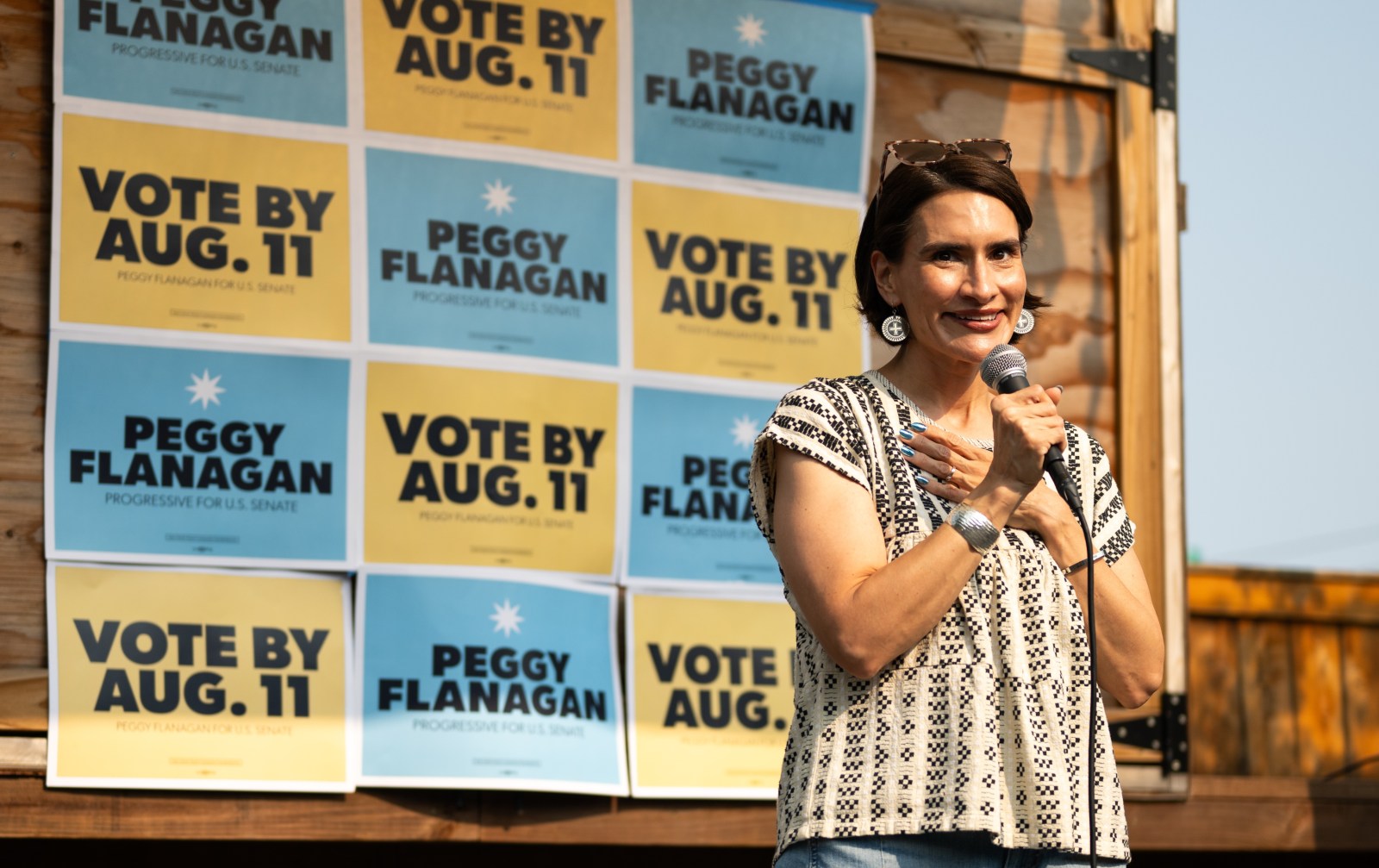
Minnesota Democrats have prioritized organizing and a message of change, overshadowing traditional advertising and allegiance to party institutions. In the race to succeed Tina Smith as the Democratic choice for the U.S. Senate, Lieutenant Governor Peggy Flanagan triumphed over Representative Angie Craig with 59 percent of the vote compared to Craig’s 39.4 percent, with 99 percent of the votes counted.
Flanagan effectively used her stance against Israel’s actions in Gaza and her refusal to accept corporate PAC money to portray Craig as a candidate entrenched in the Washington establishment, lacking the connection with voters’ desires. Craig raised $12.6 million, according to Open Secrets, while Flanagan raised $6.4 million. Notable supporters for Craig included House Minority Leader Hakeem Jeffries and former House Speaker Nancy Pelosi, whereas Flanagan had endorsements from Senators Elizabeth Warren and Bernie Sanders.
“Not taking corporate PAC money was one of the easiest decisions I’ve ever made,” Flanagan told Newsweek. “But what I also knew is that meant we had to hustle a little bit more. We needed a strong ground game.”
Craig spent $9.6 million on ads, according to AdImpact, while Flanagan spent $1.9 million. Instead of major ad spending, Flanagan invested in organizing, holding over 300 events in 112 communities across Minnesota as part of two statewide tours. In these events, she promoted policies like Medicare for All, raising the national minimum wage, and advocating for universal childcare.
This approach generated early momentum, drawing 40,000 people to the Minnesota Democratic-Farmer-Labor (DFL) Party state precinct caucuses. These caucuses select delegates for conventions that determine party endorsements. The energy from February’s precinct caucus continued into the May DFL convention, where she secured the affiliate’s endorsement.
“We had 30,000 doors knocked the weekend before the race, and many of those people knocking said to me they had never volunteered on a campaign prior to that day,” Flanagan said, emphasizing her campaign as one contrasting the many versus the money.
Flanagan will campaign against former sportscaster Michele Tafoya, the Republican Senate nominee. Although Tafoya didn’t respond for comment, her team released a statement: “This isn’t about red versus blue. It’s common sense versus crazy. We will not reelect politicians who let criminals steal billions and treat accountability as optional. We deserve better, and it’s time we demand better.”
Flanagan anticipates the GOP and corporate allies will support Tafoya, making her anti-PAC message relevant. She aims to continue promoting the economic populism of her primary campaign. While she criticized Craig for aligning with House Republicans, her general election strategy will target an anti-President Donald Trump stance, labeling Tafoya as a likely “Yes Sir Mr. President’ senator.”
The Cook Political Report rates this race as “Likely D.” Minnesota has not voted for a Republican presidential candidate since 1972, demonstrating strong Democratic support.
If elected, Flanagan plans to join progressive Democratic senators, known as “The Fight Club,” to push the Senate left. One of her first tasks would be voting for a Senate leader, and she has not committed to supporting current Democratic leader Chuck Schumer.
Flanagan plans to organize “99 coffees” upon arrival in D.C., aiming to foster relationships with Republicans. She sees common ground with progressives on scrutinizing institutions and large businesses. Flanagan is hopeful that collaboration with Republicans supportive of progressive agendas will drive constructive changes.
“We have folks who are getting elected who represent people and not corporations or special interests,” she said. “I think that is the wave of elections that you’ve seen across the country. People are done with the status quo, are ready for fighters.”