
Horror films have often served as reflections of societal issues, such as ‘Get Out’ in 2017, which addressed racism. Recently, Curry Barker’s ‘Obsession’ tackled male entitlement. Yet, the ‘final girl’—the last woman standing to face the killer—rarely gets her own redemption arc. This changes with Jane Schoenbrun’s film ‘Teenage Sex and Death at Camp Miasma.’
Hannah Einbinder, who stars in the film, spoke to Newsweek about the project’s unique approach. ‘The genre ambiguity and its empowering twist on horror slasher tropes intrigued me,’ she shared. ‘I hadn’t seen anything like this before.’
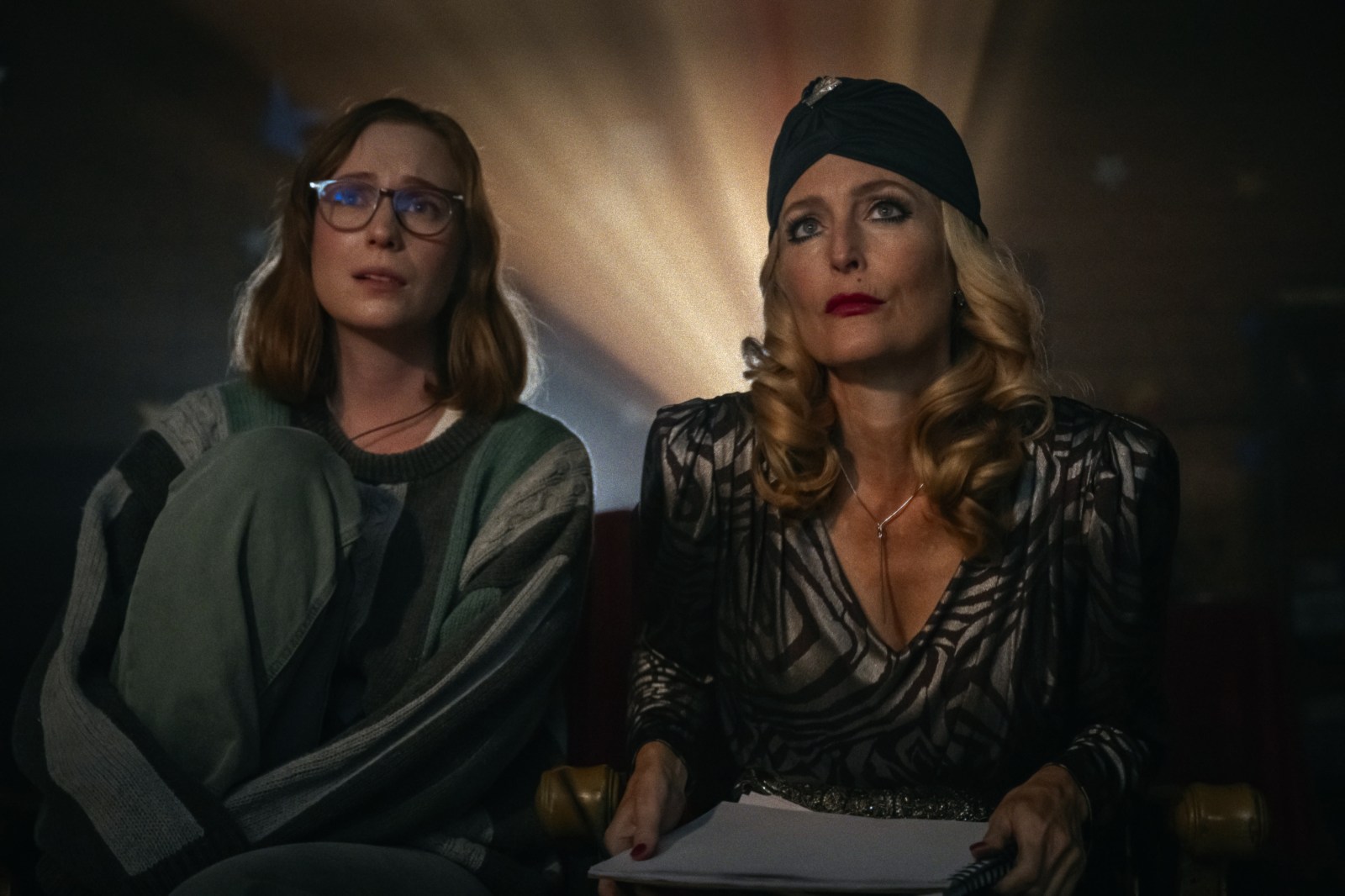
In ‘Teenage Sex and Death at Camp Miasma,’ Einbinder plays Kris, a director aiming to revive a famous slasher series by casting the original film’s ‘final girl,’ Billy Wilder, played by Gillian Anderson. Kris is determined to reshape the narrative of a male-driven series through Billy’s character. As Kris persuades Billy to join the project, the actress and director embark on a psychosexual journey, creating a distinctive film experience.
Gillian Anderson remarked on the profound impact of the film during production. ‘The set and design were created with such detail for the audience. The meta aspect of it was unexpected, even after reading the script,’ she said. Anderson believes the film speaks to diverse audiences, fostering unity and potentially leading to greater compassion among different groups.
Traditionally, horror narratives were dominated by men. However, recent films like ‘A Girl Walks Home Alone at Night’ (2014), ‘The Babadook’ (2014), and ‘The Substance’ (2024) have shown the genre expanding to include new perspectives. ‘Camp Miasma’ continues this trend, weaving a queer, female-led story into the familiar horror framework. Einbinder points out, ‘Knowing that this is personal for Jane, and all their films are, really stood out.’
Anderson’s character, Billy, mirrors the role of Norma Desmond from ‘Sunset Boulevard.’ Both characters face exclusion from their industries due to aging. In a twist, ‘Camp Miasma’ offers Billy a chance to be recognized for her potential instead of being dismissed. Einbinder notes the shift from theatricality to analysis, with Billy’s character being pushed to reflect on isolation and past success.
Gillian Anderson, familiar with genre-defining roles, draws parallels with her own career, having not let her role as Dana Scully from ‘X-Files’ confine her. Her diverse roles have maintained her fanbase’s loyalty.
When asked about their favorite ‘final girl,’ Anderson deferred to Einbinder, who chose Carrie from Brian De Palma’s film adaptation of Stephen King’s novel. Einbinder emphasized that Carrie’s narrative was defined by men, underscoring the historical depiction of women’s resilience in horror. ‘Camp Miasma’ reclaims this narrative, returning the ‘final girl’ trope to the woman at the center.