
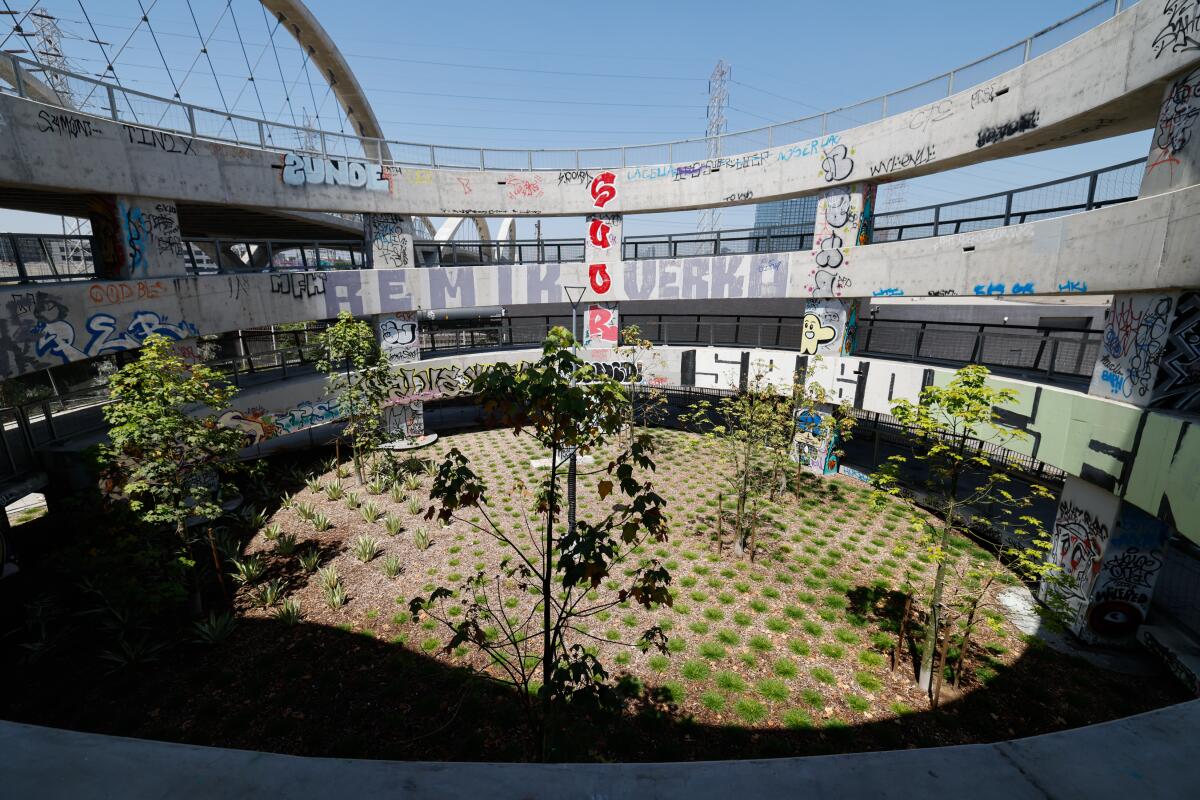
The State of the 6th Street Bridge
The 6th Street Bridge in Los Angeles faces significant challenges. The $588-million project, opened four years ago and designed by Michael Maltzan Architecture and HNTB, is marred by graffiti, especially on the spiral approaches. Copper wiring, which illuminated the bridge with light ribbons, has been stolen, resulting in nighttime darkness. Trash accumulates along the walkways.
Emergence of the Sixth Street PARC
Beneath the bridge, a different vision for Los Angeles attempts to take shape. The $62-million Sixth Street PARC aims to transform former industrial areas into vibrant recreational and cultural spaces. The park serves as a link between the Arts District and Boyle Heights, a working-class Latino neighborhood. However, the bridge’s condition already casts uncertainty on the park’s future.
According to Michael Maltzan, the park was integral to the bridge’s overall vision, intended to connect communities rather than divide them. Once completed, the 12-acre park, planned by landscape architects Hargreaves Jones and engineers Tetra Tech, will stretch from Mateo Street in the Arts District to Boyle Heights’ edge at the 101 Freeway. The park will feature various recreational facilities, including fields, plazas, and splash pads.
Funding and Design Features
Funded by a state grant and $2 million from the city, the park will provide spaces for art, fitness, and relaxation. The bridge will offer shade, its design accentuating the park’s zones. However, existing issues like graffiti and litter already hint at potential maintenance difficulties.
A Divided Park and City
A section of the park falls within the Arts District Business Improvement District (BID), which provides neighborhood security and programming. Executive director Miguel Vargas supports the park’s development but emphasizes the BID’s limited jurisdiction confined to the Arts District. Boyle Heights lacks a similar BID, posing challenges in maintaining security and cleanliness.
A proposal for a new BID, the Boyle Heights Industrial Flats Business Improvement District, aims to tax businesses to enhance security and maintenance. This proposal has drawn mixed reactions, especially concerns about its insular decision-making process.
Industry and Development Concerns
Boyle Heights has seen an influx of studios and creative businesses. East End Studios Mission Campus, Ace Mission Studios, and others have transformed warehouses into production spaces. These developments attract attention but raise concerns about security, as evidenced by frequent thefts.
Local residents remain wary of increased gentrification but acknowledge the challenges they face, including balancing new investments with their needs and concerns.
Addressing Future Management
Yuval Bar-Zemer, a developer and former committee member for the bridge’s design, proposes creating a nonprofit organization similar to New York’s Friends of the High Line. This organization would oversee the park and bridge, partnering with BIDs and community members. Bar-Zemer sees this as a valuable step in maintaining the space.
Michael Maltzan supports the idea, recognizing the potential benefits of public-private partnerships in managing civic spaces. Councilmember Ysabel Jurado has emphasized the importance of community involvement in any future management model.
Looking Ahead
The park’s success will hinge largely on ongoing collaborations. Effective communication and inclusion of local voices are crucial to addressing potential challenges.
Despite current uncertainties, Michael Maltzan remains optimistic. Properly managed, the Sixth Street PARC and bridge could form a model for urban development in Los Angeles, showcasing how physical space can foster community connectivity and enhance quality of life.