
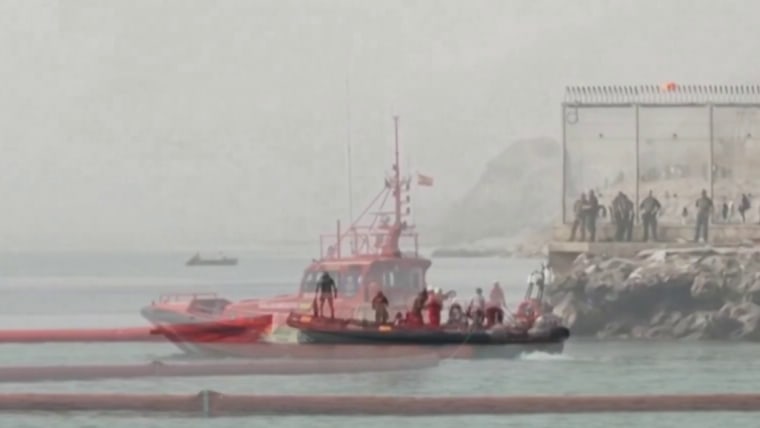
On Monday, hundreds of migrants established a camp on a beach in Ceuta, Spain’s North African exclave. This follows the massive border rush last week, putting local authorities under pressure as they struggle to manage the large numbers remaining in the small area.
Approximately 69,500 migrants have returned to Morocco over four days, surpassing the initial estimates of around 50,000 arrivals from Thursday. Official figures indicate 72 deaths on the Spanish side and 11 on the Moroccan side. Many migrants departed due to shop closures leaving them without food, hostility from locals, and an inability to proceed to the Spanish mainland.
Ceuta and Melilla, Spain’s other exclave, are situated on the Mediterranean coast of Morocco and often face attempts by migrants aiming to reach Europe. A Reuters video depicted numerous migrants, predominantly from sub-Saharan Africa, resting on the El Trampolin beach. Some were wrapped in towels as wind protection, while the army and police patrolled nearby roads.
Ceuta’s leader, Juan Jesus Vivas, stated that 3,000 to 5,000 migrants are still in the territory, noting that its reception centers for both adults and minors are overwhelmed. Local official Alberto Gaitan revealed that Ceuta is processing 862 migrant minors, who have special legal protection preventing deportation.
The presence of migrants has intensified anti-immigration rhetoric in Europe and caused diplomatic tension within the EU over border policies. Spain has criticized some EU partners for their divisive reactions, saying it had previously supported other countries during similar crises and now expects reciprocal assistance.
Spain and Italy’s disagreement over the crisis continues. Foreign Minister Jose Manuel Albares criticized Italy for spreading misinformation.
Vivas has accused Morocco of engineering the crisis, expressing that the country is deemed unreliable in Ceuta and called for measures to prevent such incidents in the future.
Morocco’s Interior Ministry attributed the surge in migration to social media misinformation, human trafficking networks, and misinterpretations of a Spanish court ruling regarding migrant return policies. Spanish intelligence believes Morocco didn’t orchestrate the mass crossing but allowed it to occur.
The gradual relaxation of Moroccan border controls in July coincided with Morocco’s Throne Day holiday, contributing to the influx at the Tarajal crossing. Requests for comments from Morocco’s Interior Ministry were unanswered, but it pledged commitment to international cooperation against irregular migration.
Tensions surfaced in Spain over the lack of warning about the surge from the intelligence service CNI, managed by the Defense Ministry. Interior Minister Fernando Grande-Marlaska expressed concerns, but an Interior Ministry spokesperson played down the issue. Defense Minister Margarita Robles praised the ‘exceptional’ work of the security services personnel.