
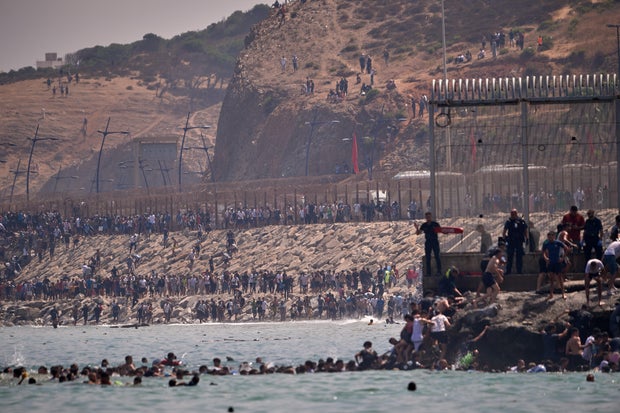
Spain has decided to deploy its military to the border with Morocco in Ceuta due to a surge of migrants. This follows requests from Ceuta authorities for help from the central government in Madrid. The situation escalated with large groups crossing the border fence into the Spanish territory. On Thursday, Spain’s government confirmed the Armed Forces would join the Civil Guard to maintain security in Ceuta. Prime Minister Pedro Sánchez and Interior Minister Fernando Grande-Marlaska planned to visit Ceuta on Friday.
Rachid Sbihi, representing the Civil Guard officers in Ceuta, described the situation as chaotic. Thousands of migrants crossed the border, leading to its collapse. Achraf Maimouni, from the Moroccan Association for Human Rights, noted the unusual circumstances of the border opening, allowing people to cross. Most migrants were reported to be Moroccans, with families among them. Footage showed people walking on Tarajal beach towards local roads, some exclaiming “Viva España!”
The sudden influx followed attempts by migrants to reach the exclave by swimming. This resulted in the deaths of at least three people. Moroccan authorities have not commented on the border crossings. However, the Spanish Interior Ministry mentioned cooperation with Morocco to manage the situation. The two countries are working to return those who entered Ceuta illegally.
Spain’s government stressed the importance of citizen safety and border integrity but did not declare a national emergency. Recent legal changes in Spain have meant migrants arriving by sea can’t be sent back without due process, unlike those crossing by land. Some activists argue that this legal shift is not widely known among migrants.
Ceuta is a primary entry point for migrants into Europe, often seen as a gateway to better opportunities. Migrants frequently swim from the nearby Moroccan town of Fnideq or Belyounech. The current situation is reminiscent of the 2021 crisis when over 8,000 migrants entered Ceuta in two days. Tensions then arose between Spain and Morocco due to diplomatic disagreements.
Ceuta’s regional leader, Juan Jesús Vivas, urged the national government to declare an emergency and increase security measures. The current migrant reception facilities are overwhelmed, and many migrants are without shelter. The Spanish Interior Ministry is closely monitoring the situation with plans to release updated migration figures soon. Up to mid-July, approximately 3,000 migrants had reached Ceuta this year.
Ceuta, located on a historic isthmus, has been a Spanish territory since 1580. It houses a mixed community of Christians, Muslims, Spaniards, and Moroccans living behind a border that many migrants attempt to cross in search of a better life in Europe.