
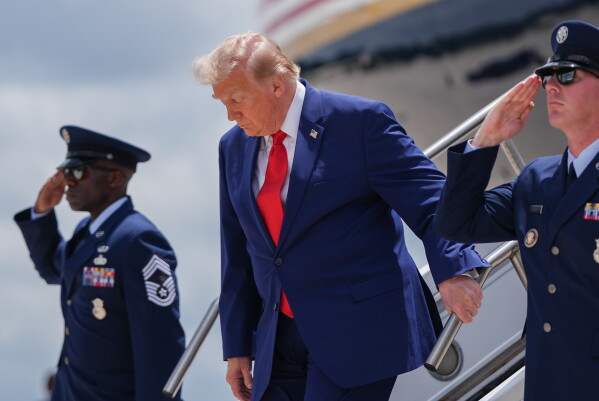
During his recent Middle East tour, President Donald Trump highlighted the ‘Abraham Accords,’ which were established in 2020. These agreements increased diplomatic relations between Israel and several Arab states, including the United Arab Emirates, Bahrain, Sudan, and Morocco. The name ‘Abraham Accords’ carries significant cultural and religious weight, referencing a biblical patriarch esteemed in Christianity, Islam, and Judaism.
Abraham, or Ibrahim in Islam, is considered a pivotal figure connecting these three major religions, which together have followers making up more than half of the global population. Bruce Feiler, author of ‘Abraham: A Journey to the Heart of Three Faiths,’ notes that Abraham is often claimed by different faith groups as their own. However, he argues that Abraham’s legacy should be a shared heritage among all.
The Abraham Accords emerged as a framework for diplomacy and commerce, influenced by the United States, aiming to create connections between Israel and majority-Muslim nations. A lasting agreement in Gaza might open further discussions with more Muslim-majority countries.
From the Bible to Present-Day Diplomacy
In the Hebrew Bible, Abraham is introduced in the Book of Genesis as an elderly man without children, who becomes the father of a nation through divine promise. The narratives describe him having two sons: Ishmael, born to Hagar, an enslaved woman, and Isaac, born to his wife Sarah through miraculous circumstances.
A significant biblical event involves God testing Abraham’s faith by ordering him to sacrifice Isaac, only to have an angel intervene at the last moment. This story sees Isaac and his descendant Jacob as the progenitors of the Jewish people. In contrast, Islamic tradition emphasizes Ishmael’s role, considering him an ancestor of the prophet Muhammad. Muslims believe that the site where Abraham prepared to sacrifice his son is within Jerusalem’s Dome of the Rock.
Abraham’s Dual Role
Throughout history, Abraham has symbolized both unity and division. Crusades, terror attacks, and other conflicts have seen all three faiths claiming Abraham as their forebear. Despite these divisions, the Abrahamic faiths’ respect for this patriarch has supported diplomatic efforts, such as the accords Trump’s administration facilitated.
Following the 9/11 attacks, President George W. Bush referred to Abraham in reaching out to Muslims, highlighting the shared belief in God’s justice. The term ‘Abrahamic faiths’ broadens religious dialogue beyond the traditional ‘Judeo-Christian’ framework, promoting inclusivity.
Efforts like the Abrahamic Family House in the UAE, encompassing a church, mosque, and synagogue, aim to reflect this unity. In the U.S., inter-religious dialogues benefit from this expanded perspective, despite growing religious tensions on other fronts.
Trump’s References to Abraham
Speaking at the Israeli Knesset, Trump focused on the Jewish implications of Abraham, using the Hebrew pronunciation ‘Avraham Accords.’ While he acknowledged Muslim leaders involved in these agreements, his policies have also been controversial, including calls to restrict Muslim immigration.
Bruce Feiler emphasizes that these complexities mirror the longstanding tensions inherent in the story of Abraham and his descendants. The narrative speaks to both division and coexistence, suggesting the need for shared space and mutual recognition.
This support for diplomatic and interfaith efforts is central to the theme of the Abraham Accords, where diverse groups are encouraged to navigate shared challenges under the legacy of a shared patriarch.