
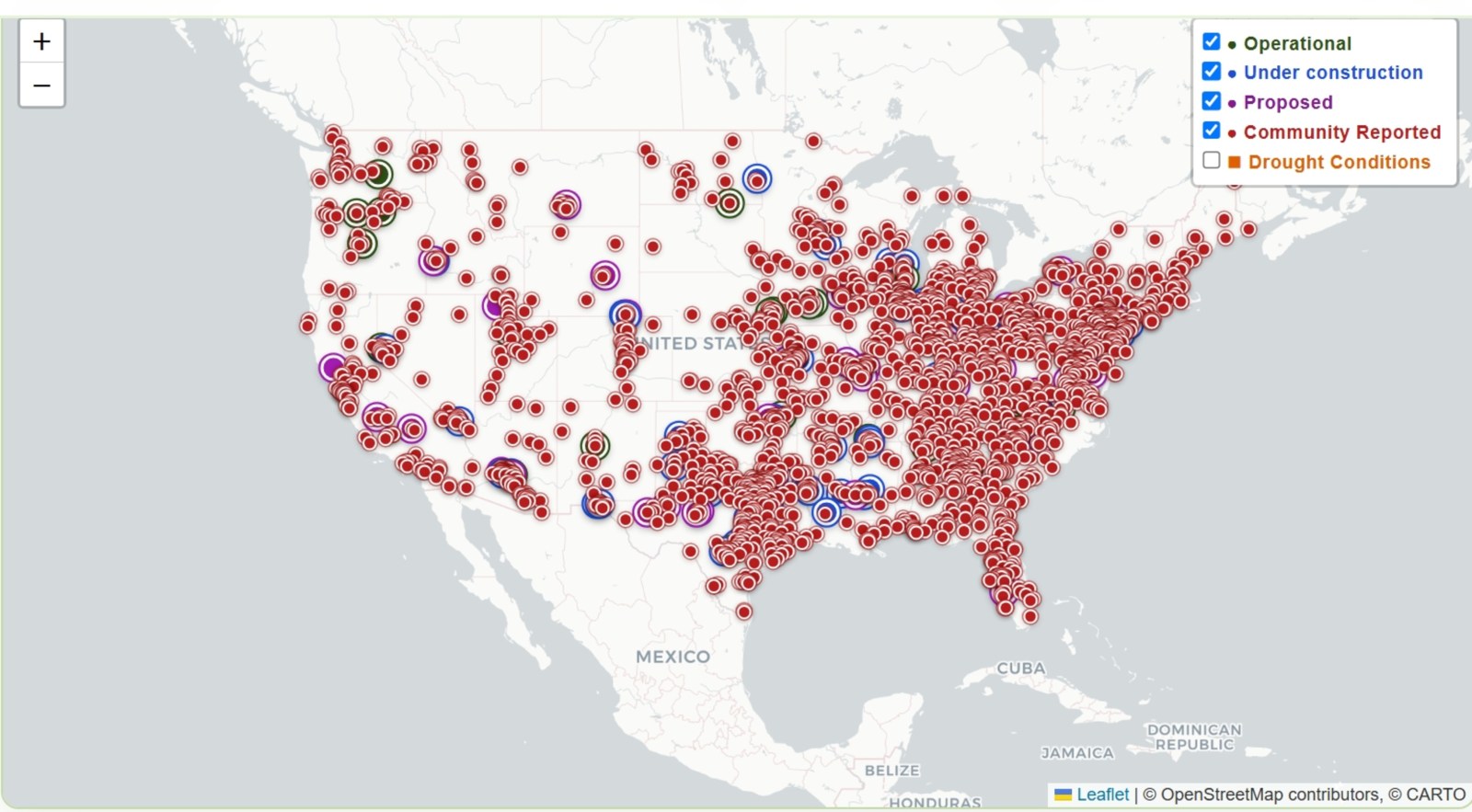
Environmental activist Erin Brockovich has launched a nationwide project to track community concerns about data centers, spurred by a wave of emails from worried residents in Louisiana. Her campaign is gaining momentum amid national debates regarding AI-powered data centers.
These facilities require extensive electricity and, often, significant water resources for cooling servers. Brockovich’s mapping project is collecting reports from numerous residents, highlighting their lack of information about data center projects in their areas. The race by technology companies to build AI infrastructure has prompted disputes over water usage, energy demands, noise, and transparency. Such issues are increasingly surfacing in towns nationwide.
“I woke up one morning and I had 30 emails … from the same community regarding the same issues—data centers,” Brockovich recounted on Theo Von’s podcast, This Past Weekend.
She began researching but found many questions unanswered. Brockovich then created BrockovichDataCenter.com, a platform for residents to self-report issues with local data centers. Rapid response revealed a country-wide concern.
“When I put this map out, in the first 72 hours, the map crashed twice, and I woke up on day three going, oh my God, it’s not one town and one aquifer and one data center, it’s the entire country,” Brockovich stated.
Her project, launched earlier this year, has grown swiftly. Brockovich’s website now displays over 8,000 community-reported data center locations, alongside operational, proposed, and under-construction facilities across the U.S. Commonly reported concerns include water use, energy consumption, electronic waste, and community planning issues.
Brockovich intends for her map to enhance community awareness regarding the fast-unfolding U.S. development boom. Thousands of submissions reflect resident worries about nearby projects.
“They had no idea. They woke up to this construction. We weren’t informed. City council didn’t tell us anything,” Brockovich said. “We were completely in the dark.”
She further alleged that confidentiality agreements have curbed public awareness in some areas. While some communities oppose these developments, industry advocates champion the economic benefits like construction spending, tax revenue, and tech investments. Brockovich contends that residents should receive more transparency about data center projects, particularly regarding their impact on local resources.
Who is Erin Brockovich?
Brockovich became globally renowned after building a case against Pacific Gas & Electric (PG&E) for groundwater contamination in California. Her recent focus has been on data centers, coinciding with the U.S.’s accelerated AI infrastructure construction amid intense global competition.
Brockovich’s fame reached new heights when Julia Roberts portrayed her in the 2000 movie Erin Brockovich. The film dramatizes Brockovich’s real-life pursuit of justice over Hinkley’s polluted water supply.
Erin Brockovich follows a mother of three who starts as a legal clerk and uncovers a pattern of illness among California town residents. Her detailed investigation resulted in a historic $333 million settlement with PG&E in 1996 due to toxic chromium-6 contamination, linked to the company’s natural gas operations since the 1950s and 1960s.
For further inquiries, contact Newsweek editors: Samantha Beech and Gray R. Thomas.