
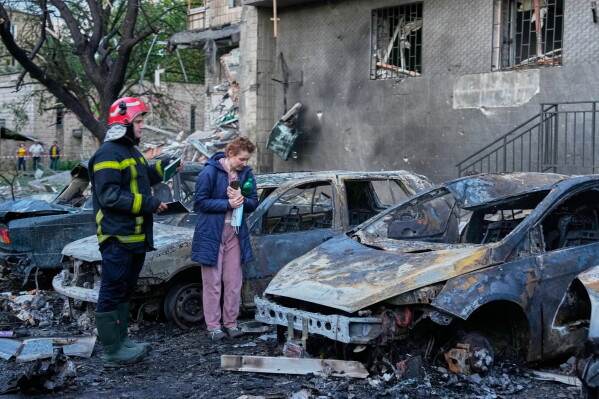
The U.S. military initiated airstrikes against Iran’s paramilitary Revolutionary Guard on Sunday. This move was in retaliation for the killing of American troops in Jordan, further increasing the conflict between the two nations. An interim deal aimed at ending their tension had collapsed.
The military campaign, lasting for a week so far, began with a struggle over control of the Strait of Hormuz. Iran has attacked U.S.-allied countries across the Middle East. The U.S. has retaliated by striking bridges, electrical facilities, and other strategic locations in Iran. In response, Tehran targeted power and desalination plants in Kuwait, disrupting the daily life in the oil-rich desert nation. Iran has also threatened to expand such strikes, prompting a warning from the United Arab Emirates.
“Iran also has stepped up its threats to further expand the strikes, drawing a warning overnight from the United Arab Emirates.”
On Sunday morning, Kuwait and Bahrain activated air defenses due to anticipated Iranian drones and missiles. The most recent U.S. strikes followed after American troops were killed. The U.S. military’s Central Command mentioned targeting “Iranian military coastal surveillance and air defense facilities, maritime capabilities, and missile and drone storage sites.” The objective is to reduce Iran’s control over the Strait of Hormuz and punish the Islamic Revolutionary Guard Corps forces.
The U.S. military shared footage showing strikes executed by fighter jets, and Tomahawk cruise missiles launched from the sea. One target appeared to be in a mountainous region, where the Guard often hides military equipment. Iran has not provided information on its losses in the ongoing campaign, which begins its eighth day as both nations seek control over the Strait.
An Iranian attack on a base in Jordan resulted in the deaths of two American service members, with one missing and four injured. Since the conflict began, 16 U.S. service members have been killed, and over 430 wounded. Iranian authorities reported at least 50 people dead and more than 500 injured in the latest U.S. strikes.
Most U.S-allied Gulf Arab states have faced Iranian retaliatory strikes. However, the United Arab Emirates has not yet been targeted. The semi-official Iranian news agency Fars issued a threat against the UAE on Saturday. An anonymous official stated that further strikes on Iranian civilian infrastructure would lead to immediate evacuation of key locations in Dubai and Abu Dhabi.
In response, the UAE’s Foreign Ministry called for restraint, warning against the targeting of civilian infrastructure which violates international law. Meanwhile, officials confirmed that both UAE and Saudi Arabia launched retaliatory airstrikes against Tehran. Jasem Mohamed al-Budaiwi, secretary-general of the Gulf Cooperation Council, accused Iran of war crimes for attacking infrastructure and civilian facilities.
“The UAE emphasized that the targeting of civilian infrastructure and civilian facilities in the region … constitute a flagrant and grave violation of the established principles and provisions of international law.”
Former President Trump had threatened to target Iran’s power stations and bridges to force a relinquishment of control over the Strait of Hormuz. Recent attacks seem to follow that strategy, focusing initially on Iran’s coastal areas along the Strait. The U.S. reimposed a naval blockade on Iranian ports to curb their crude oil shipments, and has since redirected and disabled several ships.
Iran’s Supreme Leader Mojtaba Khamenei issued a strong warning on Saturday. He cautioned of “unforgettable lessons” if attacks continued. An Iranian negotiator announced suspending commitments to a recent interim deal designed to end the fighting.
Iran’s joint military command warned the U.S. that their actions would lead to “devastating response”.
__ Sam Metz in Ramallah, the West Bank contributed to this report.