
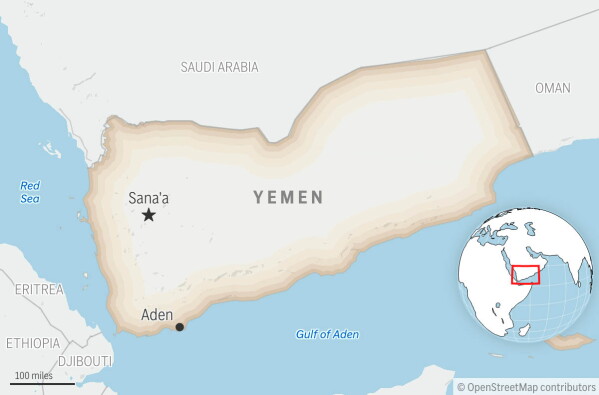
The Houthi rebels in Yemen, backed by Iran, announced that they launched missiles and drones targeting Saudi Arabia’s Abha International Airport on Monday. This action was in response to airstrikes earlier in the day on Sanaa International Airport, which the Houthis attributed to Saudi Arabia. No casualties were reported, but this marked a significant rise in conflict levels not observed since a Saudi-led coalition’s previous strikes on Houthi-held territories.
Saudi officials have not provided comments on these airstrikes. Houthi military spokesperson, Brig. Gen. Yahya Saree, issued a warning through a video on Telegram. He advised airlines to avoid Saudi airspace until the blockade on Sanaa International Airport is lifted. The recognized government in Yemen remarked that the airstrikes were intended to prevent an Iranian plane from landing.
This confrontation marked the first significant escalation between the Houthis and Saudi Arabia after a recent period of relative peace. During an emergency meeting of the U.N. Security Council on Monday, officials voiced concerns over the potential for widespread conflict. “Yemen and the wider region cannot afford another cycle of escalation,” stated U.N. Assistant Secretary-General for political affairs Khaled Khiari, urging all parties to engage in meaningful negotiations under U.N. mediation.
A Saudi-led coalition has been opposing the Houthis in Yemen for years. The conflict originated in 2014, when the Houthis overtook Sanaa and other northern areas, forcing the Yemeni government into exile. A coalition led by Saudi Arabia, including the United Arab Emirates, later intervened to attempt restoring the government.
Tensions have grown in 2023 between Saudi Arabia and the UAE, allies in the conflict against the Houthis. This rift saw the UAE withdrawing from Yemen. On the day of the recent strike, Maj. Gen. Turki al-Malki, representing the Saudi-led coalition, mentioned that air defenses addressed Houthi-launched ballistic missiles targeting the southern region.
The attack on Sanaa’s airport followed accusations by the Houthis that Saudi planes breached their airspace to stop an Iranian plane from carrying a Houthi delegation to a funeral in Tehran. Yemen’s Defense Minister, Gen. Taher al-Aqili, revealed that the runway of the airport was targeted to deter the aircraft’s return. He emphasized that Yemen would react adequately to such incursions.
The diverted plane successfully landed at Hodeida Airport. Houthi-aligned al-Masirah television showcased video footage of a missile striking the Sanaa airport runway, leading to a subsequent explosion.
In response, the southern Yemeni government announced the closure of all its airports. The surrounding areas were evacuated as ordered by the Yemeni defense ministry. Rashad al-Alimi, heading Yemen’s Presidential Leadership Council, stated the council rejected Iran’s request to operate a flight from Tehran to Sanaa. This was due to the insistence of the Houthis on bypassing civil aviation regulations.
Hans Grundberg, U.N. special envoy for Yemen, is overseeing the situation in Yemeni airspace. He expressed concerns over potential escalations and urged all parties to maintain the relative calm seen since 2022. The last Saudi-led coalition targeting of Houthi areas occurred before a U.N.-brokered ceasefire came into effect in 2022.