
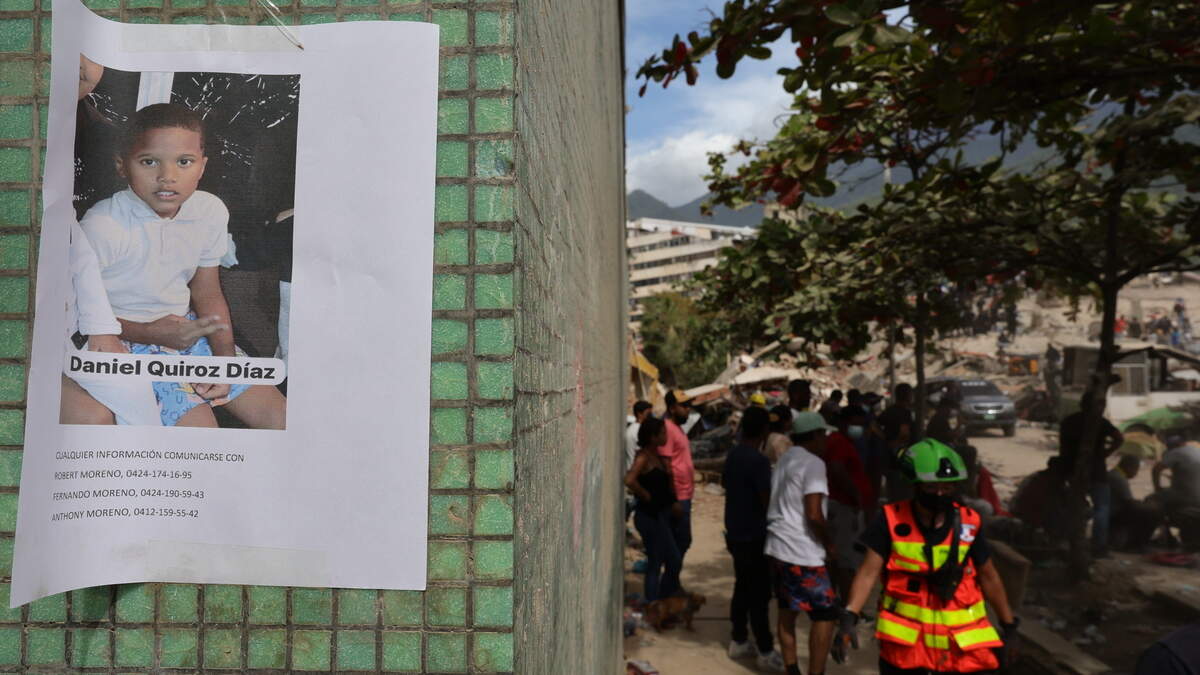
An image of a missing child on a wall highlights the human cost of the magnitude 7.2 earthquake that struck Venezuela and other regions in the Caribbean on June 28. The disaster, centered in Caraballeda, La Guaira, Venezuela, resulted in over 3,500 deaths, with thousands still missing.
The devastation raises questions about the role of human errors in the tragedy. Venezuelan citizens criticize their government’s inadequate response, adding pressure to a humanitarian crisis deeply rooted in decades of Chavista policies. These leftist, populist measures brought increased state control over the economy and led to the mass exodus of nearly 8 million people.
Survivors plead for assistance, often resorting to manually digging through debris in search of loved ones. The construction failures during the earthquakes have drawn particular attention, especially concerning government-built apartment complexes. Many say these structures, erected under questionable contracts and with materials of uncertain quality, were ill-prepared for major seismic events.
In Caraballeda, a chilling discovery of Styrofoam mixed with concrete from a collapsed public-housing building underscored fears about poor construction standards. According to NPR, La Guaira’s public housing sees a high concentration of earthquake fatalities. The New York Times reported that the Misión Vivienda project, which began under Hugo Chávez in 2011, showed little concern for soil tests or design standards.
El Estimulo, a Venezuelan digital outlet, remarked in 2017 that Misión Vivienda’s operations lack transparency. Details about materials, investments, and study results are unknown. Despite this, acting President Delcy Rodríguez claims most collapsed buildings were not state-built. Yet, in Venezuela, where Nicolás Maduro remains in power despite recent challenges, accountability and investigation seem scarce.
The government insists Misión Vivienda is successful, citing over 5.5 million constructed homes. Nonetheless, the response to the earthquakes highlights a deeper issue within U.S. policies toward Venezuela. While Maduro is absent, prospects for a democratic shift remain dim. The nation struggles with recovery, complicating efforts for fair elections.
For Venezuelans in South Florida, the disasters signify failed Chavista promises that aimed to address economic inequity. Instead, oppressive governance, corruption, and nepotism prevail. If poor public housing construction contributed to the fatality count, the calamity exceeds natural disasters.