
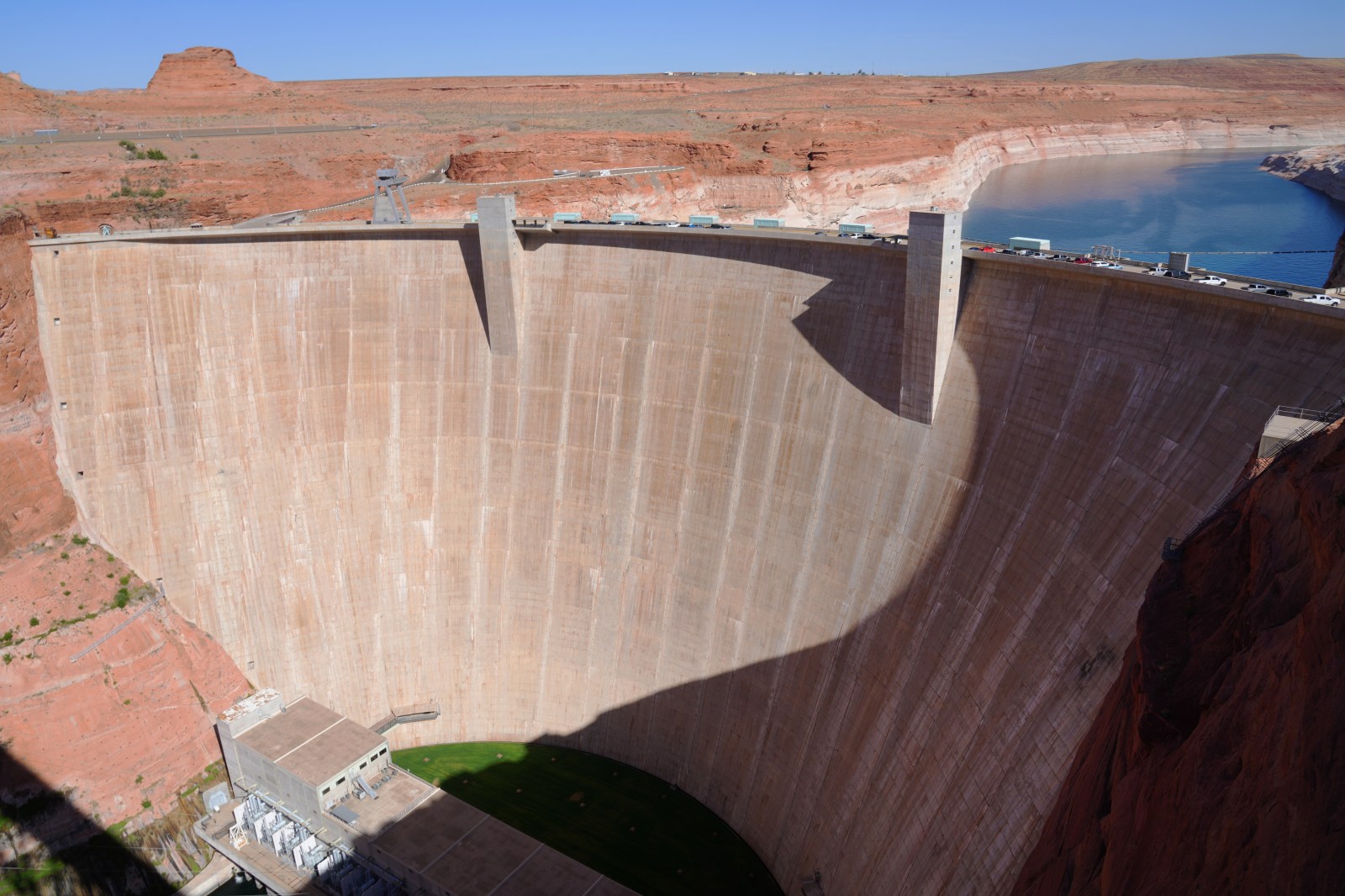
The effort to maintain sufficient water levels at Lake Powell has led to a bold proposal from a Colorado River advocate. The proposal suggests sending the reservoir’s water downstream to Lake Mead and retiring Lake Powell as a primary storage reservoir.
Lake Powell ranks as the second-largest reservoir in the United States. It shares the drought-afflicted Colorado River with Lake Mead, the nation’s largest reservoir. This river plays a crucial role, supplying water to about 40 million people in the western United States and irrigating over 5 million acres of farmland.
Examining the Past Decisions
Zanna Stutts, program director at the Glen Canyon Institute, emphasizes the need to reassess the rationale behind Glen Canyon Dam’s construction. “If we have the courage to take a step back and think about, ‘Why was Glen Canyon Dam built? Is that still working?’ The answer is no,” she stated, according to KUTV.
Earlier this year, the Bureau of Reclamation initiated emergency measures to bolster Lake Powell. These measures included moving water from the Flaming Gorge reservoir upstream and reducing releases to Lake Mead. Stutts believes these actions are temporary fixes rather than long-term strategies.
“We can’t keep doing this,” Stutts remarked. “This is reservoir triage that we’re working with right now, instead of thinking about long-term strategies to work with the actual amount of water that the river can provide.” She notes the Bureau’s actions aim to protect Lake Powell’s elevation due to infrastructure limitations at the dam.
Outdated Expectations
The Glen Canyon Dam was constructed based on mid-20th-century expectations of the Colorado River’s flow. Since roughly 2000, river flow has decreased by about 20 percent, meaning the river carries less water than designers anticipated, as per KUTV.
The dam lacks a low-level outlet, leaving roughly 6 million acre-feet of water below a certain elevation inaccessible. Lake Powell might be reported as 23 percent full, but much of the water remains unreachable. Stutts suggests considering modifications to the dam’s infrastructure.
“Lake Mead and Lake Powell are the nation’s two largest reservoirs. They are both sitting at around a quarter full,” she observed. “We have the two largest reservoirs in the country, and we can’t fill either one. What might it look like if we were to take the water that is currently stored in Lake Powell, send it downstream through the Grand Canyon, and instead store it in Lake Mead?”
Potential Solution: Redistributing Water
Water stored in Lake Powell could be directed to Lake Mead through tunnels drilled around the Glen Canyon Dam base. This approach would allow for a free-flowing stretch of the Colorado River in the current reservoir area. The dam could remain as emergency storage if Lake Mead were to refill.
KUTV notes this change would eliminate hydropower generation at the dam; however, declining water levels already threaten the facility’s power-producing capability.
“Without these emergency actions by the Bureau of Reclamation, Glen Canyon Dam wasn’t going to be producing hydropower as of this summer,” Stutts said. “If the Bureau is correct and these actions prop up the system until next year, we’re banking on Mother Nature for precipitation and snowpack next year. We’re postponing a solution for another year, but it’s not a long-term strategy.”
“Fill Mead First” Proposal
A proposal to focus on Lake Mead while retaining Lake Powell as a backup isn’t new. The Glen Canyon Institute has advanced a “Fill Mead First” strategy. This involves consolidating most stored water in Lake Mead rather than maintaining two partially filled reservoirs.
The proposal includes transferring Lake Powell’s water to Lake Mead in stages. Initially, Lake Powell would be lowered to minimum power pool levels, exposing regions previously submerged within Glen Canyon. The next phase reduces water further towards the dam’s outlet works.
The final phase involves constructing diversion tunnels around Glen Canyon Dam, creating a free flow through Glen Canyon. Lake Powell would become a backup reservoir during wetter years, with most long-term storage concentrated in Lake Mead.
As of July 5, Lake Powell was 23 percent full, holding 35 percent of its average storage for that date, according to Bureau data.
Future Outlook
From now to early fall, the regions feeding Lake Powell and Lake Mead, especially the Upper Colorado River Basin in Colorado, Utah, and Wyoming, may experience warmer conditions. NOAA’s seasonal outlook suggests near- to above-normal precipitation across much of the interior West. However, it’s not guaranteed this will counteract elevated evaporation and drought stresses.
Contact Newsweek editors on this story: John Fitzpatrick and Gray R. Thomas