
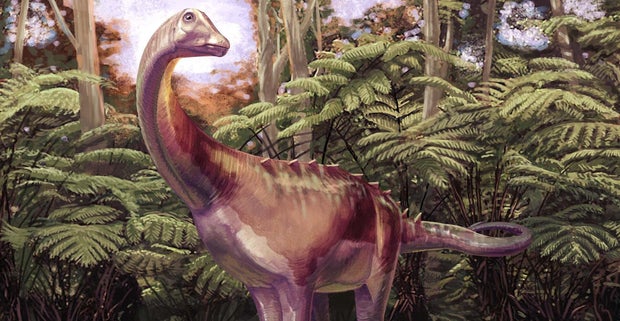
Scientists have uncovered a fossil from Antarctica that had been stored away for decades. This fossil is part of the tail of a titanosaur, a long-necked, plant-eating dinosaur. The precise species of the dinosaur remains unidentified.
The discovery dates back to 1985 during an expedition to James Ross Island in Antarctica. Geologist Mike Thomson found and collected the fossil while collaborating with the British Antarctic Survey to map the area’s rock layers. Initially, Thomson recorded the find as a large reptile fossil.
Years later, paleontologist Mark Evans noticed the bone in the British Antarctic Survey’s collections. He suspected it might belong to a dinosaur. “It’s only when you start thinking ‘what’s in this drawer,’ that sometimes you come across something and you think, ‘Ah, this looks interesting,'” Evans explained to BBC News.
Evans and other researchers analyzed the fossil’s shape and compared it to other dinosaur remains. They confirmed that the fossil was indeed part of a sauropod dinosaur. Their findings were published in the journal Acta Palaeontologica Polonica.
“This discovery represents only the second sauropod body fossil known from Antarctica, although it was the first dinosaur bone to be collected from the continent,” the study’s authors noted.
Dinosaur fossils are scarce in Antarctica due to the challenging ice caps. However, millions of years ago, the region was covered in lush forests. According to study co-author Paul Barrett from the Natural History Museum in London, this area was “rather different and much more hospitable place than we think of today.”
Titanosaurs roamed Antarctica about 80 million years ago when it was blanketed by forests. Andrew McAfee of the Carnegie Museum of Natural History estimated that the dinosaur measured around 23 feet in length, making it relatively small for its species group. This suggests it may have been young when it died.
The circumstances of the dinosaur’s demise remain unknown. Scientists speculate that after dying, its body drifted from the coast and sank to the sea floor, becoming fossilized in marine rock.
Globally, over 100 species of titanosaur have been identified. These four-legged herbivores had very long necks for reaching trees and long tails for balance. The largest among them measured over 115 feet and weighed around 60 tons.
Advancements in technology have greatly enhanced capabilities for studying fossils since the tail bone’s initial discovery. These advancements help researchers learn more about ancient creatures by providing a glimpse inside bones.
Sadly, Thomson passed away in 2020 before knowing the fossil’s significance. “If he were still with us, he would be delighted to know what this was,” Evans remarked.
This exceptional fossil discovery also carries an image provided by the Natural History Museum, featuring the fossil as part of the titanosaur group. Courtesy of the Natural History Museum via AP.