
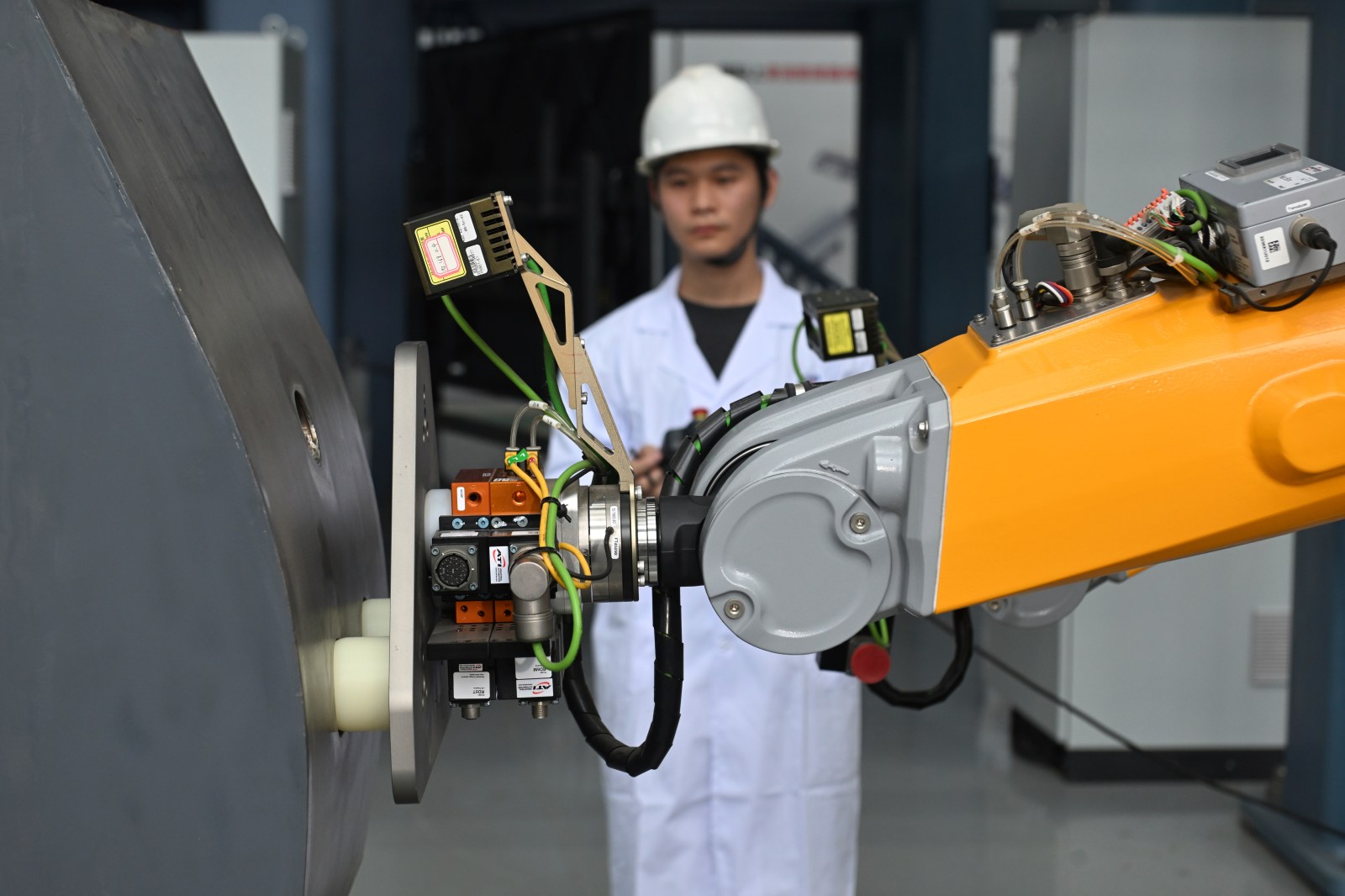
China has reached a significant milestone in its fusion energy program, progressing further in the project popularly known as the “artificial sun.” This achievement marks a noteworthy advancement in engineering efforts.
Understanding Fusion
Fusion energy is generated by combining light atomic nuclei, unlike the splitting of heavy atoms in conventional nuclear power plants. Although this reaction naturally occurs in stars, replicating it on Earth mandates temperatures exceeding 180 million degrees Fahrenheit. Fusion requires containing plasma with strong magnetic fields, as no material structure can endure direct contact with such extreme temperatures.
Fusion holds promise as a long-term energy source due to its widely available fuel, typically forms of hydrogen, and a reaction devoid of carbon emissions during operation. Fusion energy operates independently of weather or daylight conditions, unlike wind or solar power. It doesn’t involve combustion, distinguishing it from fossil fuels.
Researchers at the Institute of Plasma Physics in Hefei, Anhui province, announced on June 27 the successful testing of two critical superconducting magnet systems vital for future fusion reactors. These systems comprise a large toroidal-field magnet and a high-temperature superconducting central solenoid coil, both are essential for maintaining superheated plasma.
Technical Details and Achievements
The toroidal-field magnet measures 69 feet by 39 feet by 11 feet and weighs 582 metric tons. It has a D-shaped configuration, constructed with 16 identical magnets to form the complete torus. It possesses a 6.5-tesla magnetic field capacity and is designed for a 60-year lifespan under extreme operational conditions. The central solenoid coil is a high-temperature superconducting component that stabilizes the plasma current.
The toroidal-field magnet keeps plasma suspended in the reactor without touching the walls. It has three times the energy storage of equivalent magnets at ITER, the largest global nuclear fusion project located in France. The central solenoid directs and stabilizes the plasma current.
State researchers confirmed that the systems were entirely manufactured in China, with six years of engineering work, 47 patents, and 14 technical standards utilized to produce all raw materials. Independent Western verification remains unavailable.
This test did not involve electricity production; instead, it validated the successful development and testing of reactor-scale components designed for experimental plasma devices and future demonstration systems.
These magnets contribute to the CRAFT (Comprehensive Research Facility for Fusion Technology) national scientific infrastructure, supporting the development of future reactors.
In 2021, the “artificial sun” reactor, known as the Experimental Advanced Superconducting Tokamak (EAST), set a record by maintaining high-temperature plasma for 1,056 seconds.
China’s Green Energy Push
According to estimates from the Special Competitive Studies Project, a technology policy think tank based in Washington, D.C., Beijing has invested at least $6.5 billion in commercial fusion-related projects from 2023 to September 2025. Fusion energy is a priority area in the latest five-year plan set by the Chinese Communist Party.
Jane Nakano and Yu-Hsuan Yeh, analysts at the Center for Strategic and International Studies, noted, “China has been pursuing ‘new quality productive forces’ to enable technology-driven growth rather than traditional capital-intensive manufacturing.” Under the 15th five-year plan, priority areas include AI, quantum technology, and deep-sea and arctic exploration, alongside fusion energy.
Currently, no country has produced electricity from fusion at a scale necessary for commercial power. ITER remains the largest multinational endeavor, while research programs in the United States, Japan, and South Korea comprise both government-led and private-sector initiatives.
Contact Newsweek editors on this story: John Feng and James Debens.