
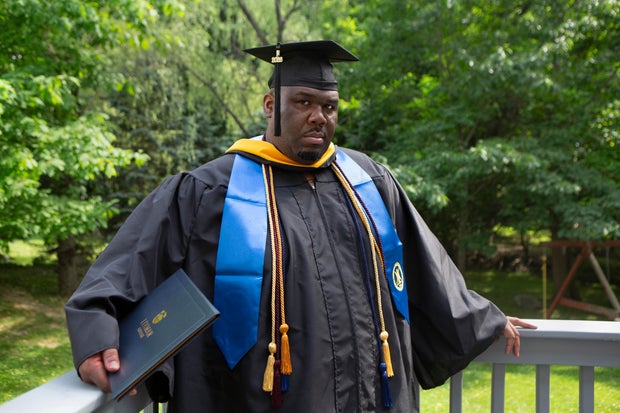
Benjamin Pinckney, 46, has long aspired to become a physician assistant. This goal surfaced after he survived a drive-by shooting in Jacksonville, Florida. During his hospital stay, a physician assistant’s daily visits left a lasting impression on him, highlighting the risks faced by Black men with gunshot injuries. These interactions inspired Pinckney to pursue a career in healthcare.
Throughout his life, Pinckney has worked with the New York City Department of Sanitation and as an Army Reserve medic. Recently, he earned a Bachelor of Science degree with honors from Lehman College. He plans to apply for physician assistant school this year from his new base in Maryland. However, he fears that changing student loan rules might hinder his dream. As of July 1, new federal student loan limits could necessitate seeking higher-interest private loans. These limits are included in the One Big Beautiful Bill Act, signed into law by President Donald Trump. Critics believe the new caps are insufficient, particularly for students restricted to $20,500 annually in federal loans.
Federal Judge temporarily blocked enforcement of the loan cap, but students might still fall short in covering tuition, housing, and living costs. This situation could compel some to rely on private lenders with less favorable terms. The new limits raise concerns about diversification in healthcare, potentially discouraging minorities and low-income students from entering graduate programs. This could worsen rural and primary care shortages.
Many acknowledge the necessity of addressing education costs, but the new limits are deemed ineffective. Todd Pickard, president of the American Academy of Physician Associates, criticized the legislation for being disproportionate to the problem. Students pursuing professional degrees face caps of up to $200,000, capping annual borrowing at $50,000. Yet, the median costs of attending medical schools are much higher, with public schools averaging nearly $300,000, and private institutions surpassing $400,000.
The Department of Education has been challenged by professional groups and states over these rules. Students like Olivia Trull are worried about the financial burden. Trull plans to start a physician assistant program costing $137,000, and though she qualifies for the maximum federal loan, she might need $100,000 from private lenders, resulting in monthly loan payments exceeding $3,000.
Pinckney, with $10,000 in undergraduate federal debt, acknowledges friends who have been offered private loans at high interest rates, compared to current federal rates of 8-9%. Federal loans typically offer better repayment options. Several lawsuits argue for higher borrowing limits for physician assistant students, contending they should match those for other professional degrees.
Cost containment is crucial, and some programs have already lowered tuition to meet federal limits. However, experts do not foresee widespread tuition reduction. New lending limits disproportionately affect Black students, who historically borrow more. A lifetime cap of $257,000 in federal loans could limit accessibility and diversity in medical education.
Andrei Robu, of the Medical University of South Carolina, highlights fears of reducing diversity in medical schools. Jasmine Vasquez plans to defer her physician assistant program enrollment, awaiting better financial options. She fears excessive private debt. Betsy Mayotte, president of the Institute for Student Loan Advisors, predicts potential bankruptcies if graduates can’t manage loan payments.
Mayotte expects declining enrollments, program closures, and shifts toward high-paid specialties, impacting underserved communities. Pinckney remains uncertain about his future. He paid for his undergraduate education by working but worries about the feasibility of balancing work with physician assistant studies. He considers alternative paths, such as biomedical science, which aligns with medicine but lacks patient interaction.