
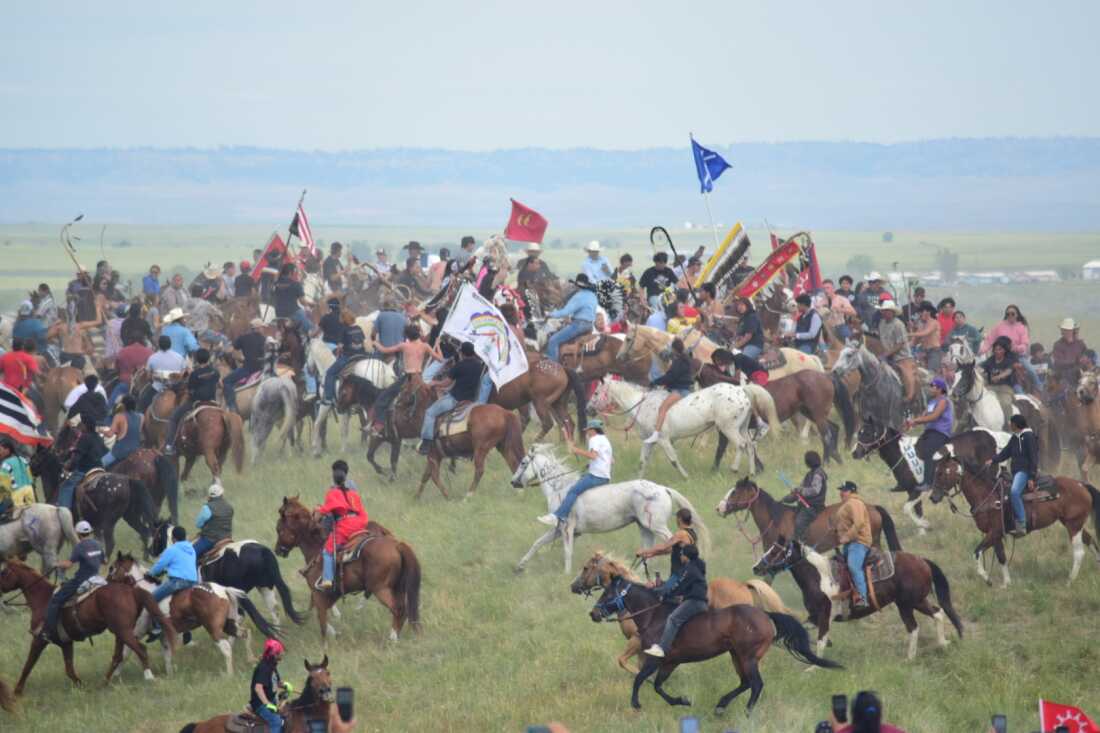
Under the vast Montana sky, hundreds of members and descendants from 19 tribal nations gathered at one of America’s most historic battlefields. This site, where their ancestors triumphed over the U.S. Army’s 7th Cavalry in 1876, draws them together. The riders, embodying their ancestors’ legacy, charge across the land, kicking up dust before circling Little Bighorn Battlefield National Monument. Some don traditional regalia while others wear casual attire. Many carry tribal flags, symbolizing the unity crucial to their historic victory.
“It was so important then, 150 years ago. It’s important today still,” said Gaby Strong, representing the Sisseton-Wahpeton and Mdewakanton. “Our victories are still possible.”
In 1876, the goal of Lt. Col. George Armstrong Custer was to confine Native Americans to reservations. After discovering gold in the Black Hills, the U.S. directed Indigenous peoples off reservations to head to field offices, risking being labeled as hostile otherwise. Native leaders like Crazy Horse and Sitting Bull organized resistance. Numerous clashes occurred as military forces tried to relocate these groups.
“Crazy Horse, he went from band to band, leader to leader, to tell them about this idea of our relatives coming together for a much greater cause than themselves,”
explained Christopher Eagle Bear of the Sicunga Lakota, Rosebud Sioux Tribe. Custer pursued a camp of Sioux, Cheyenne, and Arapaho, aided by Native scouts. To counter Custer’s forces, the village grew to 8,000 people. Custer, fearing they would scatter, launched an attack on June 25, 1876.
Custer’s decision proved fatal. Eagle Bear noted, The battle lasted as long as brewing and drinking a coffee.
Custer faced overwhelming numbers. The battle ended with 268 of Custer’s men, including himself, killed. Less than 100 Native Americans, including some women and children, died.
Custer’s defeat sent shockwaves nationwide, prompting the U.S. government to adopt forced assimilation policies. Soon after, off-reservation federal Indian Boarding Schools began operations, aiming to erase Native cultures. Eagle Bear remarked, They realized they couldn’t destroy us head-on. So, they targeted our children, taking them away.
At Little Bighorn, Eagle Bear camps where history unfolded. Tipis dot the landscape, brought by various tribes for ceremonies and remembrance. Eagle Bear aims to inspire future generations. Someday, the children here today will gather for the 200th anniversary and recount their experiences,
he shared.
Nearby, children play lacrosse with traditional sticks to the rhythm of drumming, while the Sicunga Youth Council oversees camp arrangements and activities. We’ve planned this for months,
said Ashlen Bonshirt from the youth council.
Young camp participants witness history beyond school teachings. Thirteen-year-old Gianna Larocque-Mahto of Dakota, Sisseton-Wahpeton Oyate, expressed dissatisfaction with history’s biased narrative. We didn’t learn about the Native perspective,
she stated. Champion Marquez, an 18-year-old Cheyenne, expressed hope.Seeing these kids enjoy and partake in events assures us we’re still here.