
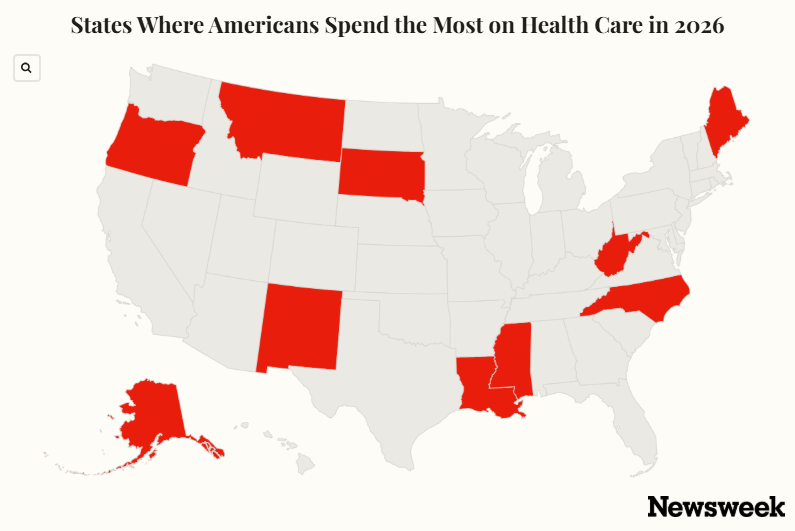
Americans are allocating an increasing share of their income to health care as costs have surged over the past two decades. A WalletHub report highlights significant state-by-state differences in this burden. In some states, people devote more than 10% of their income to medical care, while the least expensive states see this figure at around half. On average, out-of-pocket health care spending nationwide has risen from $811 to $1,514 annually, surpassing inflation and straining household budgets.
Why It Matters
Rising health care costs are influencing financial choices for many Americans. Some are delaying or avoiding care as a result. Even in states with lower costs, incomes may not fully counteract the financial pressure, especially with inflation impacting housing and food expenses.
What To Know
The WalletHub report ranked all 50 states by median household income spent on essential medical services and medications.
Top 10 States Where Americans Spend the Most on Health Care:
- Alaska — 10.08%
- Oregon — 9.32%
- Maine — 9.30%
- Mississippi — 9.18%
- West Virginia — 9.14%
- New Mexico — 9.07%
- North Carolina — 8.78%
- Montana — 8.62%
- South Dakota — 8.60%
- Louisiana — 8.13%
States Where Americans Spend the Least on Health Care:
- Utah — 5.11%
- Virginia — 5.62%
- California — 5.64%
- New Jersey — 5.81%
- Nevada — 5.87%
New York ranks in the middle, with residents spending about 7.98% of their income on health care.
What’s Driving the Differences
The data reveal that high spending is not solely tied to lower incomes. Often, the cause is high medical costs. According to the report, steep health care price hikes have made it hard for some to get essential care. Even in more affordable states, residents’ incomes may not match up due to inflation affecting various budget areas.
Alaska: Highest Burden Nationwide
Alaska leads the list, with 10.1% of median income going to health care. Notable among this is the cost of doctor visits and medications.
Oregon: High Prices Drive Costs
Oregon comes in second, where about 9.3% of income goes toward medical care. Doctor visits and optometry services are significant contributing factors here.
Maine: Lower Income Plays a Role
Maine is third, where high medical costs and lower incomes boost the care burden. It ranks as the 13th most costly state for dental visits and has a median household income of $74,733.
How the Rankings Were Calculated
Researchers evaluated five key elements of medical spending by state:
- Doctor visits
- Dentist visits
- Optometrist visits
- Prescription costs for ibuprofen
- Prescription costs for insulin glargine
The researchers compared total costs for these services with each state’s median household income. Data was collected as of April 30 from the Council for Community and Economic Research and the U.S. Census Bureau.
The percentages represent averages. They mask the significant percentage some lower-income families pay on health care costs.
What Americans Can Do To Lower Health Care Costs
Geography affects health care costs, but there are strategies to reduce expenses. Keeping insurance coverage active and using covered preventive services helps manage long-term costs. Experts suggest building an emergency fund and using tax-advantaged health savings accounts.
Some states have seen a decline in health care facilities, resulting in reduced competition and longer travel distances for residents. Being insured does not cover the full picture; several factors influence health expenses, beyond just being insured.
What Happens Next
Growing regional disparities in health care affordability may attract increased policy attention. Without changes in pricing, coverage, or income increases, high-cost states might continue to see rising portions of income spent on necessary medical care.
The consolidation of the industry and sparse competition suggest that significant cost decreases are not imminent. Health care inflation extends beyond insurance premiums, impacting the entire system and the consumer.