
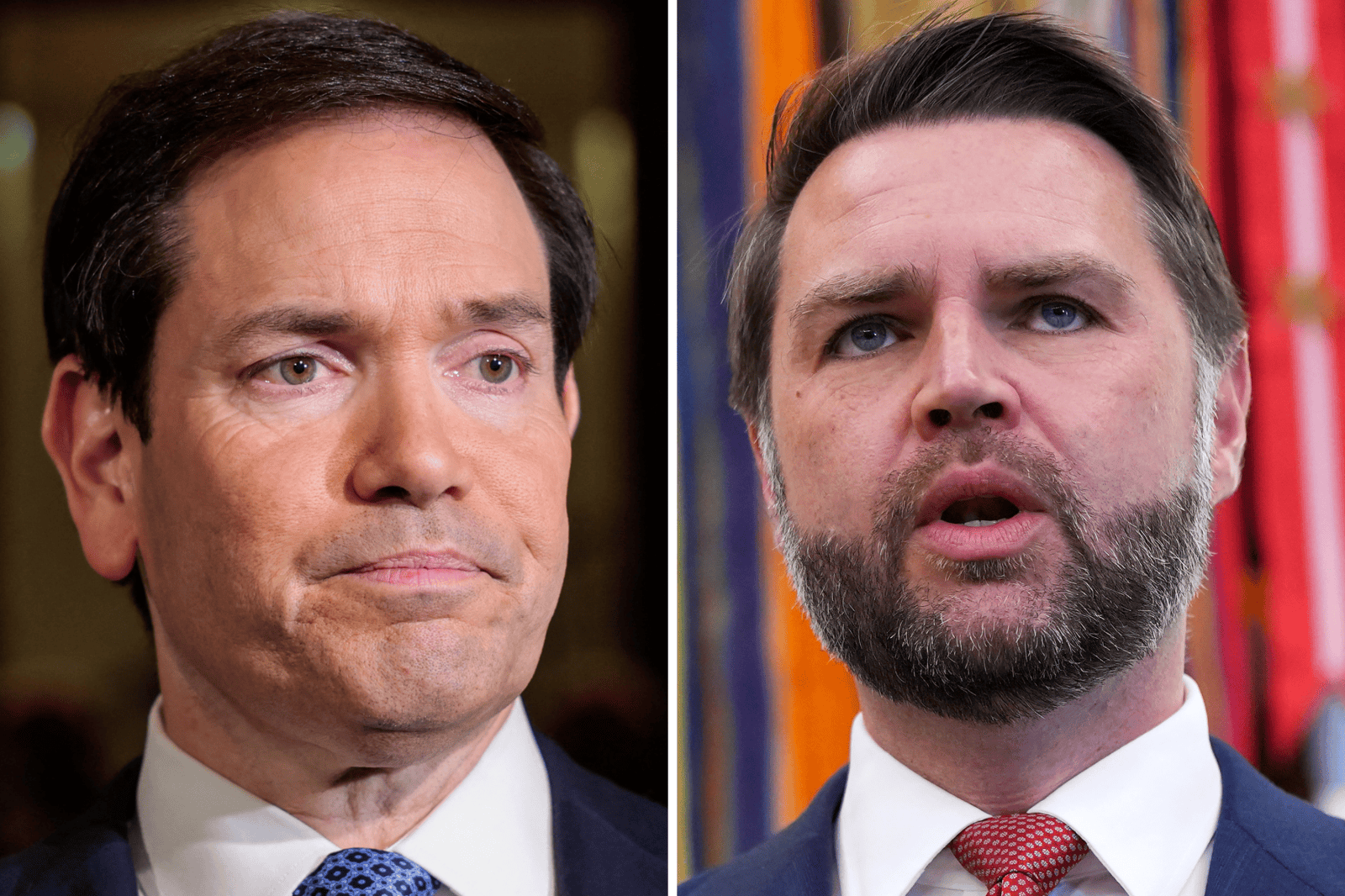
Vice President JD Vance and Secretary of State Marco Rubio have seen their positions weaken in the 2028 Republican presidential nomination prediction markets. According to an analysis by Newsweek, which examined data from Polymarket and Kalshi, both politicians have experienced significant shifts.
Polymarket’s trading volume for the Republican nominee market has reached nearly $714 million. Vance’s chances have decreased from about 53% on September 3 to 43.8% on Tuesday. Rubio’s odds declined from 27.8% on August 3 to 15.1%. Similarly, Kalshi, a U.S.-regulated prediction market, shows Vance’s odds decreasing from 45.8% to 43% during the same period, while Rubio’s dropped from 29.5% to 18%, with nearly $70,000 traded.
The decline follows Vance’s recent acknowledgment of the possibility he might not pursue the presidency, citing family considerations and his wife’s aversion to politics. This speculation raises questions about potential uncertainty within the Republican Party’s succession plan post-President Donald Trump.
“I think the main message is that people are not reading much into the announcement,” Koleman Strumpf, an economics professor at Wake Forest University, commented to Newsweek.
The usual dynamic of benefiting from a rival’s decline did not play out this time; both favorites experienced setbacks. Other potential alternatives, like Florida Governor Ron DeSantis and commentator Tucker Carlson, remain in low single digits. Strumpf suggests that the comments from Vance are not seen as particularly impactful by traders, indicating a lack of decisive shifts away from Vance and Rubio.
Midterms and Future Republican Prospects
The upcoming midterm elections could substantially shape the Republicans’ 2028 race. Costas Panagopoulos, a political science professor at Northeastern University, notes that a poor performance in the November elections could render the current administration a liability. He suggests blame could extend to key administration figures, including Vance and Rubio.
Asked about the potential implications, Thad Kousser from the University of California, San Diego, mentioned that the power associated with Trump may no longer be an asset if the midterms are disastrous.
Impacts of Midterm Results
Election results could reveal much about the Republican coalition, as highlighted by Panagopoulos. If Democrats secure victories in traditionally Republican states, the GOP may need to reassess its political strategies and consider moving away from Trump’s influence.
“If there’s a wholesale rejection of Trump and his agenda that may materialize after 2026, the constellation of Republican voices might look very different,” Panagopoulos said.
Limits of Prediction Markets
It’s important to note that prediction markets are not equivalent to public opinion polls. Keith Gaddie of Texas Christian University warned against relying solely on these markets as a reflection of voter sentiment. Although prediction markets offer continually updated forecasts, they do not represent comprehensive voter preferences.
The current market movements reflect uncertainties over who the leading candidates will be, with no clear alternatives yet emerging strongly. While prediction-market prices provide insights into potential political shifts, a broader Republican transformation will depend on a host of other factors, including voter and donor engagement, and candidate endorsements.
Newsweek produced this story with the help of Martyn, their AI assistant. For inquiries, contact editors Sam Stevenson and Dave Siminoff.