
BEIJING — Chinese leader Xi Jinping plans to visit North Korea next week, marking his first trip there in almost seven years, both countries revealed on Friday. This visit is part of China’s ongoing efforts to bolster its relationship with the nuclear-armed nation.
In recent years, North Korean leader Kim Jong Un has established connections with Russia, notably by sending military support for its conflict with Ukraine. However, over the past year, Kim has also worked to strengthen ties with China, which remains North Korea’s largest trade partner and aid provider.
“As North Korea builds closer ties with Russia, China seeks to use Xi’s trip to reassert its influence over Pyongyang and safeguard its strategic interests in northeast Asia,” said William Yang, an analyst for the International Crisis Group.
Xi’s upcoming state visit is scheduled for Monday to Tuesday, according to brief reports from Chinese and North Korean state media. His previous visit occurred in June 2019. The visit follows recent engagements in Beijing with U.S. President Donald Trump and Russian President Vladimir Putin.
Concerns persist in the United States over North Korea’s nuclear weapons program. The U.S. opposes this program, and the U.N. has imposed economic sanctions on North Korea in response to its nuclear and missile developments.
The visit’s announcement coincided with North Korea’s unveiling of a new facility reportedly for producing nuclear bomb material, speculated to be a uranium enrichment plant. During a visit to this site, Kim asserted plans to expand the nation’s nuclear capabilities at an increased pace.
Experts suggest Kim is eager to assert North Korea’s nuclear status ahead of Xi’s visit, seeking international recognition as a nuclear state. This recognition could be pivotal in negotiating the lifting of sanctions and in pursuing arms reduction talks with the U.S., aiming for concessions in exchange for reducing nuclear capabilities.
Since the collapse of significant diplomatic efforts with Trump in 2019, Kim has intensified his focus on expanding North Korea’s nuclear arsenal. Trump has expressed willingness to renew diplomacy with Kim, but North Korea insists the U.S. must first drop demands for denuclearization before engaging in talks.
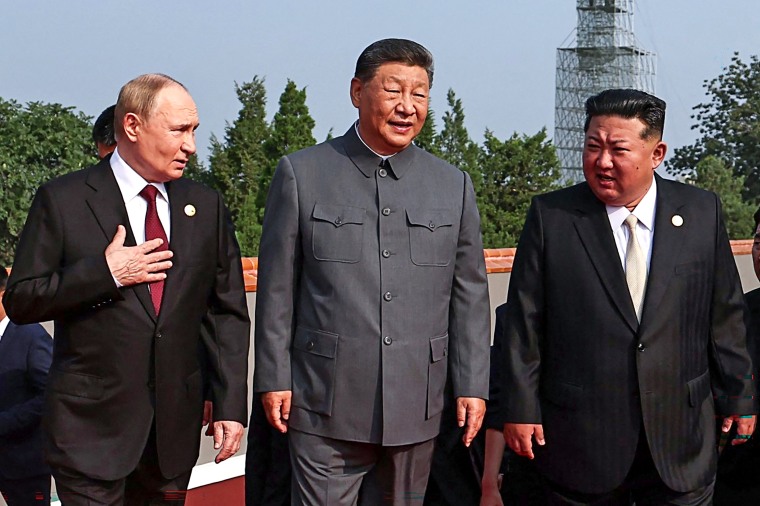
Analysts will watch closely if China addresses denuclearization during Xi’s visit. Previously, Xi and Kim met in Beijing, pledging mutual support and deeper cooperation. Kim attended a Chinese military parade alongside Putin and other international leaders.
Russia and China, both holding veto power in the U.N. Security Council, have historically hindered U.S. efforts to strengthen sanctions on North Korea despite its banned weapon tests. Their recent meeting in Beijing underscored opposition to sanctions and military pressure on North Korea.
In a stand against foreign policy isolation and underscoring a new Cold War, Kim has advocated for a more assertive foreign policy. This includes forming ties with nations opposing the U.S.
Xi’s travel plans reflect his limited international travel since the Covid-19 pandemic. His last foreign visit was to South Korea for the Asia-Pacific Economic Cooperation summit, where he met with Trump.