
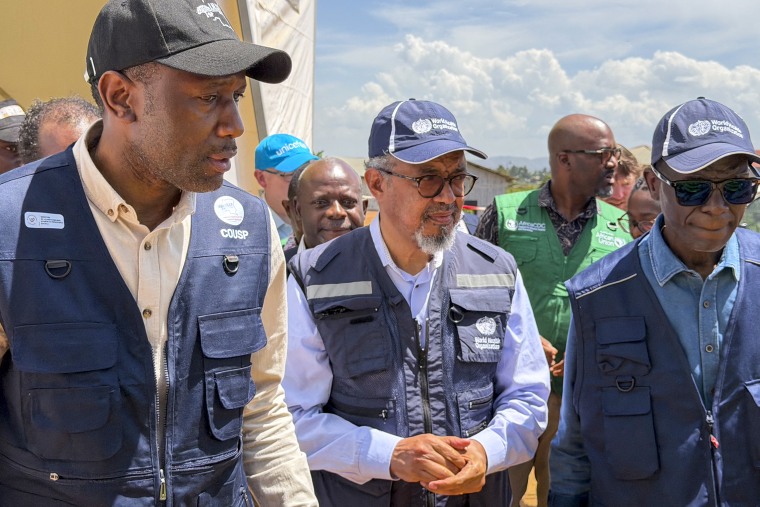
In Bunia, a city in eastern Democratic Republic of Congo, the head of the World Health Organization (WHO) has arrived amidst an outbreak of a rare type of Ebola. Despite improved health facilities and new aid, the virus continues to spread rapidly.
WHO Director-General Tedros Adhanom Ghebreyesus plans to visit a treatment center and meet with local authorities, health workers, and affected families in the area. He emphasized the importance of support to combat the disease at its source and continue assistance efforts.
“The best way to address this is to provide all the necessary support to fight the disease at its epicenter and to continue offering every assistance needed,” Tedros stated on Friday.
As of Friday, the WHO reported 906 suspected cases and 223 suspected deaths related to this Ebola outbreak. In neighboring Uganda, there have been nine confirmed cases and one death, according to their ministry of health. The current type of Ebola, the Bundibugyo virus, lacks approved treatment or vaccine.
Tedros’s visit coincides with the arrival of medical aid from the European Union in the Ituri region, the epicenter of the outbreak. Additionally, the United States announced $80 million in additional aid, bringing its total support to over $112 million. Aid efforts in Bunia’s hospitals are reportedly more organized, yet the outbreak remains one of the fastest-spreading, as noted by Doctors Without Borders (MSF).
“Never before has an Ebola outbreak recorded so many cases so soon after its declaration,” said Dr. Alan Gonzalez, MSF’s deputy director of operations. He called for expanded testing, faster aid deployment, and sustained medical supply access.
Health workers face increased dangers, with local resistance to medical protocols for handling victims’ bodies, clashing with traditional burial customs. This tension has led to several attacks on health centers. Furthermore, the response is hindered by regional conflict involving the Allied Democratic Force and ethnic militias.
The outbreak has also spread to North Kivu and South Kivu provinces. The Rwanda-backed M23 rebel group, controlling cities like Goma and Bukavu, reported two cases. In reaction, Uganda and Rwanda have closed their borders, and the U.S. placed travel bans on individuals who recently visited affected regions.
“Closing borders, as some countries have done, only discourages transparency. The Democratic Republic of Congo is reporting the situation openly and transparently,” Tedros reminded that border closures and travel bans are ineffective.