
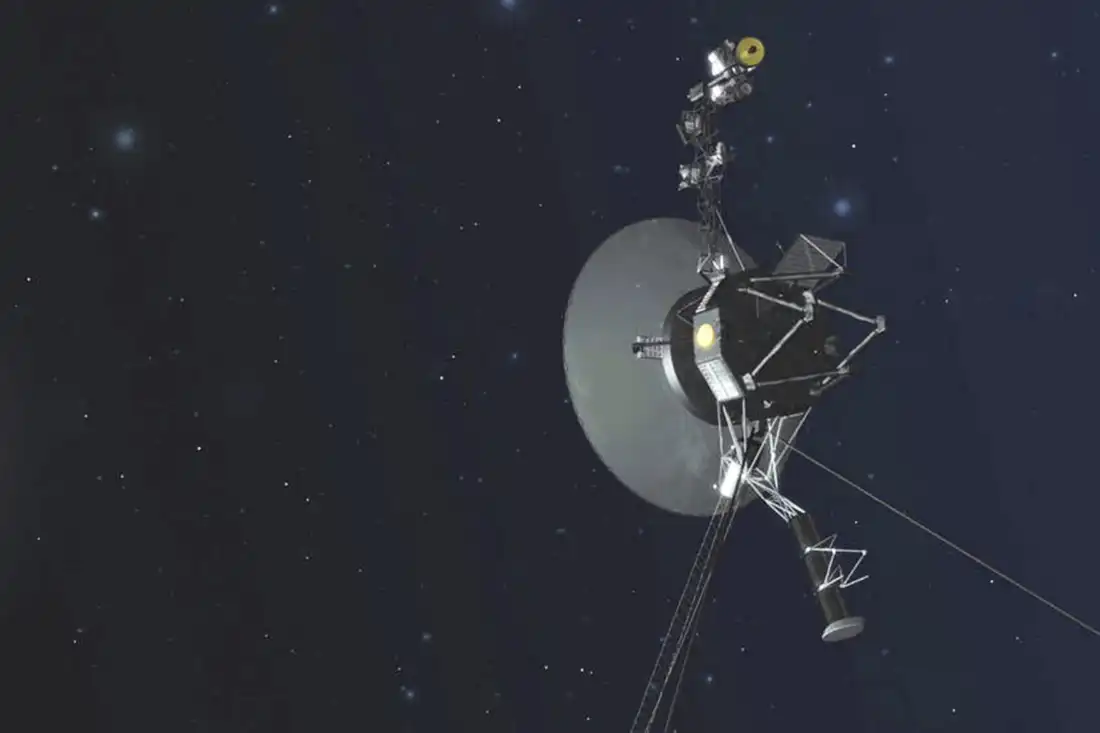
NASA’s Voyager 1 has ventured farther than any other human-made object launched into space. On Wednesday, it celebrates a new achievement: being one light-day away from Earth.
NASA plans a symbolic celebration called “Shine Bright for Voyager’s Light-Day.” On Tuesday night, the public is invited to send Voyager’s call sign V-G-R into the sky using Morse code with a flashlight, phone light, or anything that can blink in sequence:
- V – Three quick flashes, one long flash
- G – Two long flashes, one quick flash
- R – One quick flash, one long flash, one quick flash
A light-day measures the distance that light travels in 24 hours, which is over 16 billion miles. Voyager 1 has been journeying for nearly 50 years since its launch on September 5, 1977. It has conducted significant flybys of Jupiter and Saturn, discovering a faint ring system on Jupiter in 1979, and capturing detailed images of Saturn’s rings and moons in 1980.
On February 17, 1998, Voyager 1 surpassed the U.S. space probe Pioneer 10 to become the farthest human-made object. Alongside Voyager 2, it is one of the only spacecraft to have traveled outside the heliosphere, the sun’s protective boundary.
In 2012, Voyager 1 reached the interstellar boundary. During this mission, it continues to study magnetic fields, particles, and plasma waves beyond the sun’s heliosphere and the atmospheres of other stars. Recently, NASA turned off Voyager 1’s Low-energy Charged Particles experiment (LECP) to conserve power, which may extend the probe’s lifespan. Two scientific instruments remain active, measuring magnetic fields and capturing plasma wave data.
The spacecraft also carries the Golden Record, a gold-plated “time capsule” intended to communicate Earth’s story to any extraterrestrial life. This record includes 115 images, natural sounds like surf and wind, and greetings in 35 languages. Instructions in symbols provide details on playing the record and the probe’s origin.
Voyager 1 is projected to reach “light-day status” at 5:16 a.m. ET on Wednesday, after 49 years, two months, and 11 days of travel.